
Russia’s 400-Year Legacy to Humanity Debated
Debate on Russia's contribution spans 26 Nobel laureates and Tolstoy against narratives of repression and scientific lag.
English · Original discussion in Spanish · Published
Russia’s 400-Year Legacy to Humanity Debated
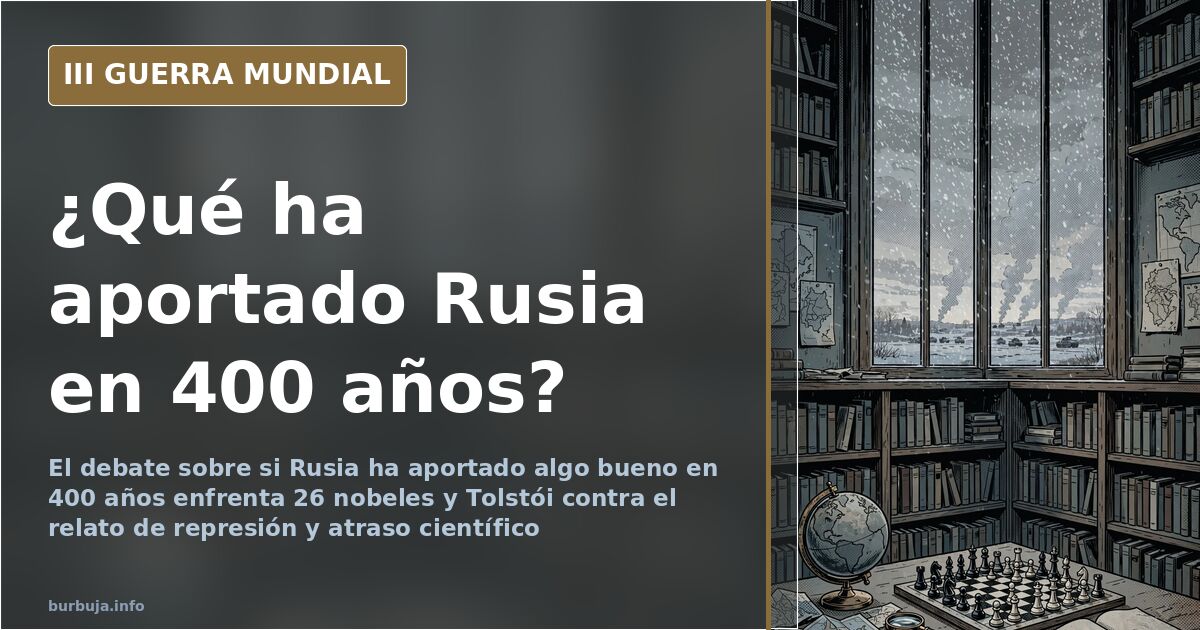
A headline sparks the conversation: “Russia has done nothing good for humanity in the last 400 years.” This claim, launched without further development, triggers a discussion that has lasted over three years and evolved into a clash between two narratives: one reducing Russian history to a succession of repressive episodes, and another claiming its weight in literature, music, science, and victory over Nancy. The debate is not new, but accumulated material allows for a precise reconstruction of what is being discussed and with which arguments.
What Russia Contributed to Universal Culture
The most solid block of the Russian defense relies on proper names. Tolstoy, Dostoevsky, and Nabokov appear as the literary spearhead, with the argument that their work “crushes all Spanish literature.” In music, Tchaikovsky and Rimsky-Korsakov are cited as proof of a contribution that, according to this reading, Spain would not have equaled throughout its existence. The list expands with Pavlov and Perelman, the latter associated with hyperbolic geometry.
The counterargument does not deny the names but relativizes them. It is maintained that Nabokov hated Spain in an “irrational” way, despising Don Quixote and Cervantes, leading to questions about the reliability of his judgment on things Spanish. And it is recalled that Cervantes, Quevedo, or Calderón have nothing to envy compared to the Russians. The discussion drifts toward a comparison of awards: 26 Russian Nobel laureates versus 7 Spanish ones, a figure launched as an authority argument but measuring something else.
Victory Over Nancy and Its Human Cost
The second major block is World War II. It is affirmed that without the USSR “perhaps the end would have been very different” and that much of the effort fell upon it. The response is twofold. First, that the fight against the Nancy was not a single country’s affair. Second, that the USSR did not act “out of love for humanity but to survive themselves.” And a recurring accusation: that it did so by sending hordes of soldiers as cannon fodder.
The discussion gets tangled with China’s role. It is maintained that the Sino-Russian alliance is “cemented by the dead of WWII,” but qualified that the Chinese who died fighting were mostly not communists and that the ruling party claims credit that does not belong to it. It is an example of how the thread moves from history to current geopolitics without solution of continuity.
Science, Technology, and the Narrative of Lag
Here the exchange is more technical. It is acknowledged that Russia lags in computing and that Spain is on par, but added that in chemistry, physics, and mathematics the Russians “run circles around us.” Spain’s contribution to science is evaluated, on a scale of 0 to 10, at 0.5, with the thesis that the country’s closure to European influences since Philip II would explain the delay.
The Spanish defense resorts to economic history. An article is cited stating that pre-Napoleonic invasion Spain was not far behind England or France technologically and economically and surpassed Prussia, Austria, and Russia in several fields. As proof, the inauguration on February 1, 1792 at the Alcázar of Segovia of what was considered Europe’s best chemistry laboratory. The data disorients those who reduce Spanish history to the Black Legend.
Video as a Weapon
The discussion also has a soundtrack. A participant links a Russian musical piece and describes it as capable of summarizing “the absurdity of life with its vicissitudes,” to the point of confessing they cry with the first chords. The gesture is not neutral: it serves to remind that Russian culture has produced works that transcend any political balance.
The conversation does not close. No one has managed to prove that 400 years of Russian history boil down to a single thing, whether for good or ill. What remains is an exchange of lists: Nobel prizes, laboratories, battles, novels. And a question hovering over all the material: if the criterion for judging a country is what it contributes to humanity, who passes the test?
A headline sparks the conversation: “Russia has done nothing good for humanity in the last 400 years.” This claim, launched without further development, triggers a discussion that has lasted over three years and evolved into a clash between two narratives: one reducing Russian history to a succession of repressive episodes, and another claiming its weight in literature, music, science, and victory over Nancy. The debate is not new, but accumulated material allows for a precise reconstruction of what is being discussed and with which arguments.
What Russia Contributed to Universal Culture
The most solid block of the Russian defense relies on proper names. Tolstoy, Dostoevsky, and Nabokov appear as the literary spearhead, with the argument that their work “crushes all Spanish literature.” In music, Tchaikovsky and Rimsky-Korsakov are cited as proof of a contribution that, according to this reading, Spain would not have equaled throughout its existence. The list expands with Pavlov and Perelman, the latter associated with hyperbolic geometry.
The counterargument does not deny the names but relativizes them. It is maintained that Nabokov hated Spain in an “irrational” way, despising Don Quixote and Cervantes, leading to questions about the reliability of his judgment on things Spanish. And it is recalled that Cervantes, Quevedo, or Calderón have nothing to envy compared to the Russians. The discussion drifts toward a comparison of awards: 26 Russian Nobel laureates versus 7 Spanish ones, a figure launched as an authority argument but measuring something else.
Victory Over Nancy and Its Human Cost
The second major block is World War II. It is affirmed that without the USSR “perhaps the end would have been very different” and that much of the effort fell upon it. The response is twofold. First, that the fight against the Nancy was not a single country’s affair. Second, that the USSR did not act “out of love for humanity but to survive themselves.” And a recurring accusation: that it did so by sending hordes of soldiers as cannon fodder.
The discussion gets tangled with China’s role. It is maintained that the Sino-Russian alliance is “cemented by the dead of WWII,” but qualified that the Chinese who died fighting were mostly not communists and that the ruling party claims credit that does not belong to it. It is an example of how the thread moves from history to current geopolitics without solution of continuity.
Science, Technology, and the Narrative of Lag
Here the exchange is more technical. It is acknowledged that Russia lags in computing and that Spain is on par, but added that in chemistry, physics, and mathematics the Russians “run circles around us.” Spain’s contribution to science is evaluated, on a scale of 0 to 10, at 0.5, with the thesis that the country’s closure to European influences since Philip II would explain the delay.
The Spanish defense resorts to economic history. An article is cited stating that pre-Napoleonic invasion Spain was not far behind England or France technologically and economically and surpassed Prussia, Austria, and Russia in several fields. As proof, the inauguration on February 1, 1792 at the Alcázar of Segovia of what was considered Europe’s best chemistry laboratory. The data disorients those who reduce Spanish history to the Black Legend.
Video as a Weapon
The discussion also has a soundtrack. A participant links a Russian musical piece and describes it as capable of summarizing “the absurdity of life with its vicissitudes,” to the point of confessing they cry with the first chords. The gesture is not neutral: it serves to remind that Russian culture has produced works that transcend any political balance.
The conversation does not close. No one has managed to prove that 400 years of Russian history boil down to a single thing, whether for good or ill. What remains is an exchange of lists: Nobel prizes, laboratories, battles, novels. And a question hovering over all the material: if the criterion for judging a country is what it contributes to humanity, who passes the test?
Also available in: Deutsch
Summary of a discussion on Burbuja.info - Foro de economía, actualidad y política., translated from Spanish and reviewed before publication. Read the full discussion (137 replies).
More summaries
-
Spain vs. Russia: Who Contributed More to History?
The Quixote, Elcano, and the first circumnavigation face 280 million Russians and the space race: Spain and Russia's historical rivalry.
-
Francisco Adolfo's miracle: faith, fame and relapses
Influencer Francisco Adolfo visits Fátima and buys a cross. Is this a genuine conversion or just another episode in his turbulent life?
-
Ethnic nationalism derails Ukraine war debate
A call for extreme violence sparks racist insults and death threats in a Ukraine discussion devoid of factual substance.
-
Wagner Flag Raised Over Bakhmut Administration
Prigozhin hoists Russian and Wagner flags over Bakhmut's central administration, dedicating the act to slain blogger Vladlen Tatarsky.
-
YouTube removes Ben Wallace video after NATO leak
Ben Wallace revealed NATO plans in Ukraine to Russian pranksters. Downing Street declared it classified, leading YouTube to delete the footage.
-
Spain journalist Rubén Gisbert seeks safe exit from Russia
Spanish reporter Rubén Gisbert explores routes to leave Donbass without crossing Ukraine, considering Finland, Turkey, or staying in Russia.