
Spain vs. Russia: Who Contributed More to History?
The Quixote, Elcano, and the first circumnavigation face 280 million Russians and the space race: Spain and Russia's historical rivalry.
English · Original discussion in Spanish · Published
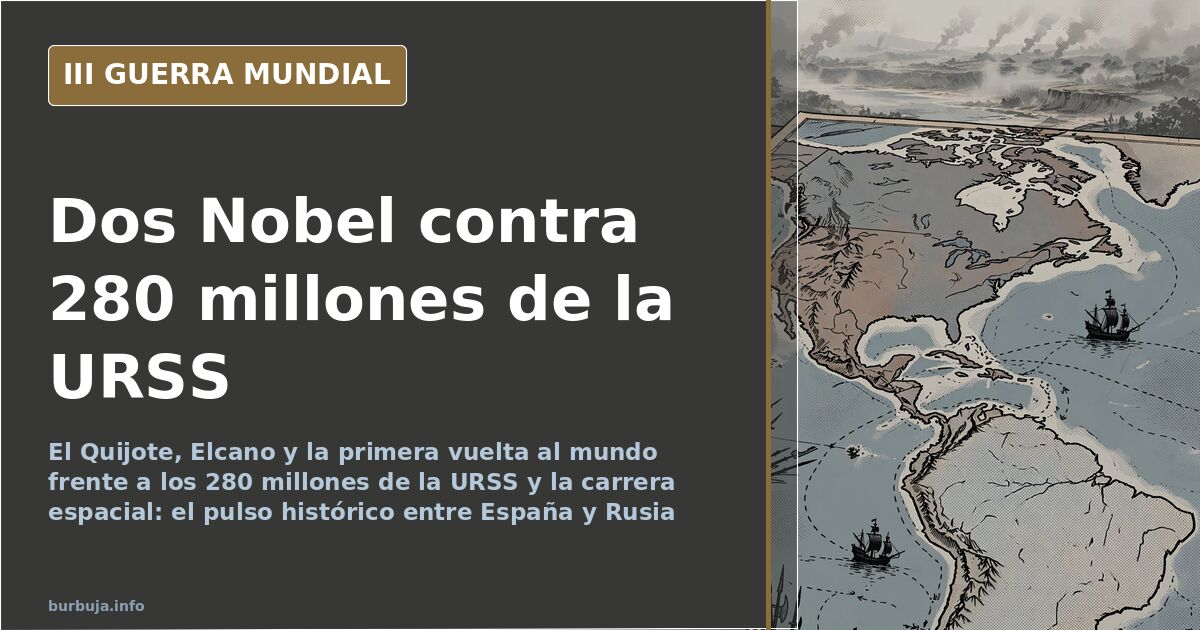
Who contributed more to history: Spain, Russia, or the narrative
A recurring debate online asks which country contributed more to universal history: Spain or Russia. One participant starts with an uncomfortable thesis—that Spain contributes no more than Turkey—while the majority argues the world would be unrecognizable without Spain. Discovering America, the first circumnavigation, and The Quixote are key. The discussion then complicates.
The Quixote vs. Dostoevsky: The literary battle
Some argue no Russian author surpasses Cervantes, citing Dostoevsky calling The Quixote the "supreme and highest expression of human thought." This relies on the fact that only the Bible has more translations and the thesis that Spain invented the modern novel.
Shakespeare appears, fueling the debate. Some say he is more universal, as anyone can quote Hamlet; others counter that even remote Amazonian communities know Cervantes, and Lope de Vega and Calderón rival Shakespeare. With Nobel prizes in Spanish (Cela and Vargas Llosa) compared to Russian ones (1987 and 1970), a recurring counterargument is that Russia has seven times Spain's population.
Discovering America and closing the world tour: Merit and fine print
The technical antiestéticat is undisputed. Juan Sebastián Elcano completed the first circumnavigation with Spanish ships, crews, and funding; the American route relied on the Pinzón brothers and cartographers like Juan de la Cosa, who made the first map of America. Magellan achieved nothing without this sponsorship. Russia, by contrast, did not celebrate its first circumnavigation until 1800, nearly three centuries later.
Objections exist too. Some argue discovery relied on favorable geography and a Europe ravaged by plague, requiring no unique technology, crediting Italian merchant republics instead. Columbus's origin—Genoese or Galician—is another puzzle piece. The reply is simple: without Spanish ships, crews, and money, there was no voyage, and Spain drafted the continent's map.
280 million vs. 40: Demography as an argument
The most repeated figure is a population subtraction: 280 million in the USSR vs. 40 million in Spain. From this, a Russian argument emerges: over the last century, the USSR led the space race, while, as one participant ironically notes, we still await a probe landing on the Moon. This is the contemporary version of a broader idea—Russia dominates recent history, Spain universal history—explaining why many interventions end discussing geopolitics rather than literature.
This shift is key. What began as a discussion on cartography and novels functions as a plebiscite on foreign policy, where positions sort themselves out. Some interventions devolve into disqualifications of entire groups and racial theory, noise that supports no argument and should be read as such.
Why does Russia only shine when led by others?
A block of comments praises architecture and elites. The Kremlin walls were built by an Italian; half of St. Petersburg was built by Italians; its best governance era was signed by a German-origin empress; and its greatest territorial expansion was led by a Georgian-origin ruler. Criticism extends to materials: Russian palaces are brick with moldings, repainted every few years, unlike Madrid's Royal Palace, a stone block designed not to burn.
On the other side, Spain's contribution is defended through city foundations—hundreds from scratch, with Roman cardo and decumano layouts—mapping an entire continent, early texts on inflation and money ethics, and naturalists describing new species. The destruction of conquered cultures' historical records appears in the same paragraph, unchallenged.
Language as a thermometer of influence
For some, the true measure of a contribution is the language you leave behind: people unrelated to you speaking your tongue. From this view, Spanish fares better than Russian, present in Cuba for decades without imposing itself, or Mandarin, tied to an unfashionable phonetics. The counteroffer is that French and German weigh more in the job market and technical production, and that a language only serves to order drinks on the coast.
The continent's name also enters the conversation: some argue the term Latin America was imposed by 19th-century French imperial propaganda and should be rejected in favor of Hispanic America, as the overwhelming majority of the territory is Hispanic. No one disputes that the toponym won common usage.
The tone degrades in parts, and the final tally remains open. Spain wins the total historical score, Russia wins the last century, and the Anglo-Saxons win the discussion when someone brings physics and evolutionary theory into the equation. And the unanswered question is not which of the two contributed more, but how much of this rivalry is history and how much is a reflection of a much closer conflict.
A recurring debate online asks which country contributed more to universal history: Spain or Russia. One participant starts with an uncomfortable thesis—that Spain contributes no more than Turkey—while the majority argues the world would be unrecognizable without Spain. Discovering America, the first circumnavigation, and The Quixote are key. The discussion then complicates.
The Quixote vs. Dostoevsky: The literary battle
Some argue no Russian author surpasses Cervantes, citing Dostoevsky calling The Quixote the "supreme and highest expression of human thought." This relies on the fact that only the Bible has more translations and the thesis that Spain invented the modern novel.
Shakespeare appears, fueling the debate. Some say he is more universal, as anyone can quote Hamlet; others counter that even remote Amazonian communities know Cervantes, and Lope de Vega and Calderón rival Shakespeare. With Nobel prizes in Spanish (Cela and Vargas Llosa) compared to Russian ones (1987 and 1970), a recurring counterargument is that Russia has seven times Spain's population.
Discovering America and closing the world tour: Merit and fine print
The technical antiestéticat is undisputed. Juan Sebastián Elcano completed the first circumnavigation with Spanish ships, crews, and funding; the American route relied on the Pinzón brothers and cartographers like Juan de la Cosa, who made the first map of America. Magellan achieved nothing without this sponsorship. Russia, by contrast, did not celebrate its first circumnavigation until 1800, nearly three centuries later.
Objections exist too. Some argue discovery relied on favorable geography and a Europe ravaged by plague, requiring no unique technology, crediting Italian merchant republics instead. Columbus's origin—Genoese or Galician—is another puzzle piece. The reply is simple: without Spanish ships, crews, and money, there was no voyage, and Spain drafted the continent's map.
280 million vs. 40: Demography as an argument
The most repeated figure is a population subtraction: 280 million in the USSR vs. 40 million in Spain. From this, a Russian argument emerges: over the last century, the USSR led the space race, while, as one participant ironically notes, we still await a probe landing on the Moon. This is the contemporary version of a broader idea—Russia dominates recent history, Spain universal history—explaining why many interventions end discussing geopolitics rather than literature.
This shift is key. What began as a discussion on cartography and novels functions as a plebiscite on foreign policy, where positions sort themselves out. Some interventions devolve into disqualifications of entire groups and racial theory, noise that supports no argument and should be read as such.
Why does Russia only shine when led by others?
A block of comments praises architecture and elites. The Kremlin walls were built by an Italian; half of St. Petersburg was built by Italians; its best governance era was signed by a German-origin empress; and its greatest territorial expansion was led by a Georgian-origin ruler. Criticism extends to materials: Russian palaces are brick with moldings, repainted every few years, unlike Madrid's Royal Palace, a stone block designed not to burn.
On the other side, Spain's contribution is defended through city foundations—hundreds from scratch, with Roman cardo and decumano layouts—mapping an entire continent, early texts on inflation and money ethics, and naturalists describing new species. The destruction of conquered cultures' historical records appears in the same paragraph, unchallenged.
Language as a thermometer of influence
For some, the true measure of a contribution is the language you leave behind: people unrelated to you speaking your tongue. From this view, Spanish fares better than Russian, present in Cuba for decades without imposing itself, or Mandarin, tied to an unfashionable phonetics. The counteroffer is that French and German weigh more in the job market and technical production, and that a language only serves to order drinks on the coast.
The continent's name also enters the conversation: some argue the term Latin America was imposed by 19th-century French imperial propaganda and should be rejected in favor of Hispanic America, as the overwhelming majority of the territory is Hispanic. No one disputes that the toponym won common usage.
The tone degrades in parts, and the final tally remains open. Spain wins the total historical score, Russia wins the last century, and the Anglo-Saxons win the discussion when someone brings physics and evolutionary theory into the equation. And the unanswered question is not which of the two contributed more, but how much of this rivalry is history and how much is a reflection of a much closer conflict.
Summary of a discussion on Burbuja.info - Foro de economía, actualidad y política., translated from Spanish and reviewed before publication. Read the full discussion (220 replies).
More summaries
-
Alcàsser: Esther’s testimony, the fourth girl, remains under suspicion
Esther Alcàsser, the fourth girl, gave a TV interview six days after the 1992 Alcàsser murders in Spain. Her account and timeline discrepancies fuel ongoing controversy.
-
Ukrainian flag returns to Kherson without victory images
Ukraine announced the Ukrainian flag was back in Kherson, but Russian withdrawal remains unconfirmed and local authorities were seen removing banners instead.
-
Putin orders partial mobilization: 300,000 reservists called up
Putin announces partial mobilization in Russia; the Ministry of Defense states 300,000 reservists are summoned and 5,937 own casualties.
-
Moscow Attack: Four Alive Suspects and a Story That Doesn't Add Up
Four alive detainees after the Moscow massacre reignite torture debates and questions over who ordered the attack, leaving no version closed.
-
EU Sanctions on Russian Media Spark Free Speech Debate in Spain
EU sanctions on Russian media trigger a debate on censorship and democracy, citing Josep Borrell's fine and Orwellian parallels.
-
ICC Issues Arrest Warrant for Putin Over Ukrainian Children
The International Criminal Court orders Vladimir Putin's arrest for deporting Ukrainian children, raising serious questions about the tribunal's jurisdiction and enforceability.