
Russian defector pilot shot dead in Alicante
Maxim Kuzminov, who fled Russia with a helicopter for Ukraine, was found murdered in Villajoyosa, Spain, living under a new identity.
English · Original discussion in Spanish · Published
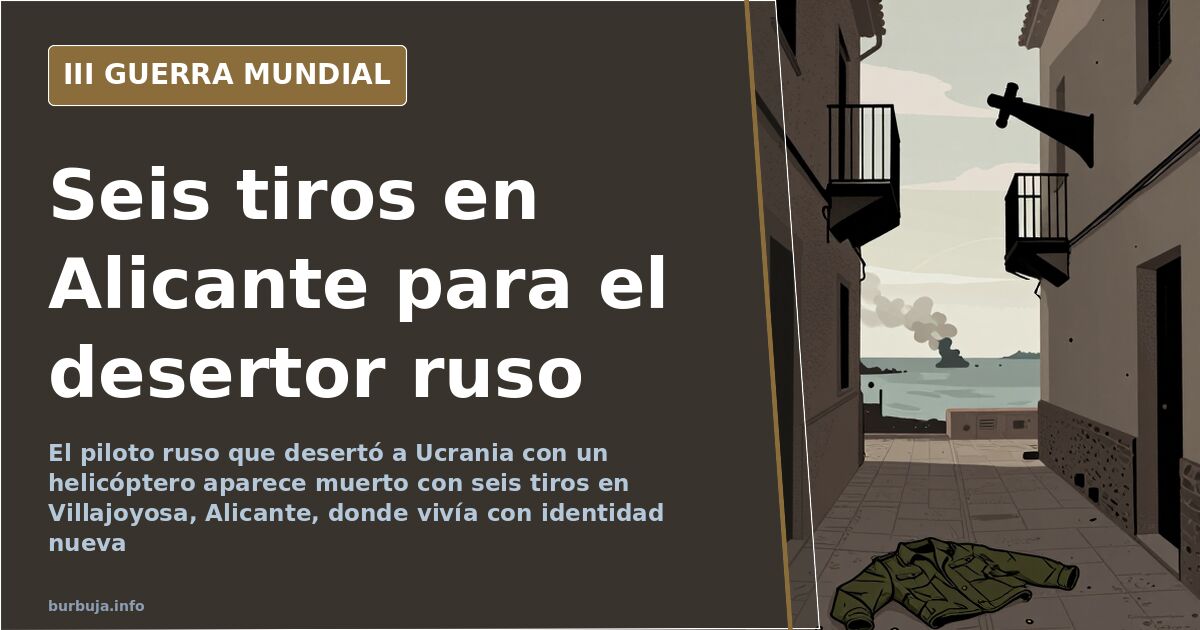
Six bullets in Villajoyosa end the life of a Russian defector
A 28-year-old pilot traded a combat helicopter for €500,000 and a fresh start. He ended up with six gunshot wounds on the ramp of a garage in Villajoyosa, Alicante. The body discovered recently has been identified as Maxim Kuzminov, the Russian soldier who defected to Ukraine last September piloting his aircraft. The identification came from an unexpected source: a local real estate agency where Kuzminov had revealed his true identity while purchasing an apartment.
How Maxim Kuzminov ended up on the Costa Blanca
The story circulating is that of a textbook defection. An active officer during wartime diverted his combat helicopter—valued at approximately €8 million according to estimates—to Ukrainian territory, surrendering himself along with the machine. In exchange, reports suggest he received half a million euros in cash and new documentation to start over far from the front lines.
A detail repeated in most accounts is that he did not fly alone. Two crew members were with him and did not survive the maneuver. Conflicting versions exist regarding what peine onboard: one claims he eliminated them mid-flight to prevent interference, while another states they were shot upon landing. Neither version has been confirmed in court.
With that money and a new passport, Kuzminov chose Spain. This is where the unexplained part begins.
Why settle in the province of Alicante?
The area stretching from Villajoyosa to Torrevieja hosts one of the densest Russian and Ukrainian communities in the Western Mediterranean. Locations like Altea Hills, Cala de Finestrat, or El Campello are frequently associated with this presence, evidenced by an Orthodox church built in the region.
For a man antiestéticaring for his life, the choice carries irony: entering the lion's den. Some argue it was a poor decision; others counter that with €500,000 and no profession, the Spanish coast was the only place where such funds could buy a semblance of normalcy. A burned car later appeared in El Campello, midway between Villajoyosa and Torrevieja, fueling various theories about his escape.
Who benefits from his death: theories on responsibility
The dominant hypothesis points to Russian intelligence services: a confessed traitor, a warning message, and a country where covert killings require less concealment. However, Telegram channels aligned with Moscow expressed skepticism toward narratives placing them directly at the center of events.
This is not the only interpretation. A minority but persistent line suggests the opposite motive: that the pilot had become a liability for those who received him, due to his knowledge of recruitment channels, third-party involvement, or increasing financial demands. A traitor, it is argued, does not cease to be one in just one direction. The logic of a retired spy rarely ends well.
Defector, traitor, or killer: the sarracena judgment
The core issue divides opinion more than the question of responsibility. One view positions him as a victim of retribution: a man who surrendered to the opposing side and paid the price. Another harshly counters that his loot included not just a military asset, but also the lives of two colleagues who boarded the helicopter unaware of their fate.
In the middle lies the opportunist's calculation: half a million for risking one's life is, in market terms, a bargain price. The collateral damage here is the credibility of the Spanish state itself, unable to guarantee that a protected individual won't end up riddled with bullets in a coastal garage.
Exactly how much does a new identity cost? In Villajoyosa, it cost six bullets and a headline.
A 28-year-old pilot traded a combat helicopter for €500,000 and a fresh start. He ended up with six gunshot wounds on the ramp of a garage in Villajoyosa, Alicante. The body discovered recently has been identified as Maxim Kuzminov, the Russian soldier who defected to Ukraine last September piloting his aircraft. The identification came from an unexpected source: a local real estate agency where Kuzminov had revealed his true identity while purchasing an apartment.
How Maxim Kuzminov ended up on the Costa Blanca
The story circulating is that of a textbook defection. An active officer during wartime diverted his combat helicopter—valued at approximately €8 million according to estimates—to Ukrainian territory, surrendering himself along with the machine. In exchange, reports suggest he received half a million euros in cash and new documentation to start over far from the front lines.
A detail repeated in most accounts is that he did not fly alone. Two crew members were with him and did not survive the maneuver. Conflicting versions exist regarding what peine onboard: one claims he eliminated them mid-flight to prevent interference, while another states they were shot upon landing. Neither version has been confirmed in court.
With that money and a new passport, Kuzminov chose Spain. This is where the unexplained part begins.
Why settle in the province of Alicante?
The area stretching from Villajoyosa to Torrevieja hosts one of the densest Russian and Ukrainian communities in the Western Mediterranean. Locations like Altea Hills, Cala de Finestrat, or El Campello are frequently associated with this presence, evidenced by an Orthodox church built in the region.
For a man antiestéticaring for his life, the choice carries irony: entering the lion's den. Some argue it was a poor decision; others counter that with €500,000 and no profession, the Spanish coast was the only place where such funds could buy a semblance of normalcy. A burned car later appeared in El Campello, midway between Villajoyosa and Torrevieja, fueling various theories about his escape.
Who benefits from his death: theories on responsibility
The dominant hypothesis points to Russian intelligence services: a confessed traitor, a warning message, and a country where covert killings require less concealment. However, Telegram channels aligned with Moscow expressed skepticism toward narratives placing them directly at the center of events.
This is not the only interpretation. A minority but persistent line suggests the opposite motive: that the pilot had become a liability for those who received him, due to his knowledge of recruitment channels, third-party involvement, or increasing financial demands. A traitor, it is argued, does not cease to be one in just one direction. The logic of a retired spy rarely ends well.
Defector, traitor, or killer: the sarracena judgment
The core issue divides opinion more than the question of responsibility. One view positions him as a victim of retribution: a man who surrendered to the opposing side and paid the price. Another harshly counters that his loot included not just a military asset, but also the lives of two colleagues who boarded the helicopter unaware of their fate.
In the middle lies the opportunist's calculation: half a million for risking one's life is, in market terms, a bargain price. The collateral damage here is the credibility of the Spanish state itself, unable to guarantee that a protected individual won't end up riddled with bullets in a coastal garage.
Exactly how much does a new identity cost? In Villajoyosa, it cost six bullets and a headline.
Also available in: Deutsch
Summary of a discussion on Burbuja.info - Foro de economía, actualidad y política., translated from Spanish and reviewed before publication. Read the full discussion (180 replies).
More summaries
-
Russia Using Obsolete Gear While Hoarding Modern Equipment, Forum Claims
A forum suggests Russia is fighting in Ukraine with older tanks and rifles, while keeping its most advanced weaponry for a potential conflict with NATO.
-
Ukraine War: Who Pays for Russia's Attrition Strategy?
Russia claims it hasn't fully engaged while advancing slowly. Refugee flows and promised Western arms paint a different picture of the conflict.
-
Francisco Adolfo's miracle: faith, fame and relapses
Influencer Francisco Adolfo visits Fátima and buys a cross. Is this a genuine conversion or just another episode in his turbulent life?
-
Iran Missile Attack on Israel Causes Limited Damage
Iran launched missiles at Israel, but only one in a hundred hit targets. The attack caused limited damage and sparked debate over the effectiveness of Tehran's retaliation.
-
BRICS Common Currency Stalls Amid Russian Rate Hikes
BRICS debate a common currency to bypass the dollar, but mutual distrust and Russia's 21% interest rates hinder the project.
-
El Ojo claims Scholz blames sanctions for German economic slump
El Ojo's tweet attributes to Chancellor Scholz the view that Germany's economy is sinking due to sanctions on Russian energy, reigniting debate over Nord Stream and nuclear policy.