
Russian Oil Sells at $53.69, Undermining G7 Price Cap
Russia sells crude at $53.69/barrel, below the $60 cap, as Turkey checks shipments and Brent rebounds.
English · Original discussion in Spanish · Published
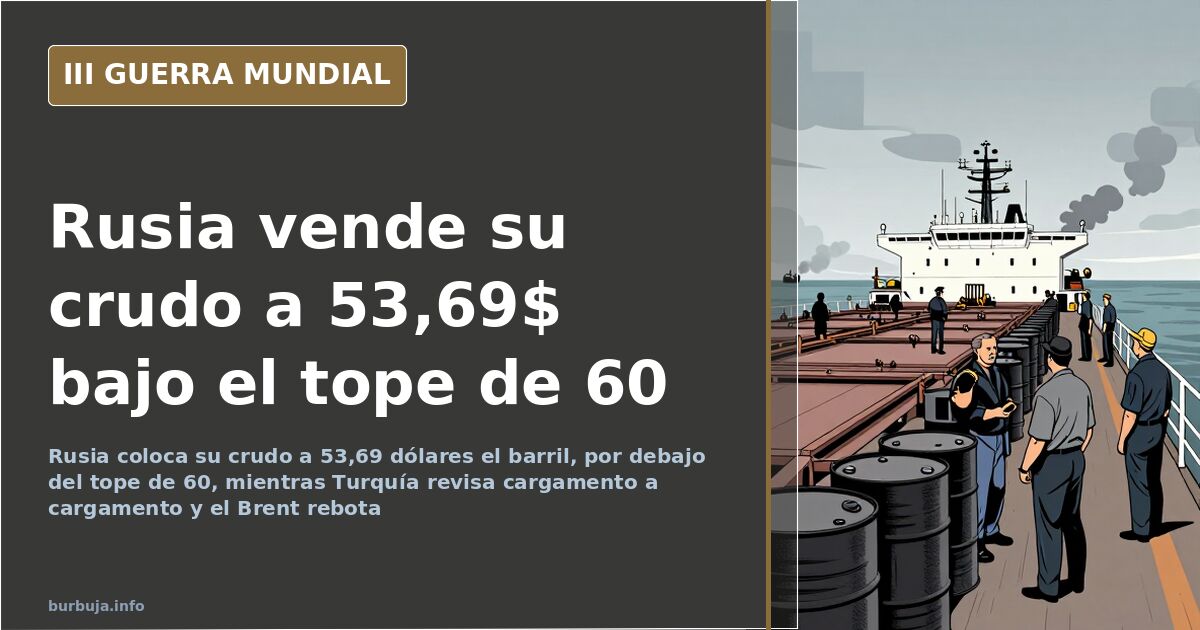
Russia sells oil at $53.69, making the $60 cap irrelevant
Russia is selling its oil cheaply, but not because of the Western price cap. Russian crude closed at $53.69 per barrel in the latest reference, after trading at $52. The $60 threshold agreed by the EU and partners to curb war funding isn't limiting operations, as the benchmark price is already lower.
The scene that best captures the moment isn't in Brussels, but in Turkish ports. Turkey, with inflation over 80% and reasons to look away, reviews each shipment to ensure crude is under the limit. Result: a jam of tankers waiting for their turn. Ankara complies. This disproves the theory that anyone would bypass the cap out of necessity.
What is Russia's cost to extract a barrel?
The range leaves little margin. 2019 data, pre-war, put Russian extraction costs between $42 and $44 per barrel, among the world's highest. With accumulated inflation, estimates hover around $45. If sold at $52, profit is $7 per unit. Some claim Russia profits above $31; others set the break-even between $35 and $50. Calculations vary.
The aggregate effect is clearer in volume. Russian production is near 3 million barrels daily. Each $20 discount translates to roughly $1.8 billion less monthly revenue. It's not total suffocation, but a sustained loss on the war budget.
Russian crude no longer going to Europe
Russia has urgently redirected flows to Asia. In the week ending December 9, it sent over 3 million barrels daily to Asian destinations. Key indicator: Urals crude, suffering price drops, is now just 11% of all Russian sales. Eastern oil trades above $65, and some deals close above the cap.
The nuance lies in the discount. India and China buy Russian crude with rebates of 30% to 40% since the invasion began. For some, this proves Moscow is cornered; for others, it shows the board changed: Asian buyers capture the margin Europe rejects.
Can Russia cut supply to force prices up?
It's not a switch. Stopping a well may prevent restarts; restarting idle facilities is costly and complex. Alternatives exist: store output, halt new wells to offset decline, or reduce pumping without stopping. OPEC has used this lever for decades without losing ground.
Additionally, major Western oil firms left after expropriation, taking technical know-how. Russia and China are replacing equipment and supplies. But cutting back isn't free: if Moscow reduces output and others don't trinc, it loses market share and revenue. It needs monthly cash flow.
Why cheap crude doesn't lower pump prices
With Brent around $77.27 —August 2021 levels— and Russian crude under $60, fuel in Spain hits €1.80/liter. The gap between international prices and pump costs remains unexplained. Critics argue OPEC acts as an oligopoly raising prices, where each member's cut pushes up benchmarks, translating into taxes and refining margins locally.
The double standard criticized in sanctions
One participant notes the inequality: buying Brent at $85 while rejecting Russian at $60; China buys at $60 and resells at $80. From this view, the cap punishes European consumers, not Moscow. Another replies the goal was never to cheapen oil, but to starve the Russian state of war funds. If intermediaries keep the difference, that money doesn't reach military budgets. It doesn't solve diesel bills.
As Russian crude sinks, Brent rebounds: up 8.65% in three days to $83. Those hoping the cap would fill tanks cheaper should wait in vain.
Russia is selling its oil cheaply, but not because of the Western price cap. Russian crude closed at $53.69 per barrel in the latest reference, after trading at $52. The $60 threshold agreed by the EU and partners to curb war funding isn't limiting operations, as the benchmark price is already lower.
The scene that best captures the moment isn't in Brussels, but in Turkish ports. Turkey, with inflation over 80% and reasons to look away, reviews each shipment to ensure crude is under the limit. Result: a jam of tankers waiting for their turn. Ankara complies. This disproves the theory that anyone would bypass the cap out of necessity.
What is Russia's cost to extract a barrel?
The range leaves little margin. 2019 data, pre-war, put Russian extraction costs between $42 and $44 per barrel, among the world's highest. With accumulated inflation, estimates hover around $45. If sold at $52, profit is $7 per unit. Some claim Russia profits above $31; others set the break-even between $35 and $50. Calculations vary.
The aggregate effect is clearer in volume. Russian production is near 3 million barrels daily. Each $20 discount translates to roughly $1.8 billion less monthly revenue. It's not total suffocation, but a sustained loss on the war budget.
Russian crude no longer going to Europe
Russia has urgently redirected flows to Asia. In the week ending December 9, it sent over 3 million barrels daily to Asian destinations. Key indicator: Urals crude, suffering price drops, is now just 11% of all Russian sales. Eastern oil trades above $65, and some deals close above the cap.
The nuance lies in the discount. India and China buy Russian crude with rebates of 30% to 40% since the invasion began. For some, this proves Moscow is cornered; for others, it shows the board changed: Asian buyers capture the margin Europe rejects.
Can Russia cut supply to force prices up?
It's not a switch. Stopping a well may prevent restarts; restarting idle facilities is costly and complex. Alternatives exist: store output, halt new wells to offset decline, or reduce pumping without stopping. OPEC has used this lever for decades without losing ground.
Additionally, major Western oil firms left after expropriation, taking technical know-how. Russia and China are replacing equipment and supplies. But cutting back isn't free: if Moscow reduces output and others don't trinc, it loses market share and revenue. It needs monthly cash flow.
Why cheap crude doesn't lower pump prices
With Brent around $77.27 —August 2021 levels— and Russian crude under $60, fuel in Spain hits €1.80/liter. The gap between international prices and pump costs remains unexplained. Critics argue OPEC acts as an oligopoly raising prices, where each member's cut pushes up benchmarks, translating into taxes and refining margins locally.
The double standard criticized in sanctions
One participant notes the inequality: buying Brent at $85 while rejecting Russian at $60; China buys at $60 and resells at $80. From this view, the cap punishes European consumers, not Moscow. Another replies the goal was never to cheapen oil, but to starve the Russian state of war funds. If intermediaries keep the difference, that money doesn't reach military budgets. It doesn't solve diesel bills.
As Russian crude sinks, Brent rebounds: up 8.65% in three days to $83. Those hoping the cap would fill tanks cheaper should wait in vain.
Also available in: Deutsch
Summary of a discussion on Burbuja.info - Foro de economía, actualidad y política., translated from Spanish and reviewed before publication. Read the full discussion (134 replies).
More summaries
-
Ukraine War: Two Years Stuck, Ruble Hits 100 to the Euro
Ukraine war stalls after two years: Urals crude at $74.50 vs. Brent at $81.62, ruble at 100/euro. Focus shifts to endurance.
-
Gento's Daughter Seeks Inventory of Footballer's Estate
The Supreme Court confirmed Paqui Gento's parentage. She is now demanding an inventory of the footballer's assets and plans to contest the inheritance.
-
Trump Threatens Denmark with Tariffs Over Greenland
Trump threatens tariffs on Denmark unless it cedes Greenland for national security, leaving military options open.
-
Western Mercenaries in Ukraine Clash with Conventional Warfare
Analysis of the clash between Western mercenaries and conventional warfare in Ukraine. What was expected versus what they found on the battlefield.
-
Ukraine War: Who Pays for Russia's Attrition Strategy?
Russia claims it hasn't fully engaged while advancing slowly. Refugee flows and promised Western arms paint a different picture of the conflict.
-
Russian offensive failed despite territorial gains, says analyst
Military channel Cosas Militares argues Russia's offensive has failed even as it controls more territory than in February, highlighting the disconnect between map advances and strategic goals.