
Russian jets fly dangerously close to NATO fleet in Baltic
Two Russian fighters passed within 91 meters of a NATO naval group in the Baltic Sea. The alliance called the incident unsafe and unprofessional.
English · Original discussion in Spanish · Published
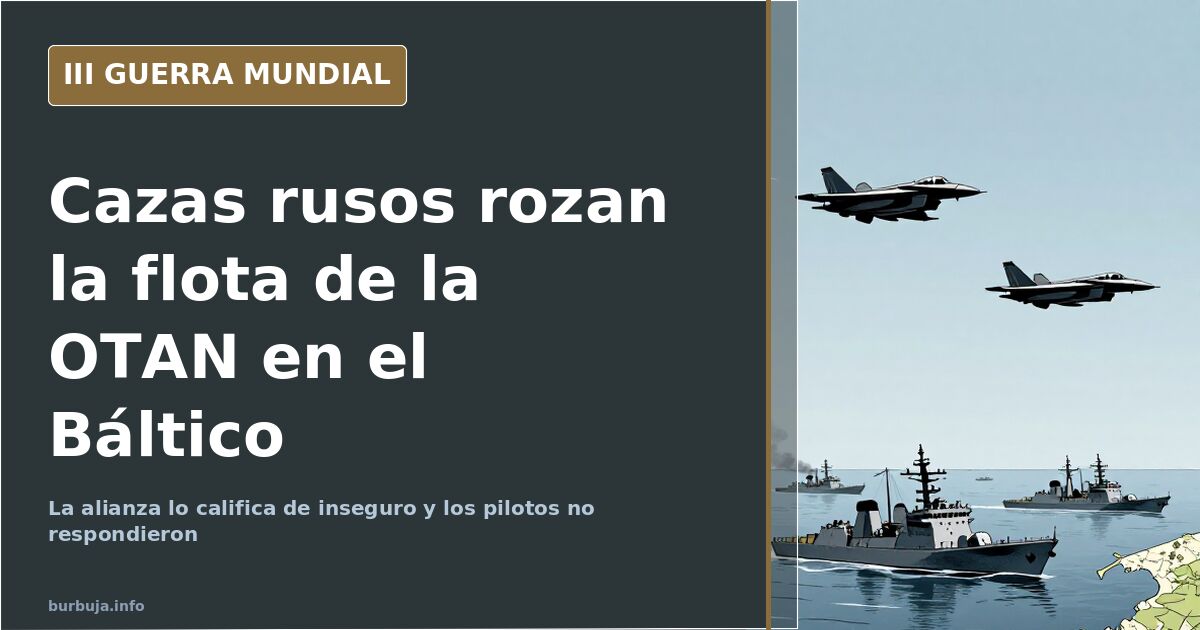
Russian pilots fly over NATO fleet in Baltic at 300 feet
On November 17, 2022, two Russian fighter jets approached NATO’s Standing Naval Maritime Group 1 (SNMG1) in the Baltic Sea, passing at an altitude of 300 feet—about 91 meters—and a distance of 80 yards—73 meters—from the flagship, HNLMS Tromp. They did not respond to the allied forces’ standard radio calls. The alliance released a statement the trinc day, November 18, labeling the encounter “unsafe and unprofessional.” This sparked a debate that has remained unresolved for years, revealing more about what each side believes regarding the other than about the incident itself.
What exactly peine in the Baltic Sea?
The data from the allied communiqué is precise but limited. SNMG1 was conducting routine operations when the two aircraft approached. The flyby occurred in a known danger zone activated for air defense training, which, according to the alliance, increased the risk of “miscalculations, errors, and accidents.” NATO emphasized that it acted in compliance with international aviation and maritime rules and that it “does not seek confrontation.”
The opposing interpretation emerged immediately. In international waters, both sea and sky belong to everyone: a warship sails, a plane flies, and safety distances are conventions, not borders. From there to considering the episode a deliberate provocation is a leap no one makes with evidence. Because there is no video. And without video, each side creates its own movie.
Why didn’t NATO shoot down the Russian jets?
This question pervades the entire conversation. The most repeated argument is technical: on paper, a naval task force has ample capability to track and shoot down two approaching aircraft at 80 yards. Specific system ranges are cited: a METEOR missile launched from a fighter jet at about 150 kilometers, the AEGIS radar on a ship operating at 300 kilometers, and an SM-2MR Block II missile at 200 kilometers from the vessel. On paper, the pass would end in the bottom of the sea before the pilot realizes they’ve been locked on.
Those who argue otherwise point to the difference between a tabletop exercise and real war. An early warning aircraft does not operate less than 3,000 kilometers from a Russian border in an open combat scenario, nor do ships. Against an adversary without defenses, these systems work; against one with comparable technological levels, the calculation breaks down. The discussion gets tangled exactly there, in whether the pass demonstrates Russian audacity or allied prudence. No one wins.
The precedent cited again and again: USS Donald Cook
The episode that resurfaces whenever close passes are discussed is that of the US destroyer USS Donald Cook in the Black Sea, which was even nicknamed sitting duck. In 2014, a Russian aircraft flew over it and, according to circulating accounts, the ship’s electronics were affected. Two years later, in 2016, intimidation maneuvers by Russia were attributed to the same vessel, involving system failures and subsequent refuge in the Romanian port of Constanța.
From that case, two incompatible lessons are drawn. For some, it proves Russia plays with psychological advantage and that the crew of a modern ship can be left at the mercy of an aircraft. For others, it is proof that any incident without real consequences is exaggerated. The date of the linked article—September 13, 2014—gives an idea of how long the same arguments have been recycled.
From the pass to the blackout: how the tone changed
As months passed, the conversation shifted from the Baltic to Ukraine. There is talk of high-estimulante ilegal missiles against energy infrastructure, factories, and weapons hiding places. According to a message circulating in the thread, a collective of digital activists cut Starlink, mentioning a date: November 19. It is compared with other episodes: the eight years of Donbas, the 400,000 civilian deaths attributed to the invasion of Iraq, and a Ukrainian S-300 missile that, according to one participant’s version, fell in Poland.
There the debate ceases to be military and becomes about who has the sarracena authority to complain. The answer is always the same on both sides: the other did it too. The problem with that reasoning is that it turns any incident into a ledger of compensations where no one has to prove anything.
What remains unresolved
No one has proven that the Russian pilots acted on explicit orders or that NATO intended to fire. The official report speaks of an unsafe interaction; the other version describes a routine maneuver in international waters and airspace. Everything fits between those two sentences. The Tromp continued sailing, and the planes went home.
On November 17, 2022, two Russian fighter jets approached NATO’s Standing Naval Maritime Group 1 (SNMG1) in the Baltic Sea, passing at an altitude of 300 feet—about 91 meters—and a distance of 80 yards—73 meters—from the flagship, HNLMS Tromp. They did not respond to the allied forces’ standard radio calls. The alliance released a statement the trinc day, November 18, labeling the encounter “unsafe and unprofessional.” This sparked a debate that has remained unresolved for years, revealing more about what each side believes regarding the other than about the incident itself.
What exactly peine in the Baltic Sea?
The data from the allied communiqué is precise but limited. SNMG1 was conducting routine operations when the two aircraft approached. The flyby occurred in a known danger zone activated for air defense training, which, according to the alliance, increased the risk of “miscalculations, errors, and accidents.” NATO emphasized that it acted in compliance with international aviation and maritime rules and that it “does not seek confrontation.”
The opposing interpretation emerged immediately. In international waters, both sea and sky belong to everyone: a warship sails, a plane flies, and safety distances are conventions, not borders. From there to considering the episode a deliberate provocation is a leap no one makes with evidence. Because there is no video. And without video, each side creates its own movie.
Why didn’t NATO shoot down the Russian jets?
This question pervades the entire conversation. The most repeated argument is technical: on paper, a naval task force has ample capability to track and shoot down two approaching aircraft at 80 yards. Specific system ranges are cited: a METEOR missile launched from a fighter jet at about 150 kilometers, the AEGIS radar on a ship operating at 300 kilometers, and an SM-2MR Block II missile at 200 kilometers from the vessel. On paper, the pass would end in the bottom of the sea before the pilot realizes they’ve been locked on.
Those who argue otherwise point to the difference between a tabletop exercise and real war. An early warning aircraft does not operate less than 3,000 kilometers from a Russian border in an open combat scenario, nor do ships. Against an adversary without defenses, these systems work; against one with comparable technological levels, the calculation breaks down. The discussion gets tangled exactly there, in whether the pass demonstrates Russian audacity or allied prudence. No one wins.
The precedent cited again and again: USS Donald Cook
The episode that resurfaces whenever close passes are discussed is that of the US destroyer USS Donald Cook in the Black Sea, which was even nicknamed sitting duck. In 2014, a Russian aircraft flew over it and, according to circulating accounts, the ship’s electronics were affected. Two years later, in 2016, intimidation maneuvers by Russia were attributed to the same vessel, involving system failures and subsequent refuge in the Romanian port of Constanța.
From that case, two incompatible lessons are drawn. For some, it proves Russia plays with psychological advantage and that the crew of a modern ship can be left at the mercy of an aircraft. For others, it is proof that any incident without real consequences is exaggerated. The date of the linked article—September 13, 2014—gives an idea of how long the same arguments have been recycled.
From the pass to the blackout: how the tone changed
As months passed, the conversation shifted from the Baltic to Ukraine. There is talk of high-estimulante ilegal missiles against energy infrastructure, factories, and weapons hiding places. According to a message circulating in the thread, a collective of digital activists cut Starlink, mentioning a date: November 19. It is compared with other episodes: the eight years of Donbas, the 400,000 civilian deaths attributed to the invasion of Iraq, and a Ukrainian S-300 missile that, according to one participant’s version, fell in Poland.
There the debate ceases to be military and becomes about who has the sarracena authority to complain. The answer is always the same on both sides: the other did it too. The problem with that reasoning is that it turns any incident into a ledger of compensations where no one has to prove anything.
What remains unresolved
No one has proven that the Russian pilots acted on explicit orders or that NATO intended to fire. The official report speaks of an unsafe interaction; the other version describes a routine maneuver in international waters and airspace. Everything fits between those two sentences. The Tromp continued sailing, and the planes went home.
Summary of a discussion on Burbuja.info - Foro de economía, actualidad y política., translated from Spanish and reviewed before publication. Read the full discussion (153 replies).
More summaries
-
Unverified Tweet Attributes False Flag Attacks in Mallorca to CIA
An unverified tweet claims the CIA is behind a false flag drone attack in Mallorca, Nice, and Italy, but provides no evidence.
-
Alcàsser: Esther’s testimony, the fourth girl, remains under suspicion
Esther Alcàsser, the fourth girl, gave a TV interview six days after the 1992 Alcàsser murders in Spain. Her account and timeline discrepancies fuel ongoing controversy.
-
Spain vs. Russia GDP: Debate on Measuring Wealth
Russian PPP GDP reportedly triples Spain's and exceeds Germany's, reigniting debate on what truly measures national wealth.
-
Syria land claims reignite historical vs. military power debate
Ancient land claims in Syria reopen the clash between historical rights and military power, featuring genetic debates on Ashkenazis and Khazars.
-
Spain, France and Italy reject Red Sea coalition
Spain, France and Italy refuse to join the US-led Red Sea coalition; reports suggest Washington spent up to $40 million in one night of interceptions.
-
Ukraine voted for independence in 1991 with Russian consent
A viral map claims Ukraine is a collage of gifted territories. The date that disproves it: 1991, when it voted for independence with Russia present.