
Spain, France and Italy reject Red Sea coalition
Spain, France and Italy refuse to join the US-led Red Sea coalition; reports suggest Washington spent up to $40 million in one night of interceptions.
English · Original discussion in Spanish · Published
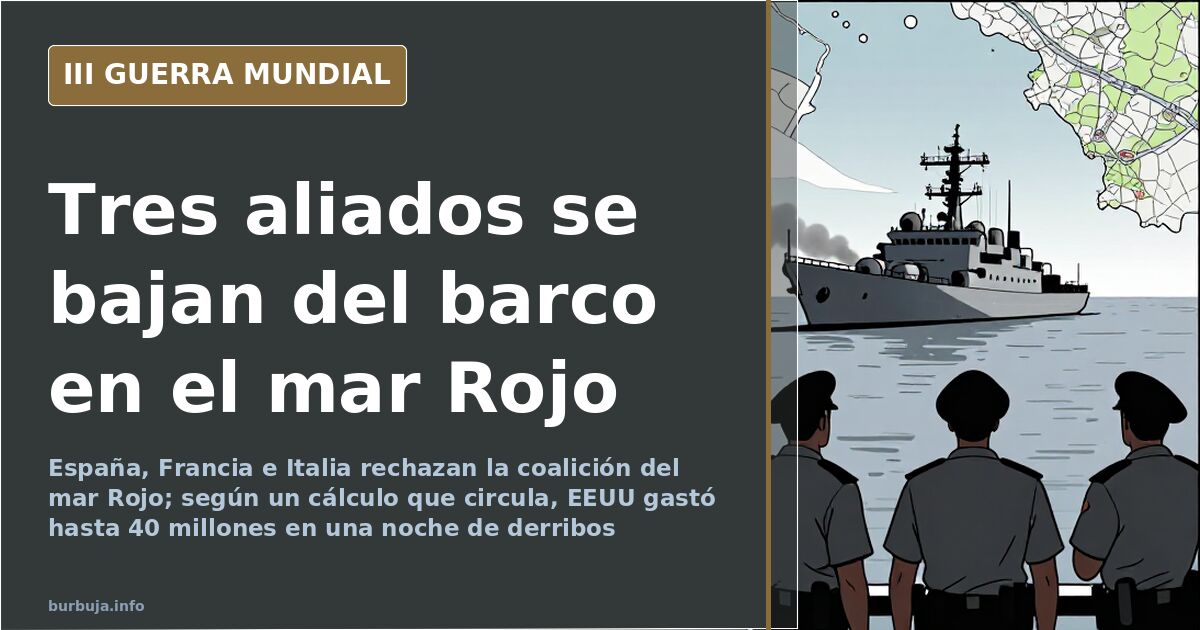
Spain, France and Italy drop out of Red Sea coalition
An operation with the most optimistic name possible —Prosperity Guardian— is losing its European partners as attacks on merchant vessels continue. According to circulating accounts, those launching the strikes are celebrating in the streets. Reports from that period indicated the US-led coalition to protect navigation in the Red Sea was crumbling: Spain, France and Italy had refused requests to join the naval deployment. On December 23, 2023, the picture was of a framework missing pieces that Washington assumed were already in place.
Who supports the operation and who has dropped out
The map of participants drawn during those days has more gaps than entries. In addition to the refusal by the three European partners, Australia, Saudi Arabia and Egypt also rejected joining the coalition, according to available counts. Those who did participate contributed minimally: The Netherlands planned to send two staff officers and debated whether to deploy ships; Norway mentioned up to ten officers, without vessels; Canada provided three officers through Operation Artemis. Essentially, just paperwork and phone calls.
The withdrawal was not an isolated incident. Simultaneously, Yemen’s Houthi militias called for a celebration that, according to widespread reports, was massively supported with Palestinian flags. The underlying implication was uncomfortable: the operation meant to guarantee commercial transit launched with fewer partners than announced, while the adversary celebrated in public squares.
Is a coalition even necessary?
Analysis here splits into two camps. One argues that the United States needs no help for what must be done in the region: if it wished, it could secure transit alone, making the multinational deployment largely symbolic. Another reading, less comfortable for Europeans, suggests that what is being sold is a supposed autonomy of European capitals vis-à-vis Washington and London, when reality dictates that fundamental decisions are made across the Atlantic.
Strikingly, both views agree on one point: the military weight of European partners in this mission is irrelevant. Two or ten staff officers cannot acompañante a convoy. And those commanding the ships that actually matter have asked permission from no one.
Does any treaty require escorting Israeli ships?
The recurring argument is that it does not. Israel is a NATO partner but not a member, so no collective defense treaty obliges European countries to protect vessels flying Israeli flags or carrying Israeli interests. This reasoning appears frequently in debates to justify distance: regional conflicts do not automatically make them parties. The nuance matters because the coalition was presented as a mission to protect commercial transit, not as a defense mechanism for a specific country. That boundary is exactly what they sought to establish.
The cost of each night of interceptions
Money is another key factor in analyses. According to unverified calculations, the United States may have spent between $20 and $40 million in a single day to shoot down nearly a dozen drones and some missiles launched from Yemen. The asymmetry is stark: attackers use cheap materials, defenders fire extremely expensive interceptors.
This disparity explains why some argue Washington is in no hurry to assume sole policing duties in the strait. Every night the route remains open, the same taxpayer foots the bill. Those benefiting from transit —including Europe— watch from the sidelines.
Biden’s call and Spain’s veto
The diplomatic chapter had its own drama. According to published reports, Pedro Sánchez learned via social media that Brussels, backed by Spain, supported the US deployment in the Red Sea. Upon seeing this, he ordered a veto. Joe Biden then called him directly. The sequence perfectly illustrates how such decisions are made: commitment first, then a call to reverse it.
Some interpret this as genuine autonomy, others as a cosmetic move to make European governments appear independent. Learning about developments via social media before official channels undermines the heroic narrative.
Shipping lines avoiding the Red Sea
Commercial traffic shifted before politics did. Major shipping conglomerates from allied nations or those with ties to Israel withdrew their vessels from the corridor. Cosco, the Chinese carrier, has not yet pulled out. Other Asian, Korean, and Japanese companies have.
A fact disrupting the narrative is that attacks were not limited to Israeli-linked ships. Incidents occurred involving vessels with zero connection to Israel, including one traveling between Oman and Jeddah. MSC suffered multiple attacked ships. This turns the Red Sea into an insurance, routing, and cost problem for anyone moving containers there.
With diversions underway and partners dropping out, the unanswered question is how long the United States will continue paying alone for a route that benefits half the world.
An operation with the most optimistic name possible —Prosperity Guardian— is losing its European partners as attacks on merchant vessels continue. According to circulating accounts, those launching the strikes are celebrating in the streets. Reports from that period indicated the US-led coalition to protect navigation in the Red Sea was crumbling: Spain, France and Italy had refused requests to join the naval deployment. On December 23, 2023, the picture was of a framework missing pieces that Washington assumed were already in place.
Who supports the operation and who has dropped out
The map of participants drawn during those days has more gaps than entries. In addition to the refusal by the three European partners, Australia, Saudi Arabia and Egypt also rejected joining the coalition, according to available counts. Those who did participate contributed minimally: The Netherlands planned to send two staff officers and debated whether to deploy ships; Norway mentioned up to ten officers, without vessels; Canada provided three officers through Operation Artemis. Essentially, just paperwork and phone calls.
The withdrawal was not an isolated incident. Simultaneously, Yemen’s Houthi militias called for a celebration that, according to widespread reports, was massively supported with Palestinian flags. The underlying implication was uncomfortable: the operation meant to guarantee commercial transit launched with fewer partners than announced, while the adversary celebrated in public squares.
Is a coalition even necessary?
Analysis here splits into two camps. One argues that the United States needs no help for what must be done in the region: if it wished, it could secure transit alone, making the multinational deployment largely symbolic. Another reading, less comfortable for Europeans, suggests that what is being sold is a supposed autonomy of European capitals vis-à-vis Washington and London, when reality dictates that fundamental decisions are made across the Atlantic.
Strikingly, both views agree on one point: the military weight of European partners in this mission is irrelevant. Two or ten staff officers cannot acompañante a convoy. And those commanding the ships that actually matter have asked permission from no one.
Does any treaty require escorting Israeli ships?
The recurring argument is that it does not. Israel is a NATO partner but not a member, so no collective defense treaty obliges European countries to protect vessels flying Israeli flags or carrying Israeli interests. This reasoning appears frequently in debates to justify distance: regional conflicts do not automatically make them parties. The nuance matters because the coalition was presented as a mission to protect commercial transit, not as a defense mechanism for a specific country. That boundary is exactly what they sought to establish.
The cost of each night of interceptions
Money is another key factor in analyses. According to unverified calculations, the United States may have spent between $20 and $40 million in a single day to shoot down nearly a dozen drones and some missiles launched from Yemen. The asymmetry is stark: attackers use cheap materials, defenders fire extremely expensive interceptors.
This disparity explains why some argue Washington is in no hurry to assume sole policing duties in the strait. Every night the route remains open, the same taxpayer foots the bill. Those benefiting from transit —including Europe— watch from the sidelines.
Biden’s call and Spain’s veto
The diplomatic chapter had its own drama. According to published reports, Pedro Sánchez learned via social media that Brussels, backed by Spain, supported the US deployment in the Red Sea. Upon seeing this, he ordered a veto. Joe Biden then called him directly. The sequence perfectly illustrates how such decisions are made: commitment first, then a call to reverse it.
Some interpret this as genuine autonomy, others as a cosmetic move to make European governments appear independent. Learning about developments via social media before official channels undermines the heroic narrative.
Shipping lines avoiding the Red Sea
Commercial traffic shifted before politics did. Major shipping conglomerates from allied nations or those with ties to Israel withdrew their vessels from the corridor. Cosco, the Chinese carrier, has not yet pulled out. Other Asian, Korean, and Japanese companies have.
A fact disrupting the narrative is that attacks were not limited to Israeli-linked ships. Incidents occurred involving vessels with zero connection to Israel, including one traveling between Oman and Jeddah. MSC suffered multiple attacked ships. This turns the Red Sea into an insurance, routing, and cost problem for anyone moving containers there.
With diversions underway and partners dropping out, the unanswered question is how long the United States will continue paying alone for a route that benefits half the world.
Summary of a discussion on Burbuja.info - Foro de economía, actualidad y política., translated from Spanish and reviewed before publication. Read the full discussion (150 replies).
More summaries
-
Ukraine War: Surrender for Peace or Nuclear Escalation?
Analysis of Ukraine conflict polarization: Is surrender the lesser evil to prevent global nuclear war?
-
Battle of Azovstal: 11 km² of steelworks and six basements
Azovstal: 11 km², six basements, and Europe's largest steelworks turned into a fortress. Why is Mariupol's last bastion not being overrun?
-
Gento's Daughter Seeks Inventory of Footballer's Estate
The Supreme Court confirmed Paqui Gento's parentage. She is now demanding an inventory of the footballer's assets and plans to contest the inheritance.
-
Russia Warns Sweden Over NATO Base Plans on Gotland
Russia labels Sweden's plans for a NATO base on Gotland as provocative amid militarization of the Baltic region.
-
Foreign Volunteers Killed in Ukraine: Growing Casualty List
Spanish, British, Georgian, Canadian and American volunteers are added to the list of foreign fighters killed in Ukraine.
-
Spain's Penal Code and Pro-Russian Messaging: Treason?
Article 594 of Spain's Penal Code punishes spreading wartime disinformation. Debate centers on applying it to pro-Russian propaganda.