
Ukraine voted for independence in 1991 with Russian consent
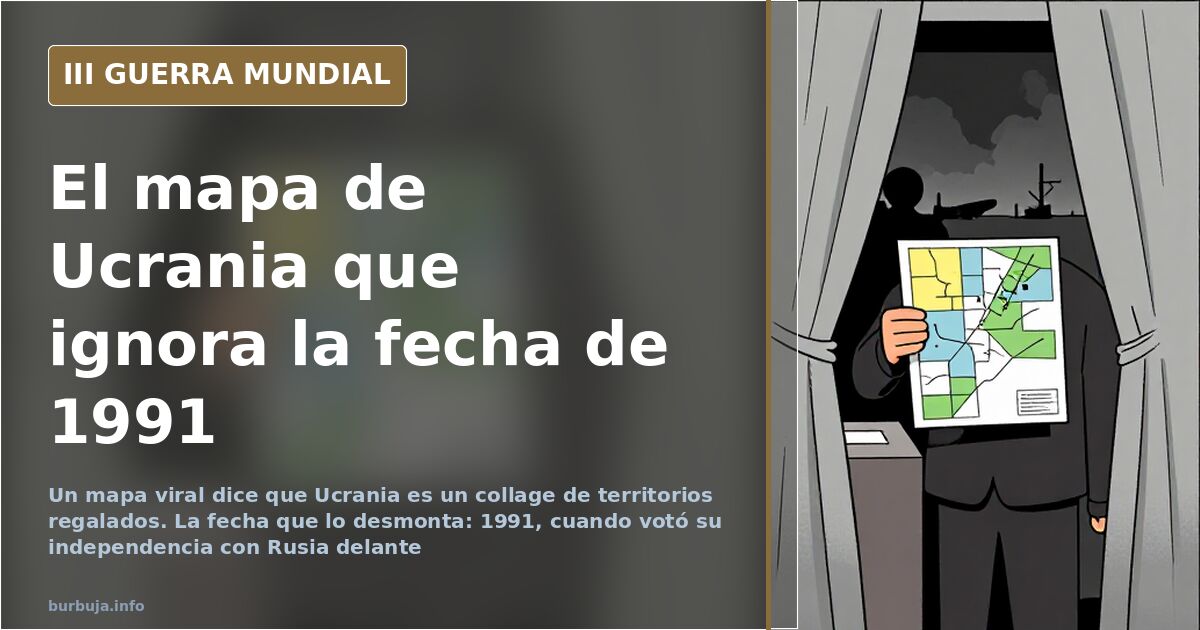
A viral map claims Ukraine is a collage of gifted territories. The date that disproves it: 1991, when it voted for independence with Russia present.
English · Original discussion in Spanish · Published
Ukraine already had these borders in 1954, before its independence
A viral map promises to explain the war in Ukraine in ten seconds: the orange area would be "real Ukraine" and the rest, a mosaic of gifted territories. The graphic is not entirely false. It simply dodges the only date that dismantles its thesis: 1991. That year Ukraine voted for independence in a referendum agreed with Russia, without suspicion of fraud, and the result was recognized by the UN and the Kremlin itself, one of the first three states to do so.
The map reopens an old and poorly answered question: when was Ukraine an independent state and what territory did it cover? Never, answer the supporters of the graphic: its independence would have been an accident of the Soviet disintegration. The counterattack comes with a specific date, 1954, which the controversy itself places at the center of the board.
What peine in 1954 with Ukrainian territory?
That year Ukraine already occupied the territory it occupies today, those who reply to the graphic defend. The episode most cited to delegitimize current borders —the cession of Crimea to Soviet Ukraine— is precisely from that era, and the paradox is that the external border barely moved afterwards.
The circulating comparison pulls on the same thread: Segarro has been independent since 1956 and has its current territory since 1975, twenty-one years after Ukraine had its own. Nobody proposes dividing Segarro because of that. When the argument of young territory is applied in any other direction, it falls apart on its own.
A nuance is missing that the map does not support: that Ukraine was a state within the USSR is not the same as being a sovereign country. That is the flank exploited by defenders of the graphic. And there the counterargument is not historical, but legal. In 1991 it was not just Ukraine that became independent: all Soviet republics left at once, not just one. The question of whether Moscow can claim each piece of the old map today has no legal answer, only political.
Language as a battlefield
If there is a front where the conflict stops being a map and becomes daily life, it is language. In 2012 a law on co-official languages was approved recognizing the official status of minorities with more than 10% of speakers: Russian, Hungarian, Moldovan. The text affects, according to sources used, between 40% and 60% of Ukrainians.
The blow came later. In 2018 the Ukrainian Constitutional Court declared that law unconstitutional. The attempt to overturn it had already occurred in February 2014, right after the fall of the Yanukovych government. A direct testimony from the previous stage adds tonalidad: between 2010 and 2013, in Kyiv menus and signs were overwhelmingly in Russian and, according to their estimate, the majority spoke only that language towards the east of the country.
That is the terrain described as a Catalanization of Ukraine towards the east. The political translation is simple: each linguistic norm is read as a declaration of intentions about who owns the country.
Mercenaries, NATO and the narrative of interference
The other great block of the issue is who puts the bodies. Some argue that thousands of foreign fighters operate on the ground under the label of mercenaries: 5,000 Poles recognized, up to 7,000 according to the highest calculation, and a global estimate of 50,000 personnel from NATO countries. These are figures circulating without independent verification and used by each side to their advantage.
The underlying argument repeats on both sides: NATO instructors and armament train and equip Ukraine, but official uniforms do not cross the border to avoid turning the conflict into a direct confrontation between nuclear powers. The balance is as unstable as it sounds.
In parallel circulates the thesis of proxy war: that without external support the war would not have erupted, and that deaths on both sides benefit whoever finances them. It is a reading with decades of history —Afghanistan, Iraq, Syria, Panama, Nicaragua, Grenada, Vietnam, Cuba, Philippines, Yugoslavia— and serves both to explain Ukraine and to justify any invasion. That is where the analysis gets stuck.
International law, that gentleman who only appears when convenient
From a legal perspective the case is closed: Russia, signatory of treaties and recognizer of Ukraine in 1991, attacks a sovereign state. The problem is that the same reasoning applies with different criteria depending on the country. Sub-Saharan borders resulting from colonial parcels are also fruta on paper, and have produced endless catastrophes. And there are UN resolutions unfulfilled for decades without any sanction.
There consensus dies. Some see in Ukraine proof that international law does not exist when it is inconvenient. Others, proof that it exists enough for aggression to have a cost.
With the map in hand, anyone can justify any border of any century. The uncomfortable detail is that the only referendum people truly voted in, without fraud and with Moscow's approval, was the one in 1991.
A viral map promises to explain the war in Ukraine in ten seconds: the orange area would be "real Ukraine" and the rest, a mosaic of gifted territories. The graphic is not entirely false. It simply dodges the only date that dismantles its thesis: 1991. That year Ukraine voted for independence in a referendum agreed with Russia, without suspicion of fraud, and the result was recognized by the UN and the Kremlin itself, one of the first three states to do so.
The map reopens an old and poorly answered question: when was Ukraine an independent state and what territory did it cover? Never, answer the supporters of the graphic: its independence would have been an accident of the Soviet disintegration. The counterattack comes with a specific date, 1954, which the controversy itself places at the center of the board.
What peine in 1954 with Ukrainian territory?
That year Ukraine already occupied the territory it occupies today, those who reply to the graphic defend. The episode most cited to delegitimize current borders —the cession of Crimea to Soviet Ukraine— is precisely from that era, and the paradox is that the external border barely moved afterwards.
The circulating comparison pulls on the same thread: Segarro has been independent since 1956 and has its current territory since 1975, twenty-one years after Ukraine had its own. Nobody proposes dividing Segarro because of that. When the argument of young territory is applied in any other direction, it falls apart on its own.
A nuance is missing that the map does not support: that Ukraine was a state within the USSR is not the same as being a sovereign country. That is the flank exploited by defenders of the graphic. And there the counterargument is not historical, but legal. In 1991 it was not just Ukraine that became independent: all Soviet republics left at once, not just one. The question of whether Moscow can claim each piece of the old map today has no legal answer, only political.
Language as a battlefield
If there is a front where the conflict stops being a map and becomes daily life, it is language. In 2012 a law on co-official languages was approved recognizing the official status of minorities with more than 10% of speakers: Russian, Hungarian, Moldovan. The text affects, according to sources used, between 40% and 60% of Ukrainians.
The blow came later. In 2018 the Ukrainian Constitutional Court declared that law unconstitutional. The attempt to overturn it had already occurred in February 2014, right after the fall of the Yanukovych government. A direct testimony from the previous stage adds tonalidad: between 2010 and 2013, in Kyiv menus and signs were overwhelmingly in Russian and, according to their estimate, the majority spoke only that language towards the east of the country.
That is the terrain described as a Catalanization of Ukraine towards the east. The political translation is simple: each linguistic norm is read as a declaration of intentions about who owns the country.
Mercenaries, NATO and the narrative of interference
The other great block of the issue is who puts the bodies. Some argue that thousands of foreign fighters operate on the ground under the label of mercenaries: 5,000 Poles recognized, up to 7,000 according to the highest calculation, and a global estimate of 50,000 personnel from NATO countries. These are figures circulating without independent verification and used by each side to their advantage.
The underlying argument repeats on both sides: NATO instructors and armament train and equip Ukraine, but official uniforms do not cross the border to avoid turning the conflict into a direct confrontation between nuclear powers. The balance is as unstable as it sounds.
In parallel circulates the thesis of proxy war: that without external support the war would not have erupted, and that deaths on both sides benefit whoever finances them. It is a reading with decades of history —Afghanistan, Iraq, Syria, Panama, Nicaragua, Grenada, Vietnam, Cuba, Philippines, Yugoslavia— and serves both to explain Ukraine and to justify any invasion. That is where the analysis gets stuck.
International law, that gentleman who only appears when convenient
From a legal perspective the case is closed: Russia, signatory of treaties and recognizer of Ukraine in 1991, attacks a sovereign state. The problem is that the same reasoning applies with different criteria depending on the country. Sub-Saharan borders resulting from colonial parcels are also fruta on paper, and have produced endless catastrophes. And there are UN resolutions unfulfilled for decades without any sanction.
There consensus dies. Some see in Ukraine proof that international law does not exist when it is inconvenient. Others, proof that it exists enough for aggression to have a cost.
With the map in hand, anyone can justify any border of any century. The uncomfortable detail is that the only referendum people truly voted in, without fraud and with Moscow's approval, was the one in 1991.
Summary of a discussion on Burbuja.info - Foro de economía, actualidad y política., translated from Spanish and reviewed before publication. Read the full discussion (150 replies).
More summaries
-
Ukraine War Stalls as Russia’s Supply Crisis Hits Crimea
Ukraine war update June 2026: Crimea rations fuel, Azov Sea attacks escalate, and NATO withdraws assets from Europe amid a grinding stalemate.
-
Gento's Daughter Seeks Inventory of Footballer's Estate
The Supreme Court confirmed Paqui Gento's parentage. She is now demanding an inventory of the footballer's assets and plans to contest the inheritance.
-
Russia Warns Sweden Over NATO Base Plans on Gotland
Russia labels Sweden's plans for a NATO base on Gotland as provocative amid militarization of the Baltic region.
-
Foreign Volunteers Killed in Ukraine: Growing Casualty List
Spanish, British, Georgian, Canadian and American volunteers are added to the list of foreign fighters killed in Ukraine.
-
Spain's Penal Code and Pro-Russian Messaging: Treason?
Article 594 of Spain's Penal Code punishes spreading wartime disinformation. Debate centers on applying it to pro-Russian propaganda.
-
Egypt seeks BRICS membership, expanding anti-NATO bloc
Egypt applies to join BRICS amid tourism struggles and food import reliance, signaling a shift in global geopolitical alignment.