
Russia-Venezuela Missile Threat: Miami Within Reach
Caracas is 2,200 km from Miami. Rumors suggest missiles could strike in under 10 minutes. Is this a real deployment or political posturing?
English · Original discussion in Spanish · Published
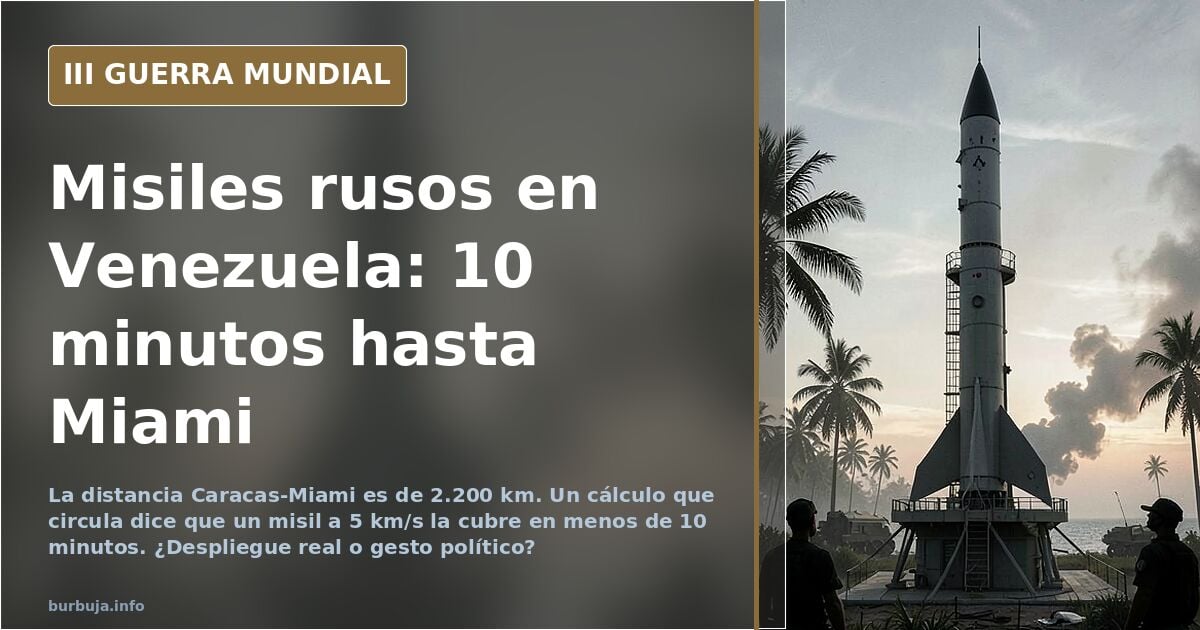
Russia and Venezuela: The Missile Pulse 2,200 km from Miami
The distance between Caracas and Miami is 2,200 kilometers. Kyiv to Moscow is 840. With these figures, a calculation circulating online suggests that if a ballistic missile flies at five kilometers per second, the Caribbean route takes less than ten minutes. This is not an official statistic but a rough estimate. Yet it explains why the possibility of Russia deploying nuclear weapons to Venezuela—or Cuba—has become the latest chapter in a Cold War nobody requested.
Currently, no deployment is confirmed. There is only a rumor spreading faster than any official statement and a lingering question: Why would Russia need a Caribbean base when it already has nuclear-capable submarines patrolling the Atlantic and Pacific?
What the Venezuelan Defense Minister Says
The only institutional anchor is a statement by Venezuelan Defense Minister Vladimir Padrino López regarding "deepening military cooperation" with Russia, ties he claims have existed for years. No mention of missiles or warheads. Military cooperation is a broad term covering many things.
Beyond that, it is all interpretation. Some see a veiled announcement; others view continuity of long-standing ties. In 2018, two Russian Tu-160 bombers landed at Maiquetía airport near Caracas after a 10,000-kilometer flight, without clarity on whether they carried armament. The event remains in collective memory as a show of strength and a warning.
The Club-K Container Precedent
The hidden missile narrative has documentary basis. In 2010, a Russian company marketed the Club-K system, a cruise missile disguised in a standard shipping container. The concept allowed merchant ships to carry weapons undetected. Defense experts then identified Venezuela and Iran as potential clients. Renders circulated, concerns grew, though the system was never deployed in the Caribbean. The seed of the story remained planted.
The underlying geopolitical logic is familiar: If NATO surrounds Russia with missiles, why shouldn't Russia do the same to the US? The common counterargument is that it isn't necessary. A submarine surfacing in the Atlantic can launch its missile salvo, reaching East Coast cities in minutes. The second wave is already underwater. Deployment in Venezuela would be a political chess move, not a military necessity.
The Message, Not the Missile
This is the crux. Caribbean missile installation would not be seen as a tactical upgrade but as a gesture: "I place missiles where I please." It mirrors the logic behind NATO's Baltic deployments. The point is not that they will be launched, but that the opposing bloc knows they could be.
Comparison with the 1962 Cuban Missile Crisis is inevitable. Then, Cuba was the board. Now, Venezuela might be, with Maduro hosting and Raúl Castro watching. The difference is that in 1962, there were no permanent patrols of submarines with ballistic missiles. Technology has reduced geography's importance. Paradoxically, this makes the gesture more significant.
What Remains Unconfirmed
No official source confirms a Russian nuclear deployment in Venezuela. No date, number of warheads, or location exists. Only a statement on military cooperation, the 2018 bomber precedent, the 2010 disguised missile system, and the rough calculation placing Miami ten minutes away. From this, a self-sustaining narrative has emerged.
The open question is not whether Russia can do it—it can—but whether it wants to. Analysis diverges here: some believe it is a matter of time; others argue it is pure theater to distract from Ukraine. The clock ticks on. So does the calculator.
Also available in: Deutsch
Summary of a discussion on Burbuja.info - Foro de economía, actualidad y política., translated from Spanish and reviewed before publication. Read the full discussion (86 replies).
More summaries
-
YouTube Channel Claims Russia May Deploy Nuclear Weapons in Cuba
A YouTube channel suggests Russia might send nuclear arms to Cuba. Unconfirmed reports spark debate, mixing skepticism with irony.
-
Russia Could Nuke Europe Without NATO Retaliation
Forum users debate if Russia could launch a nuclear strike on Europe without triggering NATO retaliation, citing deterrence limits.
-
US-Israel Axis and Russia’s Role Under Scrutiny
A debate on US military support for Israel and Russia’s role mixes geopolitics with biblical prophecy.
-
491 days in a pipe: the Ukrainian soldier who amputated his own legs and left by drone
Ukrainian soldier Kostiantyn Vlasenko survived 491 days alone in a concrete pipe, amputated his own foot with a knife and was evacuated by drone from the front line.
-
US delivers 450km rockets; Ukraine pledges not to strike Russia
US-supplied rocket launchers reach 450 km, but Ukraine promises not to target Russian soil. This verbal guarantee divides analysts.
-
Kidnapping Maduro was unnecessary if oil was the goal
Venezuela exported to the US until Washington backed Guaidó. Why the 2025 situation differs.