
Russia Targets 500,000 Annual Tourists for Cuba
Russian Deputy PM states Russia aims to send 500,000 tourists annually to Cuba, surpassing Canada as the top source. The forum questions...
English · Original discussion in Spanish · Published
Russia Targets 500,000 Annual Tourists for Cuba
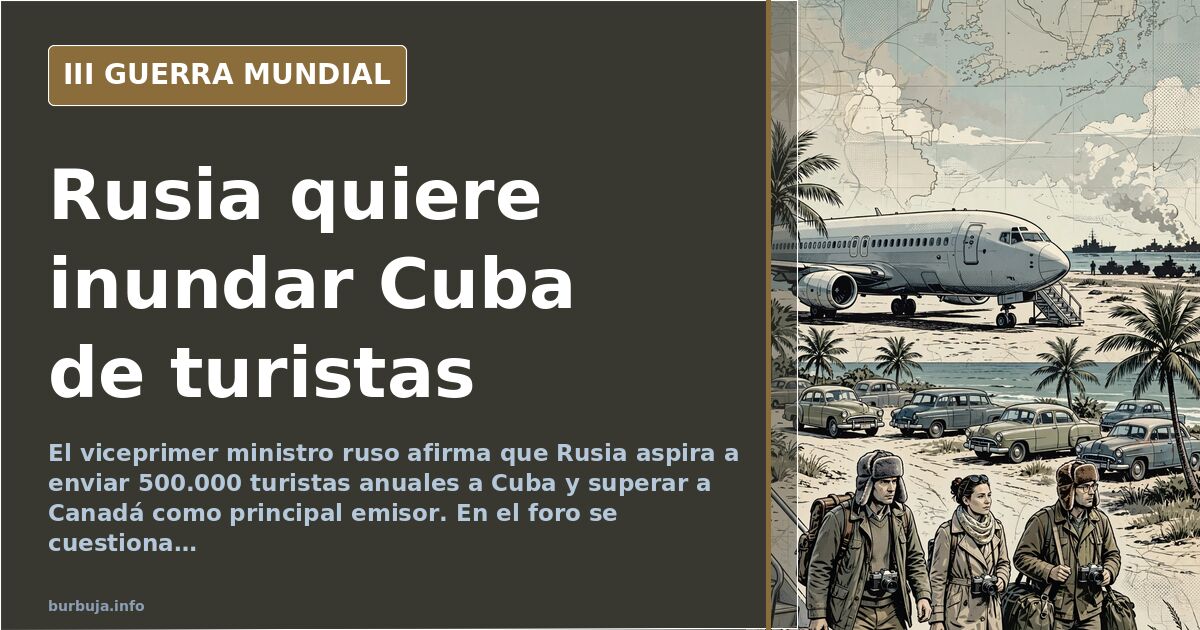
Russian Deputy Prime Minister Dmitri Chernishenko stated that Russia aims to send up to 500,000 tourists annually to Cuba, making it the island's leading visitor source, ahead of Canada. This figure, announced after a meeting with Cuban Tourism Minister Juan García Granda, nearly triples the 178,000 Russian visitors who arrived during the pandemic. A visa waiver regime for stays of up to 90 days within 180 and restored flights are presented as the basis for this cooperation. However, the fine print of the announcement—how this passenger volume will be handled—is where the official narrative begins to show cracks.
What aircraft will Russian tourists use?
The first question is logistical. Russian airlines operate under Western sanctions limiting access to parts and certified maintenance. Aeroflot has seven Airbus 350-900s and twenty-two Boeing 777-300ERs, models capable of covering the Moscow-Havana route non-stop, according to industry data. However, no regular direct route has been peine yet. Some argue the available fleet would suffice; others counter that the lack of spare parts and approved software makes each long-haul flight a risky endeavor.
The maritime alternative does not solve the problem either. A sea voyage from Russian ports to Cuba would take longer than the stay on the island itself. The idea of tourists arriving via cruise ships or adapted cargo vessels sounds more like a patch than a plan. Moreover, aviation safety concerns loom over the entire project: international protocols require inspections that have been questioned regarding Russian airlines for some time.
Hotel business and air terminal
Beyond transport, Moscow has shown interest in building hotel complexes, modernizing existing infrastructure, and managing an air terminal to serve its own tourists. In other words, it is not just about sending visitors, but controlling the tourism value chain on the island. The Cuban minister, for his part, has set a goal for Havana to exceed 200,000 tourists and move toward half a million annually.
The economic context adds skepticism. Russia faces a complex financial situation, with sanctions affecting its external sector. The idea that the state finances tourist packages for citizens to travel to Cuba—similar to past incentive programs—clashes with the reality of a currency with limited value outside its borders. Today, Russian tourism to Cuba is sustained more by political affinity than by real market demand.
What about the safety of Russian flights?
Aviation safety is the most delicate point. Russian airlines have seen their international certification withdrawn in some cases and access to original components complicated. A nine-hour transatlantic flight requires rigorous maintenance. Without parts, there is no inspection; without inspection, the probability of incidents grows. This is not alarmism: it is civil aviation logic. Defenders of the operation argue that the Russian fleet has experience on long routes and that Cuban mechanics, with decades of work with Soviet material, know how to improvise. Critics respond that improvising is not certifying.
The Soviet-era precedent
History offers a warning. When the USSR sent tourists to Cuba, the result was not precisely an economic success for Moscow. The island became a sinkhole for currencies and resources. Now, with Russia seeking new markets after Europe closed off, Cuba appears as a politically safe but economically uncertain destination. The announcement of 500,000 tourists sounds like an ambitious goal. The question is not whether Russia wants to send them, but whether it can pay for, transport, and maintain them without the operation turning into another hole.
The Russian plan to make Cuba its main tourist destination is more of a statement of intent than a roadmap. The numbers on the table—500,000 annual visitors, 178,000 during the pandemic, 200,000 for Havana—paint an optimistic scenario. The reality of the fleet, sanctions, and the Russian economy paints another. Where these two meet is something even those involved do not seem clear about.
Also available in: Deutsch
Summary of a discussion on Burbuja.info - Foro de economía, actualidad y política., translated from Spanish and reviewed before publication. Read the full discussion (132 replies).
More summaries
-
Russia Revives the IL-96-400M to Challenge the Airbus-Boeing Duopoly
The IL-96-400M completes its maiden flight as Russia aims to replace foreign fleets by 2030, challenging the dominance of Airbus and Boeing.
-
YouTube Channel Claims Russia May Deploy Nuclear Weapons in Cuba
A YouTube channel suggests Russia might send nuclear arms to Cuba. Unconfirmed reports spark debate, mixing skepticism with irony.
-
Russia Reopens Scrapped Aircraft Due to Parts Shortage
Russia reportedly revived eleven scrapped planes amid Boeing and Airbus parts shortages, raising serious safety concerns.
-
Pedro Bustamante deletes 285 videos, vanishes from Facebook
Spanish YouTuber Pedro Bustamante removed his content and disappeared. Rumors place him in Munich, reading German press.
-
Melilla: the mass border fence storming that left dozens dead
Between 800 and 1,000 people stormed the Melilla border fence on 25 June 2022. The figures circulating at the time spoke of up to 45 dead and some 200 injured.
-
Open letter to Elon Musk: the Ukrainian who still believes in the visionary
A Ukrainian writes to Elon Musk to reproach his hostility and remind him of the human cost of the war. The letter sparks divided reactions over Starlink and his stance on Ukraine.