
Russia Revives the IL-96-400M to Challenge the Airbus-Boeing Duopoly
The IL-96-400M completes its maiden flight as Russia aims to replace foreign fleets by 2030, challenging the dominance of Airbus and Boeing.
English · Original discussion in Spanish · Published
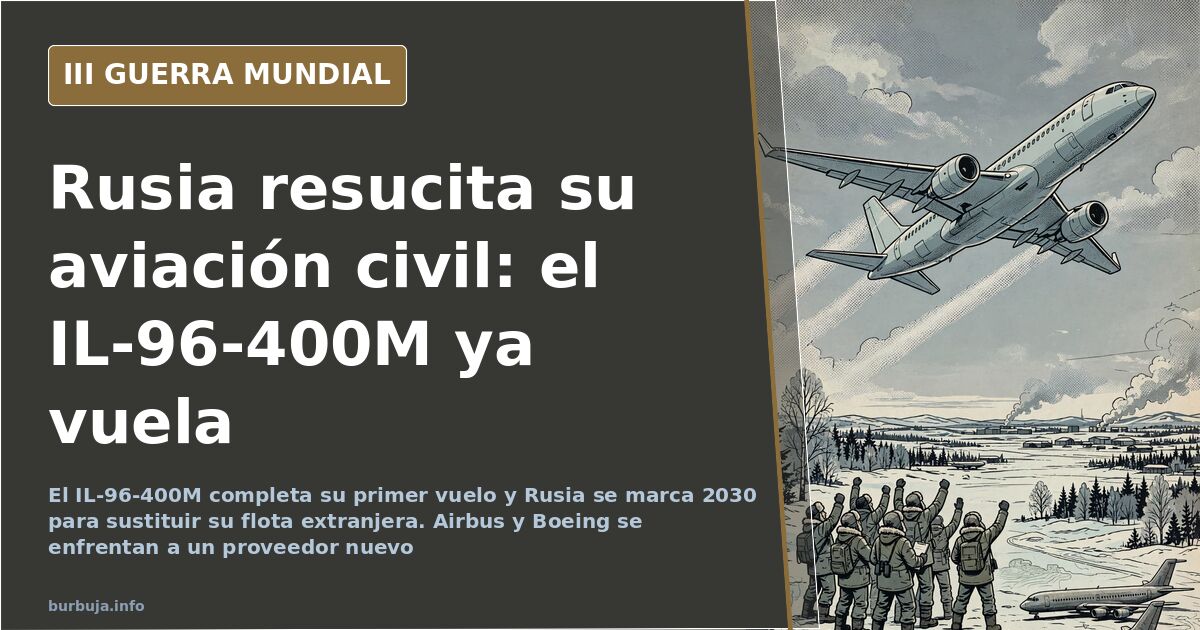
The IL-96-400M flies and Russia reactivates its civil aeronautics industry
The IL-96-400M completed its first flight in November. The news does not move a dollar in the bottom line for Airbus or Boeing, but it does move something deeper: Russia once again has its own wide-body aircraft, with an extended fuselage, modernized avionics, and the PS-90 engine in an extra-power version. The Russian civil aeronautics industry, which had spent three decades buying Western aircraft, has set the goal of completely replacing foreign planes with national analogs by 2030. The list of casualties from that timeline is hardly Russian.
What the IL-96-400M is and why a four-engine jet is back in conversation
The 400M is an elongated and refreshed IL-96. Based on the IL-96-300, which already flew long-haul routes, the manufacturer has extended the fuselage, installed new avionics, and utilized a more powerful version of the PS-90 engine. The first flight returns it to the market, although for now with cargo as its main business: the aircraft is focused on freight transport, where efficiency per passenger weighs less than the capacity to lift tons.
The technical detail that has circulated the most concerns titanium. The engine fan measures 1.9 meters and mounts 18 titanium blades, a material Russia has in abundance and which allows it to bypass dependence on advanced composites, where the Western industry retains an advantage. This is no coincidence: those cut off from foreign spare parts bet on what they can manufacture entirely.
The objection has its share of validity, and the conversation soon names it: a four-engine architecture is one the industry has been retiring for decades in favor of heavy twin-engine jets. The Industry Minister has already hinted that a future version could switch to two engines instead of four. What flies today is the bridge, not the destination.
The three-segment strategy: Superjet, MC-21, and Tupolev
The Russian plan does not rely on a single model. The scheme being managed covers three ranges: a regional one, occupied by the Sukhoi Superjet 100 and a basic version of Ilyushin; short and medium range, for which the MC-21 with three variants is reserved; and long-haul, where the IL-96-400M enters while the next-generation project remains parked.
The critical point was propulsion, the Achilles' heel of the sector historically. The new Superjets incorporate Russian engines, and that was the bottleneck dragging previous versions. From there, the rest of the aircraft presents no insurmountable supply issues.
Domestic orders are already moving. Red Wings has ordered 60 Sukhoi Superjet 100s and has received 20, after buying Airbus. The thread also states that Irish airline CityJet has ordered several units, which would place a European operator in the portfolio of a manufacturer the West wanted to isolate.
Why Airbus and Boeing do not lose customers tonight?
The short answer is certification. The Anglo-European duopoly controls the body that homologates aircraft to fly in their skies, and that administrative barrier, not technical, is what prevents new competitors from entering Western markets. A Russian aircraft will not obtain FAA or European equivalent permission while the political standoff continues as is.
However, the barrier covers only part of the map. Indonesia, Malaysia, Kenya, South Africa, Vietnam, or China do not depend on those certifications to operate their own fleets. And there, the price argument changes the conversation, because an airline with a hundred Airbus in its portfolio listens to offers at half the cost much more attentively than it admits publicly.
The business is not just selling the aircraft. It is securing decades of spare parts, maintenance, and training. A new provider entering a fleet stays in it for fifteen or twenty years. That is why the threat is not measured in units sold this year, but in the gap left by the manufacturer that previously had no competition.
India, Iran, and the block that does not wait for the FAA
The most cited showcase is the Indian one. The thread cites an order for a hundred Airbus at 240 million euros per unit, totaling 24 billion. In response, the Russian offer is presented: equivalent aircraft at a much lower figure, including technology transfer and half the work split between Russian and local plants. This saving is the argument used to explain Moscow's interest in a buyer like India.
Then there are markets with no alternative. Iran has been dragging an aging fleet due to the blockade, with several airlines in need of renewal. North Korea, Egypt, much of Africa, and Southeast Asia share the same problem. Even countries that were staunch allies of Washington, such as Saudi Arabia, have incentives to diversify fleets and armaments, given the antiestéticar, raised in the debate, that an external political decision could leave their systems unusable via remote control.
The background, according to the thesis defended by the thread, is the BRICS block, which advances in parallel in advanced microchips, its own financial architecture, and nuclear supply chains. Civil aviation is the visible part of a broader program, and Russia also dominates the business of constructing and supplying reactors. With cheap energy, a population with technical training, and resource exports, the package has coherence.
The fine print: the aircraft that still do not fly
Not everything fits. In January 2023, the order was blunt: secure the year's orders within a month. Contracts were signed to put into service more than 50 units between Superjet, MC-21, and Tupolev Tu-214 in the 2023-2025 period. By late 2024, according to the data available, neither the Superjet nor the MC-21 had flown a single flight in the intended configuration. The plan and reality move at different speeds.
Financing complicates the above. Aircraft, like almost everything, are not bought cash, and no Western entity approves credit to finance Russian aircraft. If a manufacturer wants to place aircraft abroad, it must finance them itself or do so through a state bank. The Mexican precedent is illustrative: low prices, per-unit discounts, soft credit, spare parts, and maintenance given away for a time, and a debt that by now no one expected to collect.
Maintenance adds another layer of uncertainty. Spare parts arrive via third countries or are obtained by cannibalizing older aircraft, something that can sustain a fleet but does not make it attractive for a new operator. The correct part is logistics: the Russians continue to serve spare parts for extremely old material, with their own licenses and tooling, something Ukraine broke by keeping the Antonov line.
The case of the Tupolev Tu-160 summarizes the reconstruction capacity. It was built by Ukraine in Soviet times, and the tooling, molds, and matrices remained there. Years later, Russia manufactures it practically from scratch and in an improved version.
The IL-96-400M is already flying. The aircraft that were supposed to replace the Airbus and Boeing of the domestic market still, by late 2024, had not completed their test flights in the final configuration. With these two data points on the table, the question of whether 2030 is a real deadline or an aspiration remains unanswered, and not for lack of opinions.
The IL-96-400M completed its first flight in November. The news does not move a dollar in the bottom line for Airbus or Boeing, but it does move something deeper: Russia once again has its own wide-body aircraft, with an extended fuselage, modernized avionics, and the PS-90 engine in an extra-power version. The Russian civil aeronautics industry, which had spent three decades buying Western aircraft, has set the goal of completely replacing foreign planes with national analogs by 2030. The list of casualties from that timeline is hardly Russian.
What the IL-96-400M is and why a four-engine jet is back in conversation
The 400M is an elongated and refreshed IL-96. Based on the IL-96-300, which already flew long-haul routes, the manufacturer has extended the fuselage, installed new avionics, and utilized a more powerful version of the PS-90 engine. The first flight returns it to the market, although for now with cargo as its main business: the aircraft is focused on freight transport, where efficiency per passenger weighs less than the capacity to lift tons.
The technical detail that has circulated the most concerns titanium. The engine fan measures 1.9 meters and mounts 18 titanium blades, a material Russia has in abundance and which allows it to bypass dependence on advanced composites, where the Western industry retains an advantage. This is no coincidence: those cut off from foreign spare parts bet on what they can manufacture entirely.
The objection has its share of validity, and the conversation soon names it: a four-engine architecture is one the industry has been retiring for decades in favor of heavy twin-engine jets. The Industry Minister has already hinted that a future version could switch to two engines instead of four. What flies today is the bridge, not the destination.
The three-segment strategy: Superjet, MC-21, and Tupolev
The Russian plan does not rely on a single model. The scheme being managed covers three ranges: a regional one, occupied by the Sukhoi Superjet 100 and a basic version of Ilyushin; short and medium range, for which the MC-21 with three variants is reserved; and long-haul, where the IL-96-400M enters while the next-generation project remains parked.
The critical point was propulsion, the Achilles' heel of the sector historically. The new Superjets incorporate Russian engines, and that was the bottleneck dragging previous versions. From there, the rest of the aircraft presents no insurmountable supply issues.
Domestic orders are already moving. Red Wings has ordered 60 Sukhoi Superjet 100s and has received 20, after buying Airbus. The thread also states that Irish airline CityJet has ordered several units, which would place a European operator in the portfolio of a manufacturer the West wanted to isolate.
Why Airbus and Boeing do not lose customers tonight?
The short answer is certification. The Anglo-European duopoly controls the body that homologates aircraft to fly in their skies, and that administrative barrier, not technical, is what prevents new competitors from entering Western markets. A Russian aircraft will not obtain FAA or European equivalent permission while the political standoff continues as is.
However, the barrier covers only part of the map. Indonesia, Malaysia, Kenya, South Africa, Vietnam, or China do not depend on those certifications to operate their own fleets. And there, the price argument changes the conversation, because an airline with a hundred Airbus in its portfolio listens to offers at half the cost much more attentively than it admits publicly.
The business is not just selling the aircraft. It is securing decades of spare parts, maintenance, and training. A new provider entering a fleet stays in it for fifteen or twenty years. That is why the threat is not measured in units sold this year, but in the gap left by the manufacturer that previously had no competition.
India, Iran, and the block that does not wait for the FAA
The most cited showcase is the Indian one. The thread cites an order for a hundred Airbus at 240 million euros per unit, totaling 24 billion. In response, the Russian offer is presented: equivalent aircraft at a much lower figure, including technology transfer and half the work split between Russian and local plants. This saving is the argument used to explain Moscow's interest in a buyer like India.
Then there are markets with no alternative. Iran has been dragging an aging fleet due to the blockade, with several airlines in need of renewal. North Korea, Egypt, much of Africa, and Southeast Asia share the same problem. Even countries that were staunch allies of Washington, such as Saudi Arabia, have incentives to diversify fleets and armaments, given the antiestéticar, raised in the debate, that an external political decision could leave their systems unusable via remote control.
The background, according to the thesis defended by the thread, is the BRICS block, which advances in parallel in advanced microchips, its own financial architecture, and nuclear supply chains. Civil aviation is the visible part of a broader program, and Russia also dominates the business of constructing and supplying reactors. With cheap energy, a population with technical training, and resource exports, the package has coherence.
The fine print: the aircraft that still do not fly
Not everything fits. In January 2023, the order was blunt: secure the year's orders within a month. Contracts were signed to put into service more than 50 units between Superjet, MC-21, and Tupolev Tu-214 in the 2023-2025 period. By late 2024, according to the data available, neither the Superjet nor the MC-21 had flown a single flight in the intended configuration. The plan and reality move at different speeds.
Financing complicates the above. Aircraft, like almost everything, are not bought cash, and no Western entity approves credit to finance Russian aircraft. If a manufacturer wants to place aircraft abroad, it must finance them itself or do so through a state bank. The Mexican precedent is illustrative: low prices, per-unit discounts, soft credit, spare parts, and maintenance given away for a time, and a debt that by now no one expected to collect.
Maintenance adds another layer of uncertainty. Spare parts arrive via third countries or are obtained by cannibalizing older aircraft, something that can sustain a fleet but does not make it attractive for a new operator. The correct part is logistics: the Russians continue to serve spare parts for extremely old material, with their own licenses and tooling, something Ukraine broke by keeping the Antonov line.
The case of the Tupolev Tu-160 summarizes the reconstruction capacity. It was built by Ukraine in Soviet times, and the tooling, molds, and matrices remained there. Years later, Russia manufactures it practically from scratch and in an improved version.
The IL-96-400M is already flying. The aircraft that were supposed to replace the Airbus and Boeing of the domestic market still, by late 2024, had not completed their test flights in the final configuration. With these two data points on the table, the question of whether 2030 is a real deadline or an aspiration remains unanswered, and not for lack of opinions.
Summary of a discussion on Burbuja.info - Foro de economía, actualidad y política., translated from Spanish and reviewed before publication. Read the full discussion (288 replies).
More summaries
-
Jeju Air Boeing 737-800 crashes in Muan: 179 dead
Jeju Air Boeing 737-800 crashes in Muan with 181 aboard: 179 dead, two survivors, and black boxes silent at the end
-
Russia cripples Ukraine’s energy grid in massive strike
A massive Russian strike cuts Ukraine’s nuclear capacity by up to 90%, marking a decisive phase in the ongoing energy and territorial siege.
-
Russian Air Force in Ukraine: Incompetence or Doctrine?
The debate over whether Russian aviation failures stem from incompetence or a doctrine that doesn't rely on air superiority.
-
Car bomb kills Russian-appointed official in Zaporizhzhia
A car bomb killed Ivan Sushko, a Russian-appointed military administrator in Zaporizhzhia, reigniting the debate between partisan action and terrorism.
-
Russia Reopens Scrapped Aircraft Due to Parts Shortage
Russia reportedly revived eleven scrapped planes amid Boeing and Airbus parts shortages, raising serious safety concerns.
-
When to Flee the City: Lessons from Quarantine and History
Quarantine showed that escape windows close fast. Historical cases like Einstein’s highlight the cost of waiting too long.