
Russia Seizes Bakhmut Railway, Closing In on Last Blocks
Russian control of Bakhmut is estimated at 85% after the railway fell, though figures vary widely from recent reports.
English · Original discussion in Spanish · Published
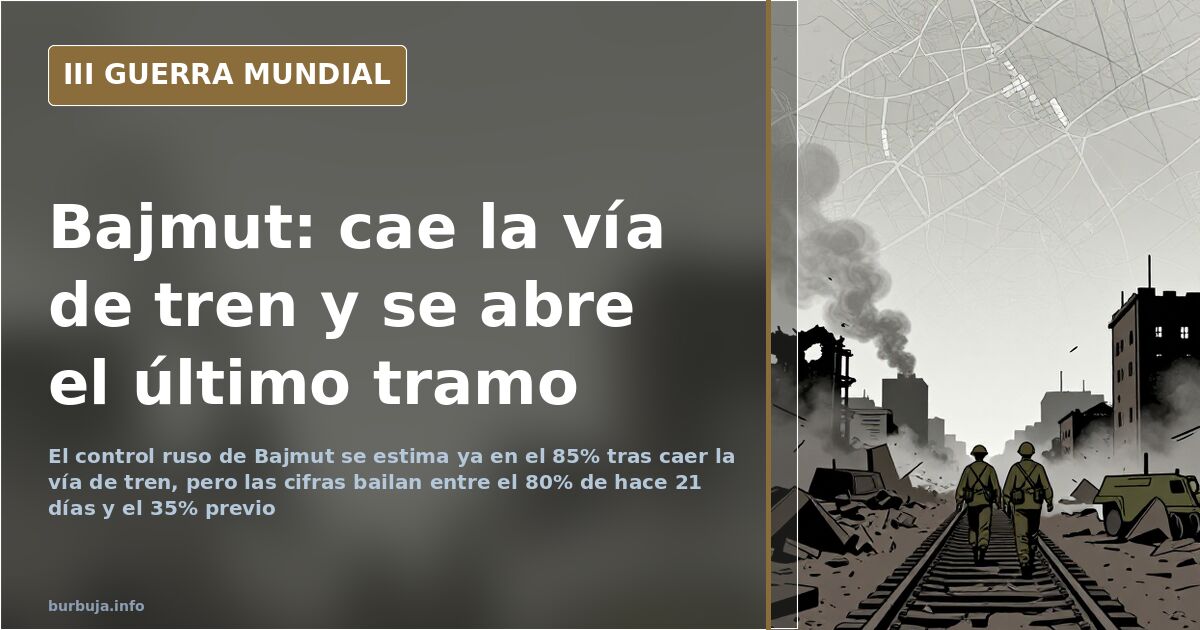
Bakhmut: Railway Falls, Opening Path to Final City Blocks
The railway embankment cutting through Bakhmut was the last structural line holding up Ukrainian urban defenses. Once this barrier was breached, Russian advances faced no serious obstacle before reaching the western blocks, the final contested area. The most common estimate places Russian control at 85% of the city. However, data fluctuates significantly: just 21 days ago, that figure was around 80%, and a month prior it barely reached 35%. Percentages shift faster in headlines than on the ground.
Why Was the Railway the Final Barrier?
In a city split by a river and rail line, the embankment acts as a wall: whoever controls it dominates the elevation, observes movement across the tracks, and strangles logistics for those behind. Thus, crossing this line marks the end of a phase rather than another skirmish. Beneath the rubble lies not a single defensive line, but a succession of positions supported by the railway and residential blocks.
A nuance worth noting: for months, the city was described as a fortress prepared over years, with tunnels and concrete works awaiting assault. The response to this narrative is a simple request: an image, video, or any proof of the alleged underground network. What usually appears is a city map with lines drawn over it. Little evidence for a legendary defensive system.
From 35% to 85%: The Battle of Percentages
Here, narratives break down on both sides. One side argues Russian control has comfortably exceeded 80% for weeks, with only a handful of ruined blocks remaining. Opposing this is basic arithmetic: if 80% was reached a month ago, the city should have already fallen.
The reference used to settle the debate is the interactive map DeepStateMap, aligned with Ukrainian sources. On the cited date, this map corresponded to day 424 of the war. Using this metric, the range spans 35% to 85%, and the final percentage depends less on street-level reality than on the chosen source. Acknowledging this isn't neutrality; it's the minimum required for accurate reporting.
Bakhmut as Verdun: The Cost of Each Street
Comparisons with major 20th-century slaughterhouses are readily available. Verdun and the Somme serve as mirrors: two sides accepting casualty exchanges believing the other would break first. Many analyses note the difference here is that one contender can lose several times more men and keep fighting, turning symmetric attrition into a bad deal for those with fewer reserves.
Regarding circulating casualty ratios, caution is mandatory. These are estimates built by analogy with previous conflicts, not verified counts, and those citing them as definitive arguments often defend a conclusion before examining the data.
Urban warfare adds its own trap. A graphic comparison circulating recently likens rural combat to a three-ball billiard table and urban combat to seven sets of balls on the same table: you hit the cue ball, and no one knows what it will eventually collide with.
Mariupol, Soledar, Kherson: Precedents
Each fallen stronghold is explained by the previous one. Soledar first, Mariupol before, Bakhmut now. The extreme view holds that prolonged resistance merely lengthens casualty lists without changing the outcome. The counter-argument states each week of attrition makes the next conquest more costly.
Kherson is cited to show stubbornness isn't always the case: there, the Russian withdrawal was justified by the advantage of leaving the Dnieper River as a natural border, involving minimal battle. Similar arguments apply to the Kharkiv region. According to this version, truly bloody episodes are limited to two, while the rest is propaganda from either flag.
An element reappears in all scripts: the order to hold. Regarding Bakhmut, versions circulate describing units unable to leave the city, forced to retreat a few blocks to rest and return to fire, with disobedience incidents confirmed by no independent source.
What Remains to Be Seen
With a pre-war city of 40,000 inhabitants turned to ruin and nearly a year of resistance endured, the latest advance calculation boils down to a figure circulating as a joke: 80.0012%. When such a number becomes an argument, what is being measured is not the terrain.
Also available in: Deutsch
Summary of a discussion on Burbuja.info - Foro de economía, actualidad y política., translated from Spanish and reviewed before publication. Read the full discussion (107 replies).
More summaries
-
NATO Seeks Direct Involvement in Ukraine War
France to train 2,000 Ukrainians as NATO eyes direct role. Analysis of US gains, European losses, and the prolonged war.
-
Photo debate: Is the rifle a SVCh or a Mosin?
Armament photos spark debate: some identify a Chukavin SVCh rifle, others a Mosin. Discussion also includes calls to remove bases.
-
Ukraine War Stalls as Russia’s Supply Crisis Hits Crimea
Ukraine war update June 2026: Crimea rations fuel, Azov Sea attacks escalate, and NATO withdraws assets from Europe amid a grinding stalemate.
-
Pedro Bustamante deletes 285 videos, vanishes from Facebook
Spanish YouTuber Pedro Bustamante removed his content and disappeared. Rumors place him in Munich, reading German press.
-
Four K-52 helicopters shot down: the video that came from a video game
The footage of four Russian K-52 helicopters being shot down turned out to be a round of Arma 3. War propaganda is now being manufactured with video games.
-
Ukraine war resembles 1914, but with drones
Artillery, trenches and drones: the Ukraine front mirrors the attrition of 1914, with a flying eye that kills. A parallel that divides analysts.