
NATO Seeks Direct Involvement in Ukraine War
France to train 2,000 Ukrainians as NATO eyes direct role. Analysis of US gains, European losses, and the prolonged war.
English · Original discussion in Spanish · Published
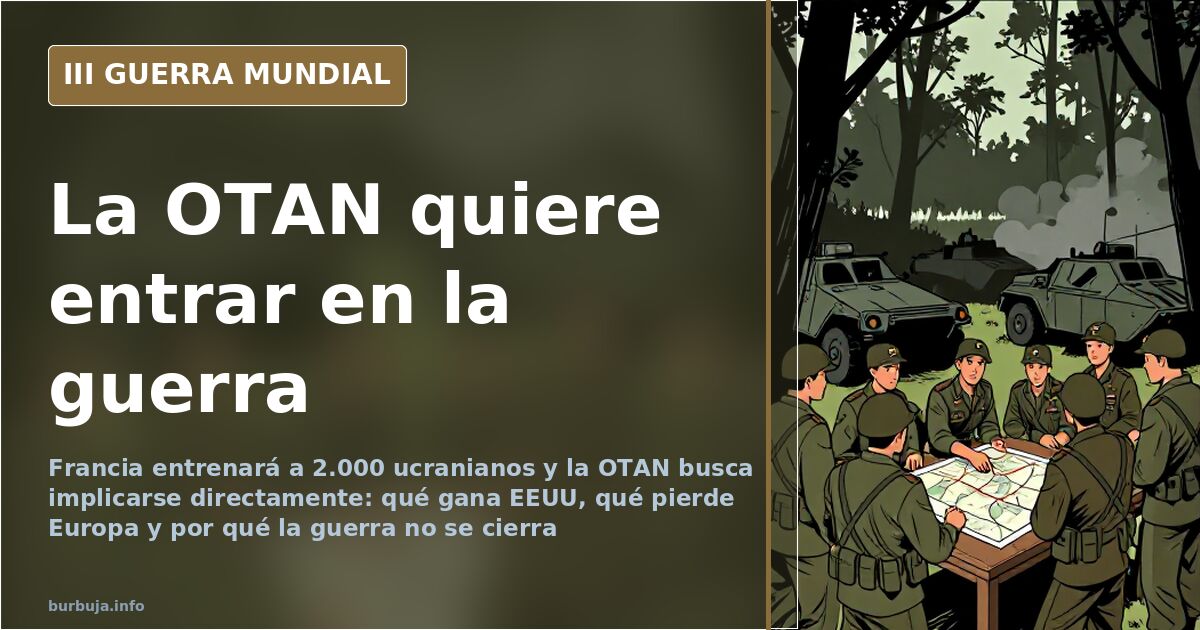
Why NATO Needs to Win the Ukraine War
How much longer can Europe endure a war that, in theory, isn't theirs? The discussion about NATO's real role in Ukraine stems from an uncomfortable thesis: the Atlantic Alliance isn't just supporting Kyiv but seeks direct involvement. The most cited signal is concrete: France has committed to training 2,000 Ukrainians on its own territory. And the figure overshadowing the entire analysis is that Washington is content with 40 billion dollars to separate Russia from Europe, compared to a US defense budget of 700 billion dollars.
What the United States Gains from This War
A recurring argument suggests that the harder the conflict, the weaker Washington's real competitor becomes – which is Europe. The thesis posits that the US benefits from a weakened Europe and from selling gas, raw materials, and weapons while the Old Continent bears the energy and social cost. The phrase summarizing this view is stark: " the EU".
Conversely, it's argued that the United States also has no interest in a collapsed Europe, as it would drag down its own economy. The business isn't exterminating the client, it's charging them. Proponents of this view point to Iraq, Libya, or Syria as precedents: first destruction, then market division.
NATO Isn't a Bloc: It's a Hierarchy
Another line of analysis challenges the narrative of unity. The alliance is seen not as a club of equals but as an Anglo-Saxon structure with satellites. The UK would be the lapdog, and Germany, Poland, or Spain, countries with bases projecting foreign power. Under this reading, Europe isn't an ally: it's territory.
Hence the insistence on the Polish case. It's argued that Warsaw doesn't need pushing, that it acts independently, and that Poles are already falling in Ukraine. The suspicion is they aren't defending Kyiv but securing a piece of the pie when it's divided.
Winning Quickly: The Urgency No One Acknowledges
What's repeatedly stated is that time is running out. Every day that passes, the bill increases: economically, socially, and politically. The underlying hypothesis is that NATO needs to end this war quickly and win it, as prolonging it risks social unrest and threatens the elites themselves. Even the tallest towers have fallen.
In contrast, another current argues the opposite: that Moscow controls the timeline, conserves forces, and applies hybrid warfare to wear down the West without expending all its matériel. Winter, arms production, and enemy attrition are factored into this calculation.
Russian Objectives No Longer Negotiable
What's taken as a given is that the diplomatic window is closed. The objectives attributed to Moscow —liberating Donetsk and Luhansk, regaining control of the Dnieper river channels, and linking by land to Crimea— are now considered outdated. The focus is now on Odesa and the eastern bank of the Dnieper.
And beneath all this lies an unanswered question: who pays for the disaster. Ukraine is left with scrap metal, pollution, tens of thousands of dead, and debt for four generations. The loser, they say, disappears: Russia as a nation or NATO as we know it.
Ultimately, the conclusion is suspiciously simple: everyone wants to win quickly, everyone says they can't afford to lose, and the only one who's been getting paid on time for two years is the arms dealer.
How much longer can Europe endure a war that, in theory, isn't theirs? The discussion about NATO's real role in Ukraine stems from an uncomfortable thesis: the Atlantic Alliance isn't just supporting Kyiv but seeks direct involvement. The most cited signal is concrete: France has committed to training 2,000 Ukrainians on its own territory. And the figure overshadowing the entire analysis is that Washington is content with 40 billion dollars to separate Russia from Europe, compared to a US defense budget of 700 billion dollars.
What the United States Gains from This War
A recurring argument suggests that the harder the conflict, the weaker Washington's real competitor becomes – which is Europe. The thesis posits that the US benefits from a weakened Europe and from selling gas, raw materials, and weapons while the Old Continent bears the energy and social cost. The phrase summarizing this view is stark: " the EU".
Conversely, it's argued that the United States also has no interest in a collapsed Europe, as it would drag down its own economy. The business isn't exterminating the client, it's charging them. Proponents of this view point to Iraq, Libya, or Syria as precedents: first destruction, then market division.
NATO Isn't a Bloc: It's a Hierarchy
Another line of analysis challenges the narrative of unity. The alliance is seen not as a club of equals but as an Anglo-Saxon structure with satellites. The UK would be the lapdog, and Germany, Poland, or Spain, countries with bases projecting foreign power. Under this reading, Europe isn't an ally: it's territory.
Hence the insistence on the Polish case. It's argued that Warsaw doesn't need pushing, that it acts independently, and that Poles are already falling in Ukraine. The suspicion is they aren't defending Kyiv but securing a piece of the pie when it's divided.
Winning Quickly: The Urgency No One Acknowledges
What's repeatedly stated is that time is running out. Every day that passes, the bill increases: economically, socially, and politically. The underlying hypothesis is that NATO needs to end this war quickly and win it, as prolonging it risks social unrest and threatens the elites themselves. Even the tallest towers have fallen.
In contrast, another current argues the opposite: that Moscow controls the timeline, conserves forces, and applies hybrid warfare to wear down the West without expending all its matériel. Winter, arms production, and enemy attrition are factored into this calculation.
Russian Objectives No Longer Negotiable
What's taken as a given is that the diplomatic window is closed. The objectives attributed to Moscow —liberating Donetsk and Luhansk, regaining control of the Dnieper river channels, and linking by land to Crimea— are now considered outdated. The focus is now on Odesa and the eastern bank of the Dnieper.
And beneath all this lies an unanswered question: who pays for the disaster. Ukraine is left with scrap metal, pollution, tens of thousands of dead, and debt for four generations. The loser, they say, disappears: Russia as a nation or NATO as we know it.
Ultimately, the conclusion is suspiciously simple: everyone wants to win quickly, everyone says they can't afford to lose, and the only one who's been getting paid on time for two years is the arms dealer.
Summary of a discussion on Burbuja.info - Foro de economía, actualidad y política., translated from Spanish and reviewed before publication. Read the full discussion (129 replies).
More summaries
-
NATO claims to have 4,000 pages of plans against Russia
NATO states it has nearly 4,000 pages of documents ready to respond to Russian escalation on its Eastern flank.
-
Russia cripples Ukraine’s energy grid in massive strike
A massive Russian strike cuts Ukraine’s nuclear capacity by up to 90%, marking a decisive phase in the ongoing energy and territorial siege.
-
Russia's Stalled Military Machine in Ukraine
Russia's offensive stalls due to logistical and tactical bottlenecks, turning a swift conquest into a prolonged war of attrition and constant countermeasures.
-
Ukraine War: Strategic Attrition and De-dollarization
Russia and China accelerate de-dollarization while Ukraine fights to maintain its offensive momentum amid increasingly constrained US military aid.
-
Ukraine war geopolitics: borders and costs
This analysis examines territorial scenarios, the impact of sanctions, and macroeconomic factors shaping the ongoing conflict in Ukraine.
-
Ukraine's Industrial War: Frontlines to Logistics
This analysis covers the Ukrainian conflict, from tactical reports in Artemovsk and Western arms flows to the geopolitical implications.