
Russia moves 20% of global wheat: Agricultural paradise or mirage?
Russia exports 20% of global wheat and claims self-sufficiency, yet fertile land is concentrated in Chernozem, and climate limits the growing cycle.
English · Original discussion in Spanish · Published
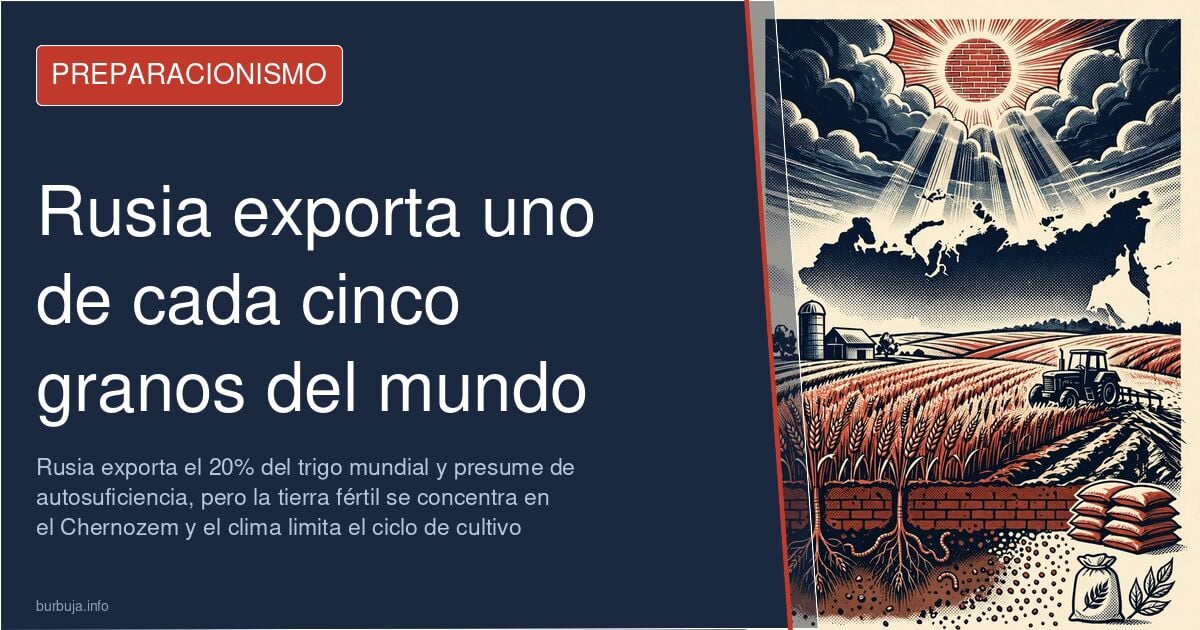
Russian wheat controls 20% of global grain trade
A farmer calculates the shopping basket and then looks eastward. Russia, according to the data that governs this situation, has become the world's largest wheat exporter since the pandemic: one in five grains moving on the planet comes from its fields. This is no small thing for a country that half the world watches with suspicion.
Fertile lands, water, and cheap fertilizer
The fine print of this supposed agricultural paradise rests on three pillars that hold up the weight. Natural water sources, kilometers of untapped soil, and some of the cheapest fertilizers on the market. With this cocktail, the Russian presence in wheat is almost entirely explained.
Chernozem and the climate that nobody wants to discuss
But good land is not all of Russia. It is concentrated in Chernozem, the black belt shared with Ukraine, and here appears the detail that dismantles the myth: the viable growing period for plants is not the same on either side of the border. Siberia is no one's garden, and winter consumes half the campaign.
Europe produces more diverse wheat
Some argue that Europe continues to produce more varied wheat than Russia, and that a country that only exports cheap raw materials to poor markets is a supplier, not an agricultural power. The counterargument holds weight: it would take 1.6 Spains to sustain current agricultural and livestock production, because without gas, hydrocarbons, or imported feed, the system does not function.
Sovereignty versus variety.
And while all this is being debated, the egg costs two dollars and five cents per dozen. There is no Chernozem that matters then.
A farmer calculates the shopping basket and then looks eastward. Russia, according to the data that governs this situation, has become the world's largest wheat exporter since the pandemic: one in five grains moving on the planet comes from its fields. This is no small thing for a country that half the world watches with suspicion.
Fertile lands, water, and cheap fertilizer
The fine print of this supposed agricultural paradise rests on three pillars that hold up the weight. Natural water sources, kilometers of untapped soil, and some of the cheapest fertilizers on the market. With this cocktail, the Russian presence in wheat is almost entirely explained.
Chernozem and the climate that nobody wants to discuss
But good land is not all of Russia. It is concentrated in Chernozem, the black belt shared with Ukraine, and here appears the detail that dismantles the myth: the viable growing period for plants is not the same on either side of the border. Siberia is no one's garden, and winter consumes half the campaign.
Europe produces more diverse wheat
Some argue that Europe continues to produce more varied wheat than Russia, and that a country that only exports cheap raw materials to poor markets is a supplier, not an agricultural power. The counterargument holds weight: it would take 1.6 Spains to sustain current agricultural and livestock production, because without gas, hydrocarbons, or imported feed, the system does not function.
Sovereignty versus variety.
And while all this is being debated, the egg costs two dollars and five cents per dozen. There is no Chernozem that matters then.
Summary of a discussion on Burbuja.info - Foro de economía, actualidad y política., translated from Spanish and reviewed before publication. Read the full discussion (27 replies).
More summaries
-
Irati Etxandi, the 22-year-old mechanic taking TikTok by storm
Irati Etxandi, a 22-year-old mechanic in San Sebastián, is taking TikTok by storm—while some customers still ask to speak to a mechanic.
-
Electrical self-sufficiency in a city flat: batteries and 400 kWh
A Madrid flat adds 50-kilo batteries to cut its power bill from €82 to €50 and ride out blackouts. The total cost still doesn’t quite add up.
-
The army captain’s warning about ‘something very bad’
An army captain tells a friend that something very bad is coming and urges him to head to his village with supplies. Reaction: skepticism and stockpiling.
-
Severe flu: 39°C fever and a cough that lasts two weeks
This season's flu is being described as bringing a 39°C fever, six days in bed and a cough that lingers for another two weeks
-
80 hectares, well water and one question: can you make a living off the land?
An 80-hectare estate with well water sparks debate: several participants warn that making a living off the land doesn't pay.
-
Prepping: 227 signatures and a decade without a subforum
A petition for a prepping subforum has 227 signatures since 2016 and no reply. The pandemic revived interest, but the category was never created.