
Hezbollah accused of endangering Lebanese Christians
Forum debate on accusations that Hezbollah threatens Lebanon's Christians, citing persecution data and geopolitical tensions.
English · Original discussion in Spanish · Published
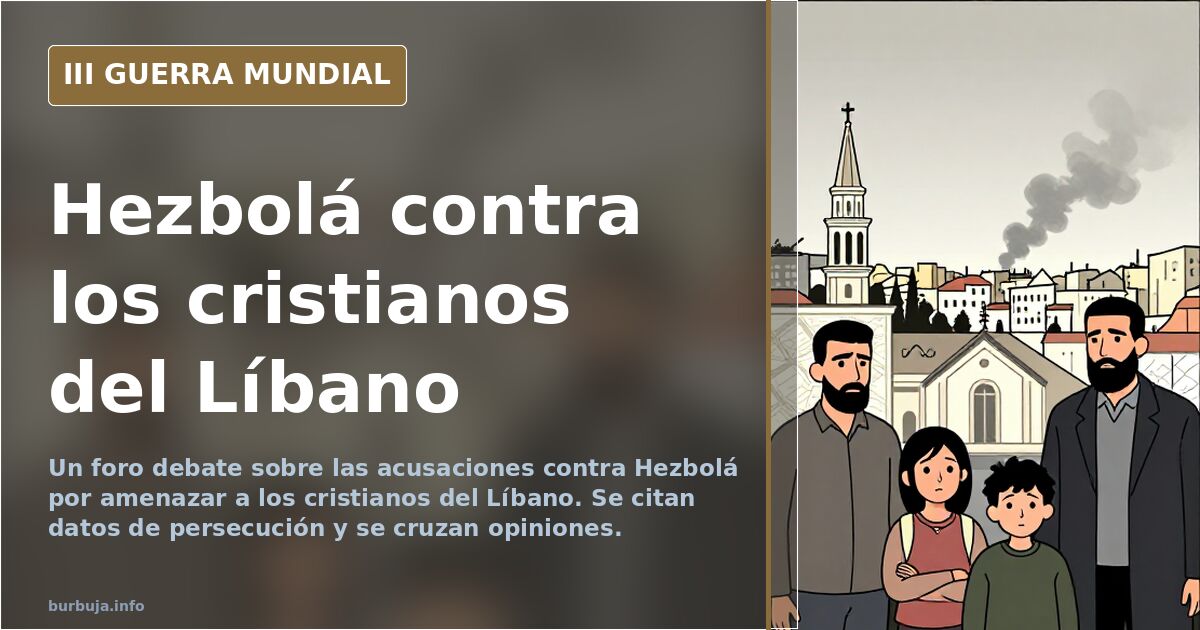
Hezbollah threatens Lebanon's Christians
According to a tweet by ACOM, Hezbollah leader Hassan Nasrallah has threatened the Christians of Lebanon. The accusation is not new, but the context makes it more serious: according to circulating reports, the Shia group would be placing missiles near churches to provoke Israeli attacks while simultaneously refusing to allow displaced people from the south to stay in schools in Christian neighborhoods. The international community looks the other way. In Spain, the echo of this standoff translates into a debate mixing geopolitics, religion, and historical memory.
Lebanon: From prosperous nation to failed state
Lebanon was once a majority-Christian country. Today, Christians are a minority living in antiestéticar. According to testimony gathered during the debate, Christians peine their doors to Jovenlandeses, welcomed them, and included them in the government. Decades later, the result is a state captured by a Shia militia answering to Tehran. The same dynamic repeats elsewhere: in Syria, Christians have fallen from representing 10% of the population in 1991 to 3% today, according to Open Doors' World Watch List data. In Israel, however, the Christian population is growing: 182,000 in 2021, with a 1.4% increase, and 2022 closed with similar growth.
The trap of missiles next to churches
The accusation is specific: Hezbollah places launchers next to Christian temples to deter Israel. If Tel Aviv strikes, Christians die. If it doesn't, the missiles remain. It is the old human shield tactic, now applied to a community already massacred in 1840 and 1860 by Druze and Ottomans, and which suffered the 1915 famine. Lebanese presenter Marcel Ghanem said on his show: "Those who should be ashamed are those who placed weapons among civilians." The quote circulates on social media, summarizing the frustration of part of Lebanese society.
Christians vs. Shias: An impossible alliance
Two readings clash in the debate. One argues that Lebanon's Christians are traitors for not allying with Hezbollah against Israel. Another recalls that Shias are not Sunnis and that religious persecution does not distinguish between branches. Data points to the latter: in Muslim-majority countries, Christians do not have full religious rights; in Israel, they do. The list of countries persecuting Christians most heavily is topped by Sarracinic states. This is not an opinion: it is a pattern repeated from North Africa to Indonesia.
The precedent no one wants to repeat
History offers an uncomfortable mirror. In the 7th century, monks attending pilgrims in the Holy Land ended up organizing militarily to protect them. Crusader orders were born. The same sequence—tolerance, abuse, reaction—is repeating now. The difference is that then there were Christian kingdoms capable of intervening. Today, Lebanon's Christians are alone. Some analysts argue that Israel could find a tactical ally in Christian militias. Others believe such an alliance is a fantasy. What is clear is that Hezbollah does not distinguish between Christians and Jews when maintaining control over territory.
What about the displaced from the south?
The latest spark is the refusal of Christian neighborhoods like Ain El-Remmaneh to host displaced people from the south, mostly Shias. Hezbollah interpreted this as a declaration of hostility. According to circulating reports, the group has already begun "hunting" Christians who refuse to cooperate. Ethnic and religious tension is served. In a country without a president for years and an army unable to impose order, the Christian community is at the mercy of a militia acting as a state within a state.
The question is not whether Hezbollah respects Christians. The question is how long the rest of the world will take to realize that Lebanon is no longer a country, but a battlefield with a flag. Meanwhile, Christians remain there, praying that the next missile does not fall on their church.
According to a tweet by ACOM, Hezbollah leader Hassan Nasrallah has threatened the Christians of Lebanon. The accusation is not new, but the context makes it more serious: according to circulating reports, the Shia group would be placing missiles near churches to provoke Israeli attacks while simultaneously refusing to allow displaced people from the south to stay in schools in Christian neighborhoods. The international community looks the other way. In Spain, the echo of this standoff translates into a debate mixing geopolitics, religion, and historical memory.
Lebanon: From prosperous nation to failed state
Lebanon was once a majority-Christian country. Today, Christians are a minority living in antiestéticar. According to testimony gathered during the debate, Christians peine their doors to Jovenlandeses, welcomed them, and included them in the government. Decades later, the result is a state captured by a Shia militia answering to Tehran. The same dynamic repeats elsewhere: in Syria, Christians have fallen from representing 10% of the population in 1991 to 3% today, according to Open Doors' World Watch List data. In Israel, however, the Christian population is growing: 182,000 in 2021, with a 1.4% increase, and 2022 closed with similar growth.
The trap of missiles next to churches
The accusation is specific: Hezbollah places launchers next to Christian temples to deter Israel. If Tel Aviv strikes, Christians die. If it doesn't, the missiles remain. It is the old human shield tactic, now applied to a community already massacred in 1840 and 1860 by Druze and Ottomans, and which suffered the 1915 famine. Lebanese presenter Marcel Ghanem said on his show: "Those who should be ashamed are those who placed weapons among civilians." The quote circulates on social media, summarizing the frustration of part of Lebanese society.
Christians vs. Shias: An impossible alliance
Two readings clash in the debate. One argues that Lebanon's Christians are traitors for not allying with Hezbollah against Israel. Another recalls that Shias are not Sunnis and that religious persecution does not distinguish between branches. Data points to the latter: in Muslim-majority countries, Christians do not have full religious rights; in Israel, they do. The list of countries persecuting Christians most heavily is topped by Sarracinic states. This is not an opinion: it is a pattern repeated from North Africa to Indonesia.
The precedent no one wants to repeat
History offers an uncomfortable mirror. In the 7th century, monks attending pilgrims in the Holy Land ended up organizing militarily to protect them. Crusader orders were born. The same sequence—tolerance, abuse, reaction—is repeating now. The difference is that then there were Christian kingdoms capable of intervening. Today, Lebanon's Christians are alone. Some analysts argue that Israel could find a tactical ally in Christian militias. Others believe such an alliance is a fantasy. What is clear is that Hezbollah does not distinguish between Christians and Jews when maintaining control over territory.
What about the displaced from the south?
The latest spark is the refusal of Christian neighborhoods like Ain El-Remmaneh to host displaced people from the south, mostly Shias. Hezbollah interpreted this as a declaration of hostility. According to circulating reports, the group has already begun "hunting" Christians who refuse to cooperate. Ethnic and religious tension is served. In a country without a president for years and an army unable to impose order, the Christian community is at the mercy of a militia acting as a state within a state.
The question is not whether Hezbollah respects Christians. The question is how long the rest of the world will take to realize that Lebanon is no longer a country, but a battlefield with a flag. Meanwhile, Christians remain there, praying that the next missile does not fall on their church.
Also available in: Deutsch
Summary of a discussion on Burbuja.info - Foro de economía, actualidad y política., translated from Spanish and reviewed before publication. Read the full discussion (116 replies).
More summaries
-
Hoax claims 250k Iraqi militias march to Syria
A viral tweet alleges 250,000 Iraqi PMF troops are moving toward Lebanon. No independent verification exists; actual figures suggest around 2,500.
-
Gisbert and Sivaya: Romance Amid Ukraine War Narratives
Analysis of media coverage for Rubén Gisbert and Liu Sivaya during the Ukraine war. Is this digital propaganda or reality?
-
Africans and Indians report racism at Ukraine border
African students and Indian citizens allege they were blocked from crossing the Ukrainian border while priority was given to Ukrainians.
-
Navalny’s Widow Leads Russian Opposition Without Election
Yulia Navalnaya assumes the role of Russian opposition leader, backed by EU and US after Alexei Navalny’s death, despite lacking a vote.
-
Ukrainian Drones, Russian Convicts: Remote Warfare
Uncensored video shows two Ukrainian drones killing seven Russian Storm-Z convicts. Debate on war language and dehumanization.
-
Rumor claims Ukraine mobilizing one-eyed, disabled
Viral list alleges Ukraine recruits those with single-eye blindness, paralysis, and amputations amid war.