
Russia grants Wagner full tactical freedom in Bakhmut
Prigozhin secures unlimited ammunition and General Surovikin as liaison, ending public feud with Russian Defense Ministry.
English · Original discussion in Spanish · Published
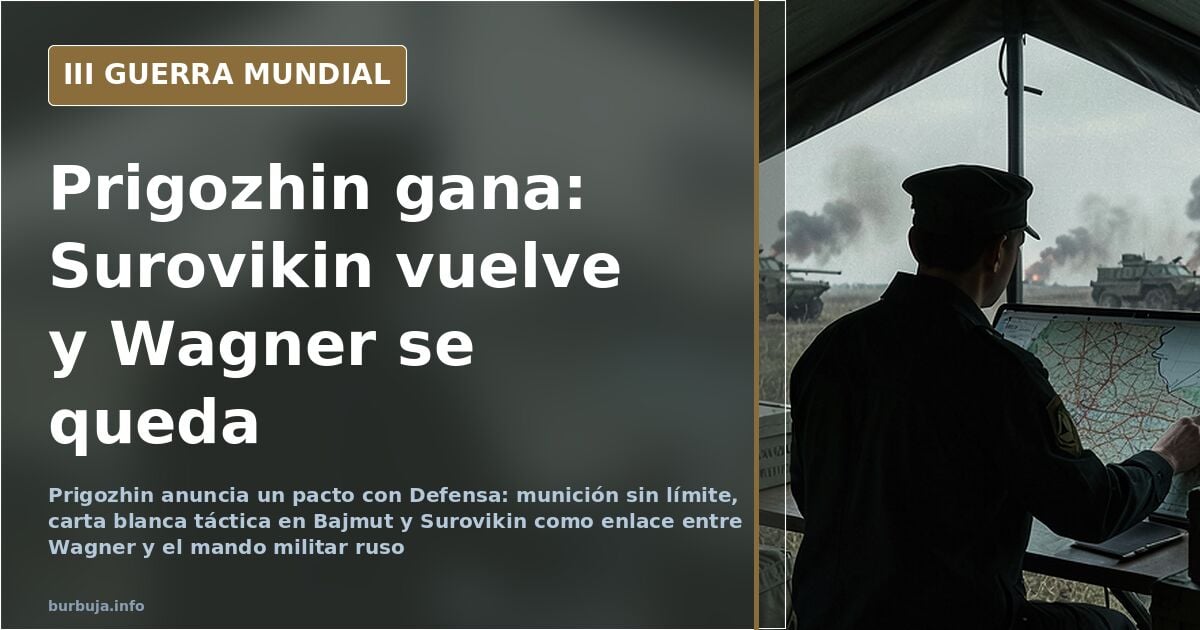
Surovikin returns as Wagner liaison while Prigozhin stays in Bakhmut
A tweet from @Russians With Attitude, reproduced at the start of this story, summarizes the power move: Prigozhin announced a new agreement with the Russian Ministry of Defense under which Wagner will receive "all supplies they need and more," have "full tactical carte blanche" on the Bakhmut front, and General Surovikin will act as the new link between the mercenary group and the ministry. A second message added that Prigozhin himself had pointed to Surovikin as the only intelligent general available. The fine print of the deal is unknown; what is clear is that ammunition is no longer an issue and that the man who ordered the withdrawal from Kherson has regained influence on the ground.
The news reads as the provisional end of an internal fight that had been leaking for weeks through videos and audio clips. Prigozhin had publicly complained about shell shortages, threatened to leave, and accused military leadership of letting his men die due to bureaucracy. Now he not only stays: he takes the general he wanted and places another loyal commander as deputy within the structure. For now, the bald one won the standoff.
What tactical carte blanche means in a town without buildings
The most striking detail of the announcement is the phrase "full tactical carte blanche" applied to Bakhmut. After months of house-to-house assault, the city is a wasteland. There are no structures left to defend or streets to preserve. On this terrain, operational freedom translates into one concrete thing: free rein to flatten whatever remains with artillery and aerial bombs, without the restrictions that previously held back certain attacks.
Some see this change in rules as a symptom that the previous command was hindering operations. The comparison circulating is that of Ugledar: there, with a general who did not authorize the use of 500-kilo FAB-500 bombs, the front stalled; after replacing him, the same type of target became rubble and the expenditure in tube artillery ammunition and lives dropped. No official explanation exists. Unofficial accounts point to personal grudges and logistics jammed by reasons no one admits.
The general who does not antiestéticar making unpopular decisions
Surovikin is not an unknown figure. His name became associated with the withdrawal from Kherson, a maneuver ridiculed at the time but which, viewed from a distance, shortened the front and avoided encirclement. Those defending his return argue it was the only sensible decision in months and that his style—bombarding everything that moves, without hesitation—is exactly what the Bakhmut front needs now.
The other reading is less friendly: Surovikin's return as liaison demonstrates that the Russian system corrects itself through open conflict, not planning. Pilingui appears in this discussion as an arbiter who lets his generals fight until one prevails, or as someone who does not control his own structure. Both things can be true at once.
Wagner stays: the twist that dismantles the retreat
The announcement comes after Prigozhin had proposed leaving Bakhmut and withdrawing from the Ukrainian conflict, with direct accusations against the Ministry of Defense for lack of supplies. The sequence—threat of departure, agreement, permanence—has left a bad taste in many mouths. The lingering question is how much was bluff and how much was real negotiation.
The practical result is that Wagner remains where it was, with better conditions. The group stops being an uncomfortable force rationed for ammunition and begins operating with formal backing, a liaison command, and a deputy commander drawn from the regular structure. Formalization has a price: it ceases to be an autonomous actor and integrates into the chain of command. Whoever gains autonomy loses independence.
The front that does not advance if they do not advance
The dependence is mutual, and that explains the urgency of the agreement. For months, the only significant advances in the sector were signed by Wagner's assault units. The regular army, with its heavy infantry divisions, has not demonstrated the same capacity for attrition in urban combat. If Wagner had left, the front would have lost its spearhead.
The unknown is what happens with the rest of the apparatus. Chechen troops, who worked well in Mariupol, do not fit equally well in an artillery attrition front. And the reserve of partial mobilization still has not been used massively, fueling suspicion that it is saved for something else. Meanwhile, artillery remains the deciding factor.
The agreement leaves three certainties and one doubt. Wagner stays, Surovikin returns, and ammunition is no longer an excuse. The doubt is whether a system that needs public conflict to function is a correction mechanism or simply disorder that sometimes works. Bakhmut will not clarify this: there is nothing left to conquer, only terrain to flatten.
Also available in: Deutsch
Summary of a discussion on Burbuja.info - Foro de economía, actualidad y política., translated from Spanish and reviewed before publication. Read the full discussion (68 replies).
More summaries
-
Wagner flags Bakhmut as NATO avoids direct combat
Wagner raises its flag in Bakhmut, sparking debate on ground control, NATO's role, and Western military aid.
-
Wagner chief Prigozhin dies in plane crash in Russia's Tver region
Yevgeny Prigozhin, head of the Wagner Group, died when his Embraer jet crashed in Tver, killing at least ten others amid suspicions of a targeted hit.
-
Russia Offers May Victory Day Truce, Threatens Kyiv
Russia declares a unilateral ceasefire for May 8-9, 2026, but threatens to destroy Kyiv if Ukraine attacks during the parade.
-
Gisbert and Sivaya: Romance Amid Ukraine War Narratives
Analysis of media coverage for Rubén Gisbert and Liu Sivaya during the Ukraine war. Is this digital propaganda or reality?
-
Ukrainian soldier throws ring in mud, story unverified
A Ukrainian soldier discards a ring in the mud. The gesture is real, but the surrounding narrative lacks verification.
-
Russian Terminator and 30mm Fire Sweep House
Armored vehicle fires 30mm tracer rounds at a home. Video confirms neither occupants nor shooter.