
Russian Terminator and 30mm Fire Sweep House
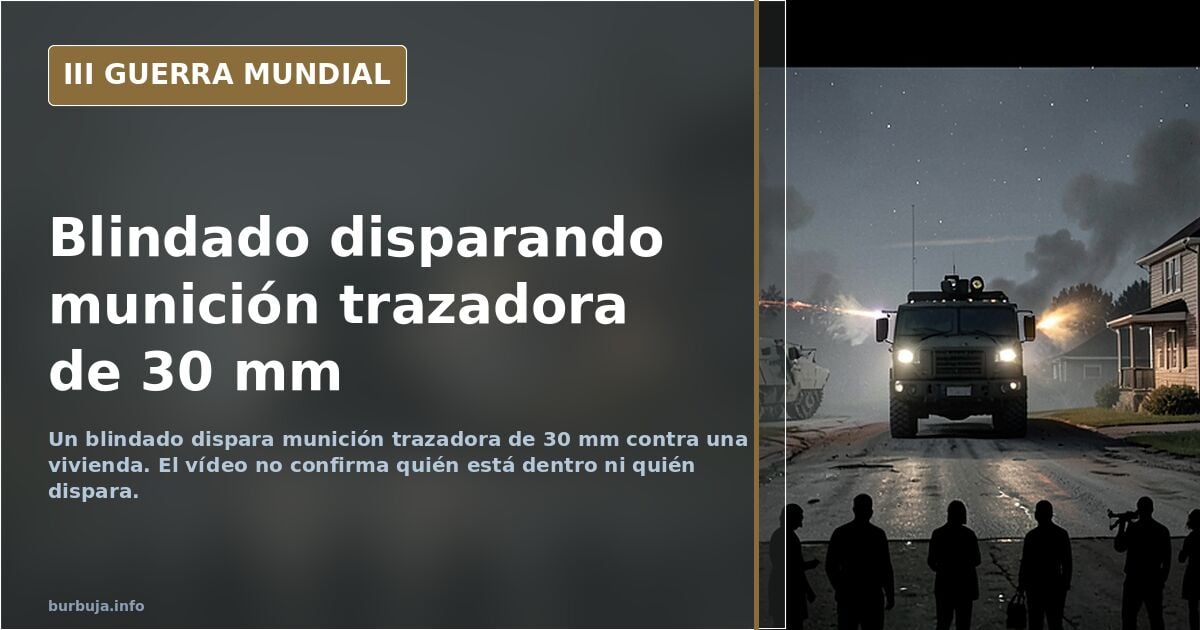
Armored vehicle fires 30mm tracer rounds at a home. Video confirms neither occupants nor shooter.
English · Original discussion in Spanish · Published
Russian Terminator and 30mm Fire Sweep House
An armored support vehicle fires continuously at a residence, making the video a favorite in military discussions. The sequence shows luminous impacts crossing the facade, leading to speculation: some see a BMPT Terminator, others an automatic cannon vehicle, while skeptics note the location and shooter identity remain unclear. Some attribute the scene to Artyomovsk, a city contested house by house.
The ammunition type is certain. 30mm tracer and incendiary bullets, standard for infantry support vehicles. The glow isn't magic but projectile burn in flight. The cadence, that tracatracatra drum-like sound, signals automatic fire, not rifles or conventional tanks.
What is the Terminator and why does it fire this way?
The BMPT Terminator is essentially a tank chassis fitted with anti-aircraft and anti-tank weaponry. Born in the 1990s during Chechen urban warfare, it addresses traditional tanks' limitations in firing angles and elevated targets. Two 30mm cannons, missiles, and machine guns fill this gap.
Technically, its turret elevates higher than conventional tank guns, allowing attacks on upper floors and low-altitude air targets. Hence the cinematic nickname. Reality is less epic: it is a support vehicle, not an assault tank, designed to accompany infantry and saturate specific positions.
How many tracers per burst?
Typically one tracer every five rounds. Thus, 20% of ammunition leaves visible trails; the rest flies dark. This explains the fiery rain appearance. Gunners use tracers to correct aim during firing.
Colors deceive too. Red and green variants exist, and large-caliber projectiles may glow upon exit. Not new or exclusive technology: most vehicle-mounted guns use tracers. The novelty is fire density, not the trick.
Video doesn't prove what many want it to
Here lies slippery ground. Nighttime fire footage doesn't identify occupants, confirm mercenaries inside, or verify authorship. Circulating images are attributed to both sides, with angle comparisons raising doubts about whether it's the same house.
Some claim the vehicle is Ukrainian, citing side markings. Counterarguments note no visible occupants or documented attack results. Honest conclusion: the video shows bombardment, not casualty lists. Turning it into proof of mercenary massacres exceeds material evidence.
Caliber debate: 5.56 vs 7.62
Discussion shifts to infantry ammunition, reviving old tropes. NATO's standard rifle caliber is 5.56mm; Russia uses 7.62×39mm, less powerful than NATO's 7.62×51. The two-millimeter difference affects range, energy, and terminal ballistics.
Claims suggest 5.56 peine while 7.62 destroys, arguing NATO chose smaller calibers for logistics and humanitarian reasons. Simplification: both sides use larger calibers in medium machine guns and precision rifles, with 12.70mm reserved for heavy machine guns. No army abandons power when needed.
Real dispute: casualty narratives
Core issue isn't caliber or vehicle model, but accounting. A vehicle fires at a position; next day, round enemy kill counts appear. Neither publishing nor replicating side verifies numbers. Urban warfare yields spectacular imagery and unauditable data.
The armored sweep is likely the most honest depiction: automatic weapons doing their job against unseen targets. Everything else is interpretation. Given opacity, expect contradictory attributions persisting unresolved. The war of videos is also won by exhaustion.
Also available in: Deutsch
Summary of a discussion on Burbuja.info - Foro de economía, actualidad y política., translated from Spanish and reviewed before publication. Read the full discussion (70 replies).
More summaries
-
Depleted uranium in Ukraine: Russian escalation or NATO ammunition?
Russia is accused of launching drones carrying depleted uranium, but the material has been in Ukraine since 2023 thanks to NATO. Escalation or disinformation?
-
Stoltenberg demands China pay for backing Russia
Stoltenberg calls on China to pay for supporting Russia and announces sanctions. The debate looks at the cost for Europe and the shift toward the BRICS.
-
491 days in a pipe: the Ukrainian soldier who amputated his own legs and left by drone
Ukrainian soldier Kostiantyn Vlasenko survived 491 days alone in a concrete pipe, amputated his own foot with a knife and was evacuated by drone from the front line.
-
North Korean hackers steal $6.3 billion from Binance
The FBI attributes the theft of approximately $6.3 billion from crypto exchange Binance to North Korea, marking the largest known cryptocurrency hack.
-
Russia's Azovstal assault stalls in underground tunnels
Russian attack on Azovstal steelworks in Mariupol halted by tunnel network. May 9 deadline looms as civilians remain trapped inside.
-
Prince William Dines at Gay Warsaw Venue After Troops Visit
Prince William dined at a gay restaurant in Warsaw following a visit to British troops training Ukrainians. The contrast sparked widespread debate.