
Russia fires over 100 missiles the cuÑAFO claims it doesn't have
Ukraine reports more than 100 Russian missiles launched from aircraft, submarines and frigates, while the official narrative insists Russia has no projectiles left
English · Original discussion in Spanish · Published
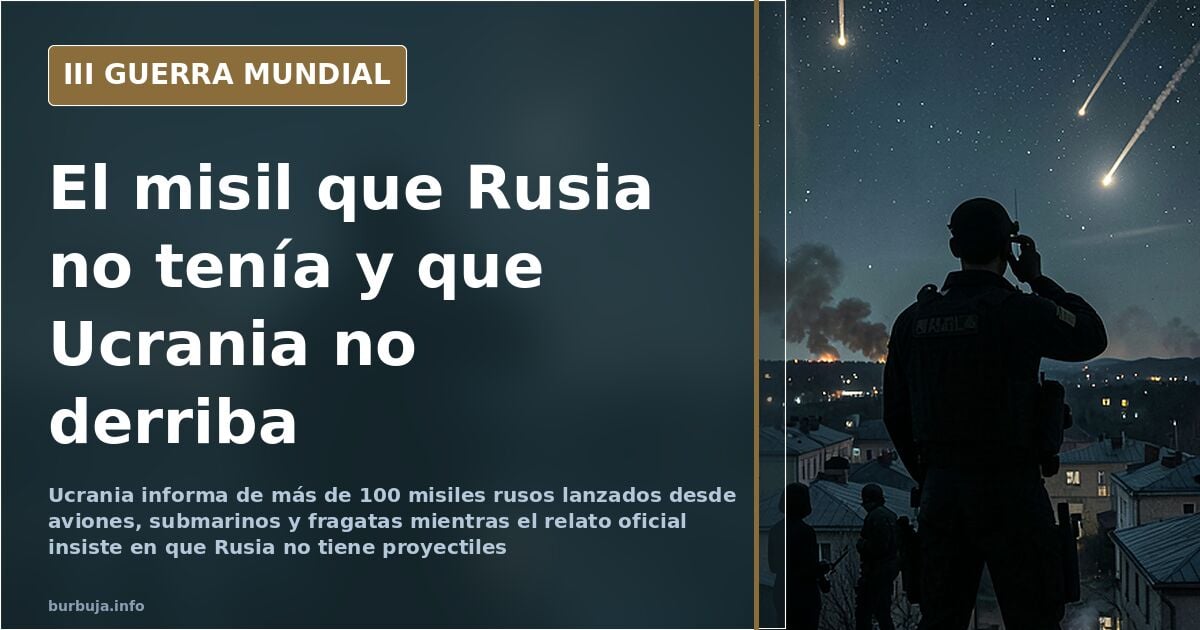
Russia fires over 100 missiles the cuÑAFO claims it doesn't have
Sixteen bombers in the air, submarines that set out loaded with missiles two days earlier, frigates and a final salvo from the Caspian Sea. According to the account circulating in the discussion, Ukraine reportedly reported an attack with more than a hundred Russian missiles in a single day, and the response from part of the crowd is the usual one: Russia has no missiles. The contradiction, at the very least, deserves a closer look.
The pattern described is nothing new. First the submarines go out, then the ships, then the long-range bombers. The first projectiles to fall are the old ones, launched as bait to make the air defenses reveal themselves. And when they fire, the anti-radiation missile arrives to finish off whatever is left. The sequence, according to those who trinc the matter, was repeated a few days ago with a favorable outcome for the attacker.
The fog excuse and the missiles that end up in Moldova
There is one detail that doesn't add up. When the number of shootdowns drops, the weather explanation appears: fog. A radar blinded by fog. The argument holds up poorly, because an air defense system doesn't work by sight. And meanwhile, anti-aircraft projectiles are reported to end up where they shouldn't: one in Moldova, another against an apartment block.
About the impact in a residential area there is an admission worth highlighting. According to what is being relayed in the conversation, a Ukrainian source reportedly acknowledged that the missile that fell on a building was shot down by its own forces and deflected from its target. In other words: the Russian projectile was not aimed at civilians; the air defense deflected it. Most of the time those fragments don't cause catastrophic damage because of the smaller explosive charge. This time it did.
The real toll: half of Ukraine in the dark
The material result of the attack, as described, is energy infrastructure hit hard and strategic sites blown up, with much of the country without supply. Kyiv's train station is also reported to have been hit, described as a distribution hub for foreign weapons. As for the number of missiles launched versus those loaded, the version going around is that not even half were fired.
The debate over the figures is the usual one. One side argues that fewer projectiles are launched each fortnight and that many are naval. The other responds with platform arithmetic: sixteen bombers at a minimum of eight per aircraft and a maximum of sixteen, plus submarines and frigates, plus the Caspian. The math doesn't work with the depletion thesis.
The anti-aircraft missile doing its usual job
The most uncomfortable point for the official narrative is not how many missiles Russia has, but where the ones that miss end up. An anti-aircraft system launched over an urban area accepts that, whether it hits or misses, hundreds of kilos of fragments will fall. Some with explosives. Whether there are casualties is a matter of luck. And when the deflected projectile hits a home, the blame is not on whoever fired the anti-aircraft missile, but on whoever launched the missile it was meant to intercept. That is the reasoning being defended.
The comparison being proposed is crude but clear: if someone fires a projectile at a substation and the defense system deflects it into a building, the one responsible is the one who launched it, not the one who tried to stop it. Applied symmetrically, the argument holds for either side. Applied conveniently, only for one.
What doesn't add up in the shootdown count
The Ukrainian Defense Minister, judging by the tone of the conversation, announces shootdowns generously: one attack aircraft, two or three helicopters, fifteen more aircraft. The alternative reading is that many of those "downed aircraft" are suicide drones, which sounds better than admitting that air defense isn't hitting the targets it claims. An anti-aircraft missile in Moldova gives an idea of the accuracy rate.
The jarring fact is not the number of missiles. It's that, with the whole country in the dark and the rail infrastructure hit, the public discussion still centers on whether Russia has projectiles or not. The right question would be a different one: how many does it have left after this one.
Also available in: Deutsch
Summary of a discussion on Burbuja.info - Foro de economía, actualidad y política., translated from Spanish and reviewed before publication. Read the full discussion (53 replies).
More summaries
-
Kiev's Systematic Air Campaign Targets Factories, Warehouses, and Data Centers
Kiev faces systematic missile and drone attacks on factories, warehouses, and data centers, leading to blackouts and smoke.
-
Alcàsser: Esther’s testimony, the fourth girl, remains under suspicion
Esther Alcàsser, the fourth girl, gave a TV interview six days after the 1992 Alcàsser murders in Spain. Her account and timeline discrepancies fuel ongoing controversy.
-
Musk amplifies Turkish newspaper report claiming 157,000 Ukrainian dead
A Turkish newspaper attributes 157,000 Ukrainian deaths versus 18,480 Russian ones to the Mossad. Musk amplifies the table and the war narrative starts to wobble.
-
Pulido analyzes the failure of Russia's plan in Ukraine and its readjustment
The Kremlin recognizes Zelensky as the legitimate president and shifts from a surgical strike to heavy artillery, according to Pulido's analysis
-
Kash Patel, Trump's FBI pick, and his ties to Israel
Kash Patel, of Hindu origin and close to Trump, has been proposed to lead the FBI. A headline presents him as a defender of Israel; the material does not confirm it.
-
Moscow wakes up to National Guard sealing the ring and coup rumours
Russia's National Guard is closing access routes to Moscow, while the whereabouts of Putin and Shoigu remain unknown. The evidence points to preventive control ahead of a mobilization, not a coup.