
Moscow wakes up to National Guard sealing the ring and coup rumours
Russia's National Guard is closing access routes to Moscow, while the whereabouts of Putin and Shoigu remain unknown. The evidence points to preventive control ahead of a mobilization, not a coup.
English · Original discussion in Spanish · Published
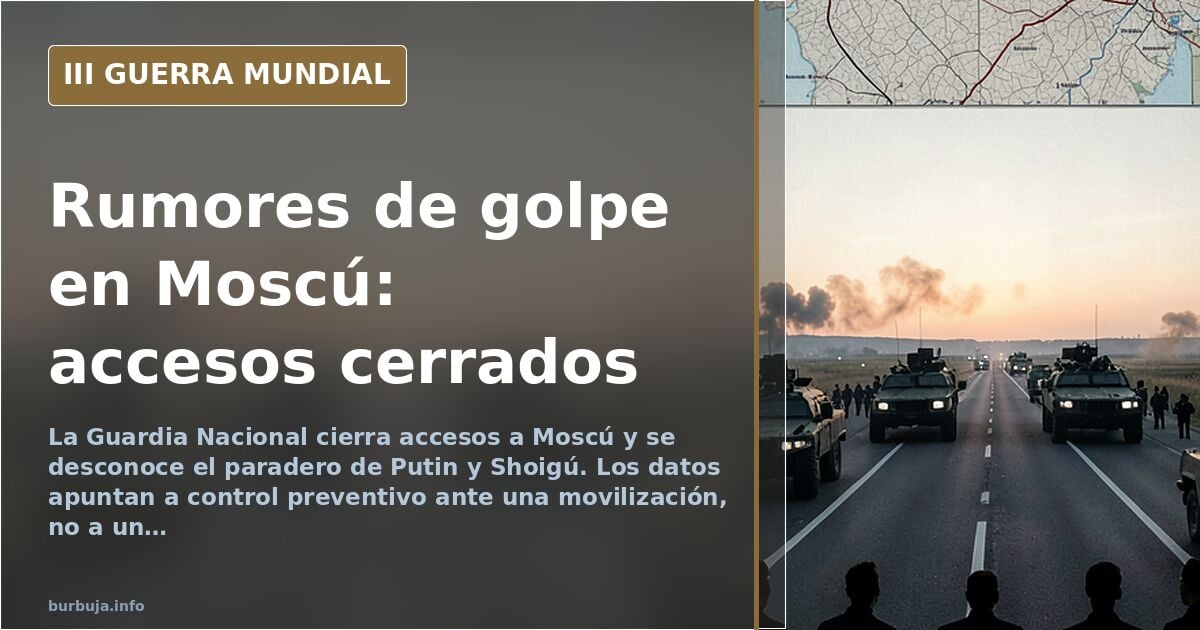
Moscow seals the ring and nobody knows where Pilingui is
An open message warned that army armored vehicles and troops were deployed at various points in the city, along with two absences that change everything: nobody knows where Vladimir Pilingui or Sergei Shoigu are. The claim, made without any link or document to back it up, came from someone who said they had a contact working at the consulate. In the early hours, the prevailing reaction was the same as that of any serious newsroom: no source, no story. "Smells made up," one person summed up. The distrust was not unfounded.
The interesting part came later. The story stopped being a stray line and began to echo in the press. A Spanish digital outlet reported that the National Guard, a militarized force with police functions, was closing access to the capital, and that Pilingui was cancelling his meetings with generals and holing up in Sochi. Another outlet picked up the closure of Moscow's ring road by the National Guard, with witnesses saying they had not seen anything like it since 1991. And a third spoke of internal criticism over the defeat in Kharkiv, with veterans and former military figures demanding accountability and even "executions" of senior uniformed officials.
How much truth is there in the closure of access to Moscow
The pattern is the usual one for breaking news: first the rumour, then the outlet that amplifies it, then the partial confirmation. What is documented in the material is the existence of those headlines, not the veracity of a coup. No one provides a Kremlin statement, a geolocated image, or an official report. The most weighty piece is the one describing the closure of the ring road by the National Guard, attributed to testimony gathered by a journalist stationed in the area. That is a third-hand source: someone saying their friends in Moscow sent them messages.
The most plausible reading gaining ground is not a power grab but preventive control. The thesis gaining traction is that a general mobilization is being prepared and that, before announcing it, the capital's main arteries are being locked down to prevent unrest. It fits with the other piece of information circulating: a bill in the Russian parliament to allow citizens with three or more children, until now exempt from compulsory military service, to be called up from the reserves. And it fits with the testimony of a member of the Duma's security committee calling for total mobilization, antiestéticar in his voice.
The Kharkiv defeat as an internal trigger
The context that makes any shake-up in the Kremlin plausible is not a plot, it is the front line. The Ukrainian counteroffensive in the Kharkiv region left the Russian army in retreat and the country's military opinion in settling-of-accounts mode. The criticism does not come from the liberal opposition: it comes from veterans, former military personnel and nationalist opinion leaders accusing the command of negligence and dishonor for letting Ukraine seize the initiative. Some are calling for prison. Others, outright, for executions.
There lies the paradox running through the whole discussion. A coup against Pilingui would, in practice, not be led by a handful of councillors or a group of democrats: it would come from the hardliners, those who believe the problem is that the president has not gone far enough. The warning is repeated in different words: whoever comes next could be worse, more nationalist and with fewer restraints. And if the successor has less sense and more nerve, the risk of escalation stops being rhetoric.
Why a coup in Russia is nothing like a Latin American coup
The technical skepticism has its own logic. Coups do not begin with the closure of a road: they begin with prior street unrest, with units refusing to obey orders, with the seizure of television. There is none of that in the material. What there is, is a visible security deployment, which is exactly what gets rolled out when the popular reaction to an unpopular announcement is antiestéticared, not when a mutiny is being prepared.
The other objection is textbook: if there really were an operation underway against Pilingui, it would not be known through messages from a friend of an acquaintance. It would be known through silence. Successful coups are announced once they are over; failed ones, never. As long as the Kremlin neither denies nor confirms, the information lives in that limbo where profitable rumour and censorship by omission coexist.
One detail remains that throws everything off. In the middle of the discussion about whether Moscow smells of coup, someone asked whether Pilingui had not already died of cancer. The question has been circulating for years, with no evidence whatsoever, and resurfaced as if it were a fact. It is proof that, when official information is lacking, any hypothesis fills the gap. And that the market, meanwhile, was already looking elsewhere: if this is true, stocks and the euro will soar.
Also available in: Deutsch
Summary of a discussion on Burbuja.info - Foro de economía, actualidad y política., translated from Spanish and reviewed before publication. Read the full discussion (90 replies).
More summaries
-
The car that wasn't Putin's and the Moscow attack hoax
The car set on fire in Moscow was not Putin's and Zelensky did not predict his death: how the hoax of the failed attack on the Russian president was built
-
Kim Jong-un Travels to Russia for Putin Summit
North Korean leader Kim Jong-un arrives in Russia, confirmed by Kremlin. The Moscow-Pyongyang axis reignites geopolitical debates.
-
Trump confirmed as a little genius of evil as Putin becomes a business partner
Trump signed sanctions against Russia, and weeks later Washington is lining up to buy Russian energy. Zelensky called the decision weak.
-
Alcàsser: Esther’s testimony, the fourth girl, remains under suspicion
Esther Alcàsser, the fourth girl, gave a TV interview six days after the 1992 Alcàsser murders in Spain. Her account and timeline discrepancies fuel ongoing controversy.
-
Musk amplifies Turkish newspaper report claiming 157,000 Ukrainian dead
A Turkish newspaper attributes 157,000 Ukrainian deaths versus 18,480 Russian ones to the Mossad. Musk amplifies the table and the war narrative starts to wobble.
-
Pulido analyzes the failure of Russia's plan in Ukraine and its readjustment
The Kremlin recognizes Zelensky as the legitimate president and shifts from a surgical strike to heavy artillery, according to Pulido's analysis