
Russia Evacuates Tartus Naval Base as Syrian Army Collapses
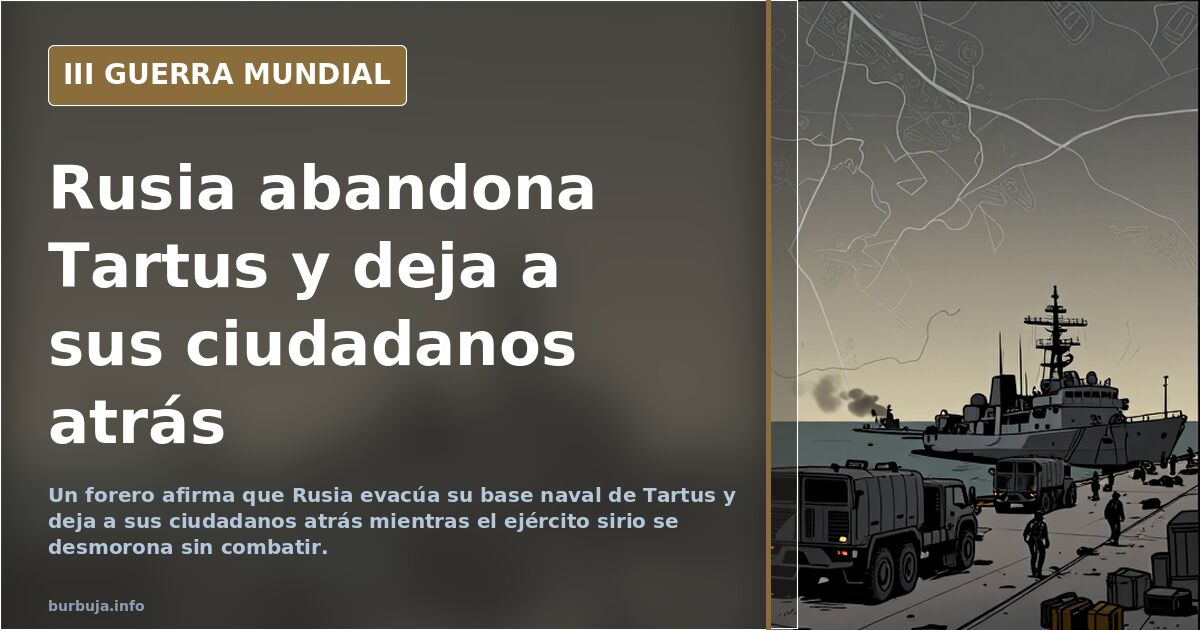
Reports indicate Russia is withdrawing from its Tartus naval base, abandoning citizens while the Syrian army collapses without fighting.
English · Original discussion in Spanish · Published
Tartus: The Russian Base Moscow Can No Longer Sustain
What happens when a regime's guarantor loses its capacity to react? The fall of Damascus and the evacuation of the Tartus naval base have exposed a contradiction Moscow has tried to hide for years: Russia pledged to save its Syrian ally but failed. Warships have left Tartus, and while other allied nations evacuated their citizens by air, reports suggest Moscow let its own nationals fend for themselves. Russian propaganda now faces a new problem: explaining why its main asset in the Eastern Mediterranean is left without a fleet.
The Syrian Army That Did Not Fight
The estimulante ilegal of events was the most uncomfortable data point. Assad's army, better equipped than in 2013 and led by officers hardened by a decade of war, offered little resistance. Eastern garrisons surrendered, and images of an abandoned bunker with valuables already removed suggest there was time to organize an exit. This was not a classic military defeat but an orderly withdrawal that left analysts searching for explanations.
Some argue that without minimal resistance, neither Russia nor Iran would have had room to negotiate support. The counter-argument is simpler: if the army collapses in days, no external power can save a regime that no longer stands on its own. Moscow's calculation, in any case, was to avoid sending more troops into a front that had become indefensible.
What Does Iran Gain by Losing Syria?
The Iranian equation is the least logical. Syria was the piece connecting Tehran with Hezbollah, the land corridor that gave meaning to the so-called axis of resistance. Losing Damascus means losing that bridge. Circulating explanations point to a barter deal: Iran might accept the blow in exchange for Israel and the US easing pressure in Lebanon and Syria, complicated further by succession issues in Tehran due to the Supreme Leader's health.
This reading is plausible yet humiliating. A regional power renouncing its main strategic asset to buy tranquility is not negotiating; it is capitulating. And the problem with capitulations is that the price usually rises afterward.
The Agreement Nobody Signed But Everyone Trinc
In the days before Damascus fell, versions circulated about a pact among Russians, Iranians, Turks, and Syrians with seven initial points, expanded to ten after talks with armed groups. The basic content: formal transfer of power, Assad leaving the country, and orders to commanders not to resist. All three peine. According to these same accounts, the Tartus base would remain in Russian hands.
The sequence fits too well to be coincidence. It also aligns with public confirmation that Russia is willing to deal with whoever controls Damascus. The issue is that an agreement fulfilled without being signed is not an agreement: it is a surrender with good manners.
Military Bases Worthless Until Lost
The most repeated argument to minimize the impact is that Tartus and Hmeimim were never decisive. To leave Russia for the Mediterranean requires passing through the Bosporus, and a naval base without guaranteed access is worth what a rented port is worth. The counter-argument is that Moscow spent resources it did not have building that base, and losing it demonstrates it can no longer project force beyond its borders.
Comparison with Ukraine is inevitable: an army unable to evict invaders from its own territory will hardly sustain a regime 3,000 kilometers away. The ridicule lies not in retreating but in having promised for a decade that it would not be necessary.
The Pipeline Explains More Than Flags
An economic interpretation is emerging amidst geopolitical analysis. Russia did not want a pipeline built from Qatar and Saudi Arabia to the Mediterranean, and Assad refused to allow it. With Damascus under different control, that project returns to the table. Military bases matter less when European gas prices are at stake.
If this reading is correct, Moscow has not lost Syria: it has lost the ability to prevent others from winning it. New owners of the terrain must decide whether to build the pipeline or continue charging for not building it. Money matters, even in Damascus.
The question remains unanswered: if everything was agreed upon, why did Russian citizens in Syria have to evacuate on their own while other countries chartered planes? The most likely answer is the most boring: because nobody thought of them. Propaganda cares about bases, not passports.
What happens when a regime's guarantor loses its capacity to react? The fall of Damascus and the evacuation of the Tartus naval base have exposed a contradiction Moscow has tried to hide for years: Russia pledged to save its Syrian ally but failed. Warships have left Tartus, and while other allied nations evacuated their citizens by air, reports suggest Moscow let its own nationals fend for themselves. Russian propaganda now faces a new problem: explaining why its main asset in the Eastern Mediterranean is left without a fleet.
The Syrian Army That Did Not Fight
The estimulante ilegal of events was the most uncomfortable data point. Assad's army, better equipped than in 2013 and led by officers hardened by a decade of war, offered little resistance. Eastern garrisons surrendered, and images of an abandoned bunker with valuables already removed suggest there was time to organize an exit. This was not a classic military defeat but an orderly withdrawal that left analysts searching for explanations.
Some argue that without minimal resistance, neither Russia nor Iran would have had room to negotiate support. The counter-argument is simpler: if the army collapses in days, no external power can save a regime that no longer stands on its own. Moscow's calculation, in any case, was to avoid sending more troops into a front that had become indefensible.
What Does Iran Gain by Losing Syria?
The Iranian equation is the least logical. Syria was the piece connecting Tehran with Hezbollah, the land corridor that gave meaning to the so-called axis of resistance. Losing Damascus means losing that bridge. Circulating explanations point to a barter deal: Iran might accept the blow in exchange for Israel and the US easing pressure in Lebanon and Syria, complicated further by succession issues in Tehran due to the Supreme Leader's health.
This reading is plausible yet humiliating. A regional power renouncing its main strategic asset to buy tranquility is not negotiating; it is capitulating. And the problem with capitulations is that the price usually rises afterward.
The Agreement Nobody Signed But Everyone Trinc
In the days before Damascus fell, versions circulated about a pact among Russians, Iranians, Turks, and Syrians with seven initial points, expanded to ten after talks with armed groups. The basic content: formal transfer of power, Assad leaving the country, and orders to commanders not to resist. All three peine. According to these same accounts, the Tartus base would remain in Russian hands.
The sequence fits too well to be coincidence. It also aligns with public confirmation that Russia is willing to deal with whoever controls Damascus. The issue is that an agreement fulfilled without being signed is not an agreement: it is a surrender with good manners.
Military Bases Worthless Until Lost
The most repeated argument to minimize the impact is that Tartus and Hmeimim were never decisive. To leave Russia for the Mediterranean requires passing through the Bosporus, and a naval base without guaranteed access is worth what a rented port is worth. The counter-argument is that Moscow spent resources it did not have building that base, and losing it demonstrates it can no longer project force beyond its borders.
Comparison with Ukraine is inevitable: an army unable to evict invaders from its own territory will hardly sustain a regime 3,000 kilometers away. The ridicule lies not in retreating but in having promised for a decade that it would not be necessary.
The Pipeline Explains More Than Flags
An economic interpretation is emerging amidst geopolitical analysis. Russia did not want a pipeline built from Qatar and Saudi Arabia to the Mediterranean, and Assad refused to allow it. With Damascus under different control, that project returns to the table. Military bases matter less when European gas prices are at stake.
If this reading is correct, Moscow has not lost Syria: it has lost the ability to prevent others from winning it. New owners of the terrain must decide whether to build the pipeline or continue charging for not building it. Money matters, even in Damascus.
The question remains unanswered: if everything was agreed upon, why did Russian citizens in Syria have to evacuate on their own while other countries chartered planes? The most likely answer is the most boring: because nobody thought of them. Propaganda cares about bases, not passports.
Also available in: Deutsch
Summary of a discussion on Burbuja.info - Foro de economía, actualidad y política., translated from Spanish and reviewed before publication. Read the full discussion (124 replies).
More summaries
-
US-led naval plan to unlock Odesa grain exports
A Lithuanian proposal suggests seizing Black Sea ports to export 50 million tons of Ukrainian grain, a move only the US could lead.
-
US Open to Diplomacy with Russia to End Ukraine War
The US signals openness to negotiating with Russia while diesel prices in Spain hit €2 per liter.
-
Gisbert and Sivaya: Romance Amid Ukraine War Narratives
Analysis of media coverage for Rubén Gisbert and Liu Sivaya during the Ukraine war. Is this digital propaganda or reality?
-
Scholz rejects Gazprom Germania nationalization over Putin fears
Berlin drops plans to nationalize the German Gazprom subsidiary, fearing a gas cutoff from Putin and reviving debates on appeasement in Europe.
-
Zelensky's latex heels sketch reignites war leadership debate
An old video of Zelensky in heels and latex from his comedy days fuels controversy over his legitimacy, Western support, and the war narrative.
-
Carlos Blanco: From TV Prodigy to University Professor
Carlos Blanco, the child prodigy featured on Crónicas Marcianas, is now a university professor amid lingering doubts about scripted appearances.