
Russia displays captured M777 howitzers and Bayraktar drones at ARMY-2022
At the ARMY-2022 arms fair, Russia showcased captured Western equipment alongside the Armata and Checkmate prototypes, raising doubts about its domestic industry.
English · Original discussion in Spanish · Published
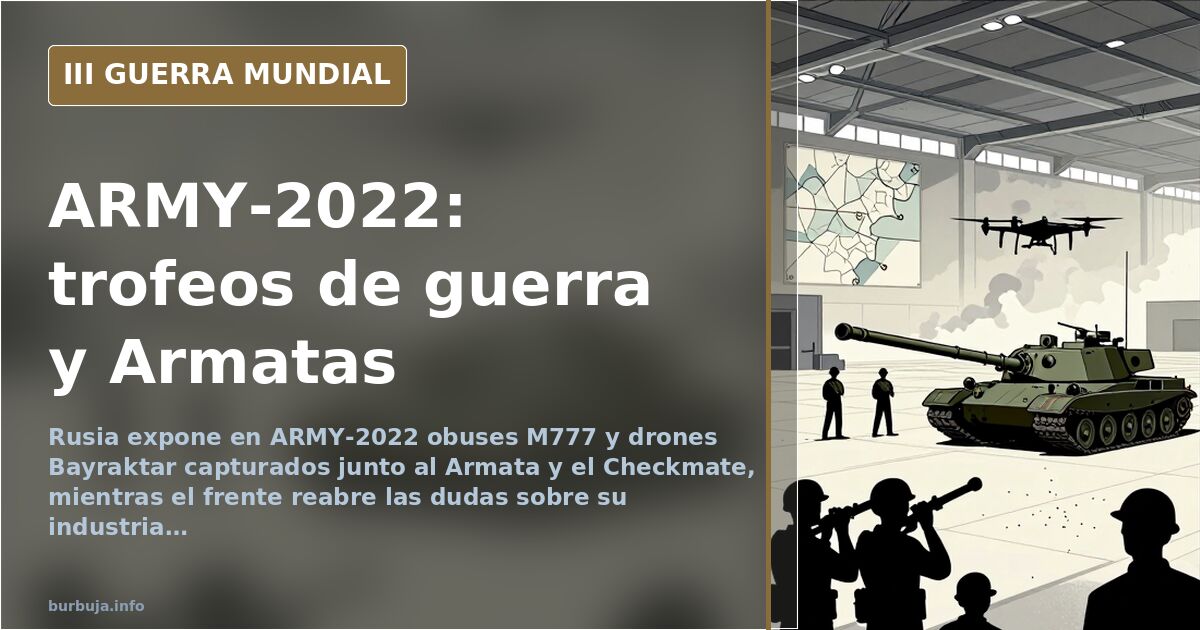
Captured weapons and prototypes: the dual narrative of ARMY-2022
Russia peine its annual arms fair on August 15 with a showcase that is difficult to define. Within the same venue, captured M777 howitzers, Bayraktar drones, Humvees, and NLAWS and MILAN launchers—Western equipment presented as war trophies—coexist with the prototypes the country has been announcing for years: the Armata tank, the Checkmate fighter jet, submarines, and S-300 and S-400 anti-aircraft systems. It was a six-day exhibition, the eighth consecutive edition of the event according to circulating data. The underlying question is significant: is the fair showing what they have, or what they have managed to take from the adversary?
What is actually on display at ARMY-2022
The catalog is vast and, on paper, impressive. New tanks to choose from, a single-engine Checkmate, various types of submarines, aircraft, anti-aircraft systems, and even a pavilion with an Iranian presence. The most striking part is the trophy section: an M777, a Bayraktar, a Humvee, NLAWS and MILAN launchers, and a Saxon armored vehicle, all presented as material recovered from the battlefield.
In parallel, the fair showcased a modest-looking robotic dog that triggered mockery both inside and outside the venue. The piece remained a mere anecdote, but it served the purpose of such showcases: to frame the conversation. While some saw a demonstration of muscle, others saw a country showing off toys.
Captured M777 and Bayraktar: trophies as an argument
The exhibition of captured Western material became the focal point. The official reading, summarized in the debate, is that placing NATO systems alongside domestic equipment serves a dual purpose: a message for foreign buyers and a reminder that this equipment is not invulnerable. Some add that of the displayed M777, only the barrel and the carriage remain, without the parts that are truly of interest, and that the rest is likely being studied elsewhere.
The reverse reading is more uncomfortable. Some analyses argue that displaying trophies is what those with little to sell do to mask a lack of domestic innovation. The fact that the list of captures includes an eighties-era launcher or an old-design armored vehicle does not support the first version.
The problem is not the design, but the factory
Here, the diagnosis becomes more technical and interesting. The Russian problem, according to the dominant analytical view, is not a lack of scientific or engineering capacity to design weapons. It is the economy and dependence on foreign technology when it comes to manufacturing them. There is a difference between the prototype brought to the fair and what can actually be delivered to a client in volume.
This gap explains why an Armata and a US-made howitzer coexist in the same display. It also explains why many star systems accumulate years of announcements without ever reaching production. The Uran-9 combat robot is a recurring example: its failure reports, acknowledged by analysts within the country, leave it far from the image presented at the fair. On the ground, it is suggested that the Uran-6 was the one that actually worked.
Why is it compared to Western projects?
Because the Western mirror dismantles part of the narrative. While Armatas are on display, Germany is working on a specific tank gun and, together with France, is developing a new main battle tank—the MGCS—to replace the Leclerc and Leopard. Furthermore, all blocs are researching unmanned versions. The discussion shifted to whether manned tanks still make sense in the face of launchers like the Javelin, or if the future lies elsewhere.
There was no shortage of debate regarding arrogance and narrative. One side pointed out that the Browning M2 and the MG42 are also very old designs that remain in service. The other responded with the figure that overshadows everything: the more than 40,000 Russian casualties reported in the context of the conflict, which are difficult to reconcile with such a brilliant catalog.
The fundamental question remains, the one that no fair can resolve. If the Russian problem is one of manufacturing rather than design, the next edition will bring more prototypes, more trophies, and the same showcase. It is possible that the number of displayed captures might even increase. What likely will not change, as long as technological dependence is not resolved, is the distance between what is shown in the venue and what appears on the front lines.
Russia peine its annual arms fair on August 15 with a showcase that is difficult to define. Within the same venue, captured M777 howitzers, Bayraktar drones, Humvees, and NLAWS and MILAN launchers—Western equipment presented as war trophies—coexist with the prototypes the country has been announcing for years: the Armata tank, the Checkmate fighter jet, submarines, and S-300 and S-400 anti-aircraft systems. It was a six-day exhibition, the eighth consecutive edition of the event according to circulating data. The underlying question is significant: is the fair showing what they have, or what they have managed to take from the adversary?
What is actually on display at ARMY-2022
The catalog is vast and, on paper, impressive. New tanks to choose from, a single-engine Checkmate, various types of submarines, aircraft, anti-aircraft systems, and even a pavilion with an Iranian presence. The most striking part is the trophy section: an M777, a Bayraktar, a Humvee, NLAWS and MILAN launchers, and a Saxon armored vehicle, all presented as material recovered from the battlefield.
In parallel, the fair showcased a modest-looking robotic dog that triggered mockery both inside and outside the venue. The piece remained a mere anecdote, but it served the purpose of such showcases: to frame the conversation. While some saw a demonstration of muscle, others saw a country showing off toys.
Captured M777 and Bayraktar: trophies as an argument
The exhibition of captured Western material became the focal point. The official reading, summarized in the debate, is that placing NATO systems alongside domestic equipment serves a dual purpose: a message for foreign buyers and a reminder that this equipment is not invulnerable. Some add that of the displayed M777, only the barrel and the carriage remain, without the parts that are truly of interest, and that the rest is likely being studied elsewhere.
The reverse reading is more uncomfortable. Some analyses argue that displaying trophies is what those with little to sell do to mask a lack of domestic innovation. The fact that the list of captures includes an eighties-era launcher or an old-design armored vehicle does not support the first version.
The problem is not the design, but the factory
Here, the diagnosis becomes more technical and interesting. The Russian problem, according to the dominant analytical view, is not a lack of scientific or engineering capacity to design weapons. It is the economy and dependence on foreign technology when it comes to manufacturing them. There is a difference between the prototype brought to the fair and what can actually be delivered to a client in volume.
This gap explains why an Armata and a US-made howitzer coexist in the same display. It also explains why many star systems accumulate years of announcements without ever reaching production. The Uran-9 combat robot is a recurring example: its failure reports, acknowledged by analysts within the country, leave it far from the image presented at the fair. On the ground, it is suggested that the Uran-6 was the one that actually worked.
Why is it compared to Western projects?
Because the Western mirror dismantles part of the narrative. While Armatas are on display, Germany is working on a specific tank gun and, together with France, is developing a new main battle tank—the MGCS—to replace the Leclerc and Leopard. Furthermore, all blocs are researching unmanned versions. The discussion shifted to whether manned tanks still make sense in the face of launchers like the Javelin, or if the future lies elsewhere.
There was no shortage of debate regarding arrogance and narrative. One side pointed out that the Browning M2 and the MG42 are also very old designs that remain in service. The other responded with the figure that overshadows everything: the more than 40,000 Russian casualties reported in the context of the conflict, which are difficult to reconcile with such a brilliant catalog.
The fundamental question remains, the one that no fair can resolve. If the Russian problem is one of manufacturing rather than design, the next edition will bring more prototypes, more trophies, and the same showcase. It is possible that the number of displayed captures might even increase. What likely will not change, as long as technological dependence is not resolved, is the distance between what is shown in the venue and what appears on the front lines.
Also available in: Deutsch
Summary of a discussion on Burbuja.info - Foro de economía, actualidad y política., translated from Spanish and reviewed before publication. Read the full discussion (102 replies).
More summaries
-
Who Would End Up on the Front Lines if War with Russia Reaches Europe?
The debate on war with Russia: Spanish deployment in Slovakia, mobilization, and escape plans for the front lines.
-
Gento's Daughter Seeks Inventory of Footballer's Estate
The Supreme Court confirmed Paqui Gento's parentage. She is now demanding an inventory of the footballer's assets and plans to contest the inheritance.
-
Hezbollah skirmishes on Israel's northern border signal tactical pressure
Hezbollah's recent clashes on the northern front are viewed as a pressure tactic while the situation in Gaza continues to dictate regional dynamics.
-
Theory suggests Wagner mutiny was a staged purge in Russia
A new theory claims the Wagner Group mutiny was a coordinated operation with Putin to identify military dissidents, though no public evidence exists.
-
Disputed authorship of alleged hangings with signs in Ukraine
Telegram images show alleged hangings of civilians with warning signs in occupied areas of Ukraine, sparking a debate over who is responsible.
-
62-year-old Russian Wagner general shot down in Su-25 over Popasnaya
Kanamat Botashev, a 62-year-old Wagner Group general, was killed after his Su-25 was downed by a Stinger missile near Popasnaya, Ukraine reports.