
Russia claims 5,000 Ukrainian casualties in Lisichansk retreat
Moscow reports over 5,000 losses and destroyed armor in Lisichansk, while Western media frames the withdrawal as a tactical success.
English · Original discussion in Spanish · Published
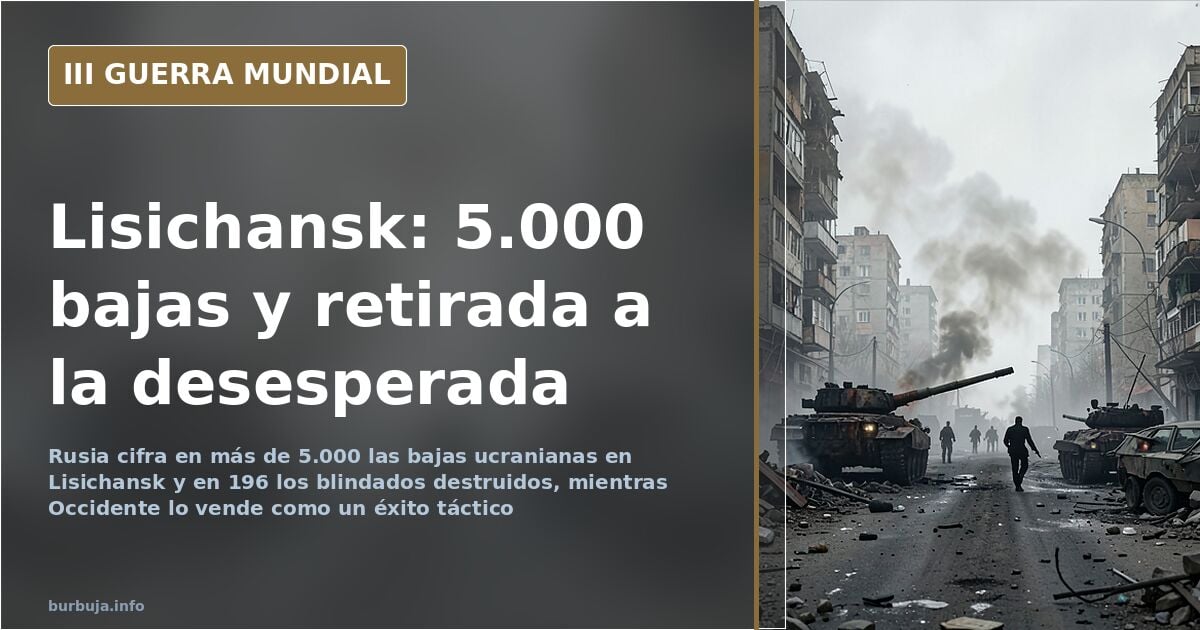
Lisichansk: 5,000 casualties and a retreat called victory
The Russian Ministry of Defense released figures trinc the capture of Lisichansk: more than 5,000 Ukrainian casualties during the operation, including over 2,000 irrecoverable losses, according to Sergei Shoigu's report. The tally also includes 12 aircraft, 6 long-range air defense systems, 39 abandoned tanks and armored vehicles in the city, 196 destroyed armored units, one helicopter, and captured Western equipment: 48 Javelin and NLAW launchers, plus 18 Stingers. The striking detail is not just the volume, but the contrast: while some Western press presents the maneuver as a Ukrainian tactical success, much independent analysis views it as a desperate retreat.
What was actually lost in Lisichansk
The figure of 5,000 casualties in a single operation is hard to reconcile with the narrative of an orderly withdrawal. Some argue the Ukrainian maneuver was a disguised flight, with soldiers abandoning positions and leaving equipment on the ground—hence the 39 armored vehicles left behind—and that Anglo-Saxon propaganda merely rebrands defeat as strategic retreat. Conversely, there is the argument that a withdrawal saving lives can be rational even if territory is lost; the problem here is that both were lost.
The inventory of destroyed and captured gear depicts more than a specific defeat. 196 tanks and armored vehicles destroyed in one location, plus 12 aircraft and 6 long-range air defense systems, represents a material hemorrhage that cannot be replenished overnight. And the captured Western equipment—Javelins, NLAWs, Stingers—opens a parallel front often overlooked in analysis: reverse engineering.
NATO catalog ends up in Russian hands
One prominent line of analysis concerns the value of captured weaponry. The circulating thesis is that each Western system falling into Russian hands becomes study material: not only is it learned how to counter, but it is dismantled, copied, and adapted. This argument has industrial logic—Russia has been receiving batches of NATO-designed equipment meant to avoid capture for months—and explains why the trickle of deliveries has become so sensitive in Western offices.
The irony hovering over this: so-called game changers alter the war less than they change the adversary's engineering manuals. A win-win, in terms of the hardware itself, though the second win is the least publicized.
War of attrition and casualty rates
The most repeated calculation is the casualty ratio: 1 to 10 in recent months, with approximately 1,000 daily Ukrainian losses versus about 100 for Russia and its allies. If this pace continues at 30,000 per month, the Ukrainian recruitment system collapses within a year. It is a projection, not a fait accompli, but it fits the image of an army already drawing on untrained civilians and mobilization notices reaching men over 50.
Against this, the Russian reading of the conflict is patience: no rush to end it, each passing week wears down Ukraine and its suppliers further. The full calculation, with monthly casualty breakdowns and comparison to material wear, is the kind of data missing from headlines.
An army fighting wars for twenty years
The experience gap is another key axis. The Russian military accumulates campaigns in Chechnya, Georgia, Syria, and now Ukraine; the Ukrainian force fights with what arrives and accelerated NATO training. Comparisons with other theaters—the Korean War as the last precedent of major power clash—help scale the situation, though the parallelism is flawed: here there is no stabilized front or clean withdrawals.
The lingering question is how much of Ukrainian resistance is organic capacity versus the Western check. And how long that check lasts.
What the official narrative omits
Criticism of media coverage is constant: credibility of Ukrainian outlets tends toward zero since Maidan, and Anglo-Saxon press filters the conflict through a propaganda prism. The practical consequence is that Western readers receive data late and are poorly informed about ground realities. Meanwhile, the war stagnates, fronts move slowly, and real figures—casualties, material, territory—are known weeks after the fact.
How many more casualties are needed to change the narrative?
Also available in: Deutsch
Summary of a discussion on Burbuja.info - Foro de economía, actualidad y política., translated from Spanish and reviewed before publication. Read the full discussion (84 replies).
More summaries
-
Ukraine’s former advisor warns country could vanish
A Ukrainian general rules out a breakthrough while an ex-advisor declares the war lost, amid disputed casualty figures.
-
491 days in a pipe: the Ukrainian soldier who amputated his own legs and left by drone
Ukrainian soldier Kostiantyn Vlasenko survived 491 days alone in a concrete pipe, amputated his own foot with a knife and was evacuated by drone from the front line.
-
Azovstal Surrender: Ukraine Frames Defeat as Evacuation
Ukraine and Russia offer conflicting accounts of the Azovstal surrender, with military analysis highlighting a propaganda war over evacuation versus captivity.
-
Lavrov: Ukraine must clear mines to export grain
Russia links Ukrainian grain exports to demining and ship inspections. Kyiv holds over 20 million tons, while Moscow denies theft claims.
-
Ukrainian slogan sparks brawl in Spanish bar
A Ukrainian waiter shouted 'Glory to Ukraine' at Russian customers in Torrevieja, leading to a fight captured on CCTV.
-
Putin’s Dresden Myth: The Truth Behind the Bullet Story
The Dresden bullet legend mixes wrong dates, ranks and testimonies. Here is what actually happened.