
Russia bets on quantity over quality with modernized T-62M tanks
Russia restores up to 3,000 T-62Ms for a war of attrition: Soviet scrap against Javelins and economic strain.
English · Original discussion in Spanish · Published
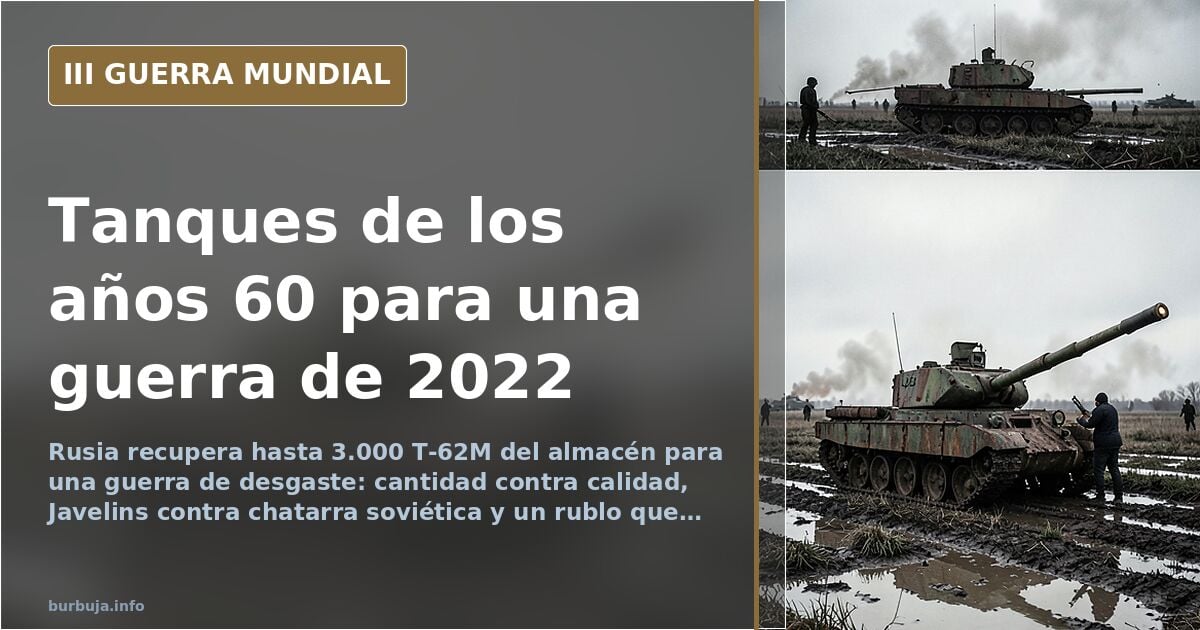
Russia rescues T-62Ms from storage: Soviet scrap vs. Javelins
The Ukraine war is predicted to last at least two more years. This forecast underpins the analysis: Russia has decided it does not need to win quickly, only to avoid losing slowly. To that end, it is deploying what should have stayed in storage: newly modernized T-62Ms, Soviet-era tanks that had been rusting in maintenance plants for decades.
The initial estimate suggests that while most of the 12,000 officially stored Russian tanks are irreparable, between 2,000 and 3,000 could return to combat after cannibalizing parts. They would arrive pogre, like mobilized reservists. The doctrine mirrors World War II and the Cold War era: Dimitri horde, quantity over quality, pushing until the enemy front collapses from exhaustion.
What modernizing a T-62 means during wartime
Upgrading a T-62M does not turn a 1961 tank into a Leopard. It involves slightly better optics, reactive armor, and little else. The reservist crew will have served in cavalry, recalling controls within a week, basic maintenance the next, plus brief tactical training and accelerated communications courses. One month for the first group due to urgency; three months for subsequent ones if lucky.
The military consequence is predictable: destroyed or heavily worn Russian mechanized columns, as seen in the invasion's first month. Poor strategic and worse tactical logistics do not help. An old tank with inexperienced crews and no reliable supply chain is just a tracked target.
Ukrainian quality vs. Russian manpower
This is the core issue. Ukraine improves in quality—Western weapons continue arriving with support—but its human capital remains uncertain. Russia increases quantity at the expense of quality. In a long war of attrition, human factors weigh heavily: Russia has more men to spend. Material advantage lies with Ukraine.
Debate intensifies when examining details. A recurring argument: if NATO spends Javelins and Bayraktars destroying T-62s, Russia wins economically. The counterargument: using Javelins against T-62s implies Russia lacks operational T-90s or trained crews. Moreover, a Javelin destroys a Merkava as easily as a Soviet tank; missile superiority is independent of the target.
Sanctions and the Russian economy debate
The discussion shifts to economics. Some argue Western sanctions aim to destroy Russia’s medium-to-long-term economy, with short-term effects already devastating: reliance on North Korean artillery and Iranian drones. The ruble offers a counterpoint: it appreciated against the dollar so much that the central bank intervened to devalue it, suggesting sanctions aren’t working as advertised.
Though heated and imprecise, this yields a useful insight: war costs extend beyond tanks. They include industrial capacity, foreign currency reserves, internal cohesion, and time. Time is the resource Russia believes it has in abundance.
Why doesn't Russia dominate the air?
This question arises mid-analysis without a definitive answer. Hypotheses include communication and navigation issues, inability to coordinate real-time air traffic, and pilots with barely sufficient flight hours to avoid crashes. Experienced pilots trained in Syria are being lost. Without air superiority, Ukrainian artillery survives, and GPS-guided HIMARS rockets threaten armies relying on unguided rocket launchers.
This technical counterpoint challenges the steamroller: 16 HIMARS and 10 M270 systems disrupted Russian logistics. Quality currently beats quantity.
Conclusion: larger massacre, not quick victory
Russian mobilization escalates rather than decides the war. It increases quantity at the expense of quality, pogre but not decisively. Ukraine retains room to mobilize more troops, and Western arms will continue flowing. The likely outcome is a prolonged, growing massacre as both armies expand.
With reservations: neither the T-62M horde breaks the front nor sanctions sink Russia before Western patience runs out. More of the same awaits: more people, poorly equipped on one side; better equipped, fewer people on the other. Time will tell—or not.
Also available in: Deutsch
Summary of a discussion on Burbuja.info - Foro de economía, actualidad y política., translated from Spanish and reviewed before publication. Read the full discussion (82 replies).
More summaries
-
Russia's offensive stalls: 483 vehicles lost, fuel shortages spread
Russia loses 483 vehicles in a recent tally as half its refineries face downtime and gas lines grow. The war of attrition...
-
Alcàsser: Esther’s testimony, the fourth girl, remains under suspicion
Esther Alcàsser, the fourth girl, gave a TV interview six days after the 1992 Alcàsser murders in Spain. Her account and timeline discrepancies fuel ongoing controversy.
-
Kidnapping Maduro was unnecessary if oil was the goal
Venezuela exported to the US until Washington backed Guaidó. Why the 2025 situation differs.
-
Russia's Unupdated Casualty Count Stalls at 498
The Kremlin reported 498 soldier deaths and hasn't updated the figure. Without independent verification, casualty counts remain acts of faith.
-
EU arms Ukraine as Moscow threatens to strike convoys
The EU establishes an arms procurement cell and mobilizes Madrid's satellite center. Moscow warns it will attack European supply lines.
-
Maduro's wife lost teeth and weight in US custody, NYT reports
The New York Times reports Cilia Flores lost two teeth and over 11 kg while detained in the US. Her defense claims she may have suffered a mild heart attack.