
Rural Sweden: Houses for €30,000 and €500 Monthly Costs
Cheap rural Swedish villas lure those fleeing Spain's empty regions, but hidden costs and lifestyle challenges remain.
English · Original discussion in Spanish · Published
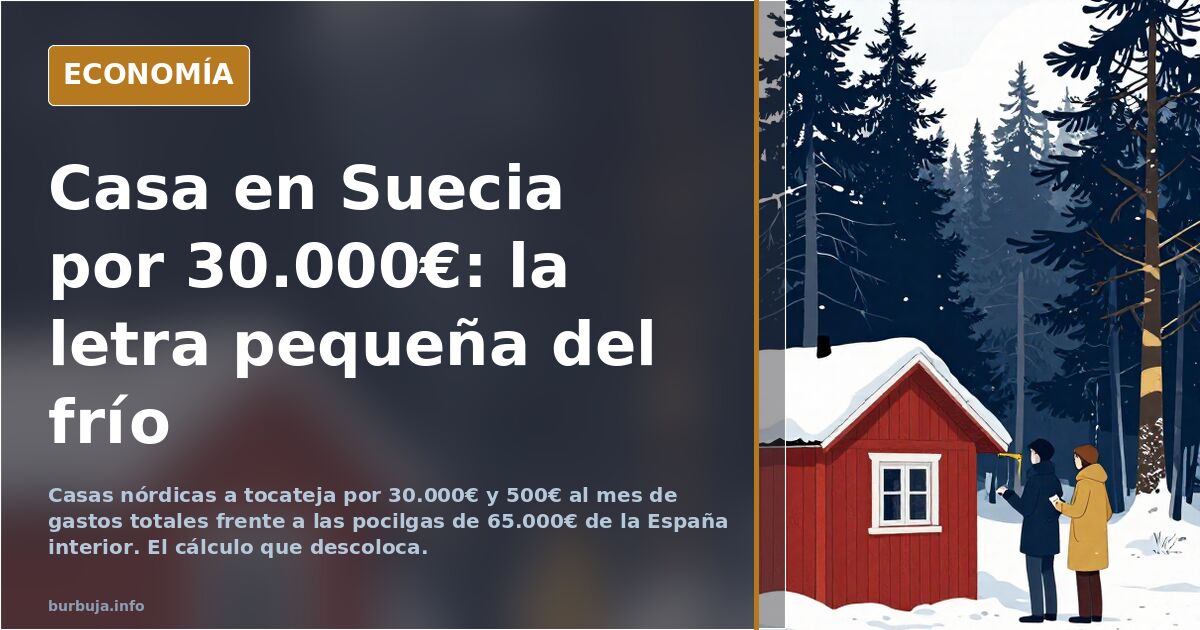
Rural Sweden: Houses for €30,000 and €500 Monthly Costs
A viral calculation suggests buying a villa in deep rural Sweden for €30,000 or €40,000, paid upfront, with central heating and municipal services included for just €400 or €500 per month. Compared to Spain’s depopulated areas, where apartments cost €65,000 with high energy bills of €200–€300, the difference is only €150–€250 monthly. For remote workers or savers, moving north seems rational. However, the fine print reveals significant pitfalls.
Housing Prices: From €8,000 Apartments to €40,000 Villas
The premise holds: rural Sweden offers homes at prices that seem like typos in Spain. Initial discussions cite apartments for €8,000 and villas for €30,000–€40,000, antiestéticaturing Nordic construction standards without needing major renovations. This stems from depopulation in municipalities of 3,000–15,000 residents, where supply exceeds demand.
However, a crucial nuance is often missed. Much of Sweden’s housing stock consists of bostadsrätt (cooperative ownership), where buyers purchase shares, not the property itself. These shares carry cooperative debt, and members pay a monthly fee (avgift). One example cited: a 78-square-meter unit with a fee of 5,140 SEK, equating to 791 SEK per square meter annually, above the Swedish average of 744 and median of 735. The low purchase price reflects this ongoing financial burden—it is effectively a loan with a different label.
What Does Living in Sweden Really Cost?
The claimed total monthly expense of €400–€500—covering heating, internet, and municipal tax—is highly debated. Proponents argue it includes effective central heating, allowing comfort indoors during winter, unlike Spain’s soaring electricity and gas costs. Critics counter these figures are unrealistic unless living minimally, noting actual expenses can easily double.
Comparisons with Spain are also flawed. Southern Spain offers winter rentals starting at €400 for ten months, with alternatives for the remaining two. While an energy cost differential exists, it isn’t the abyss suggested initially. Moreover, a critical omitted cost is transportation. In Sweden’s dispersed rural areas with limited public transport outside cities, owning a car is essential. Fuel, insurance, and road taxes add significantly to the budget.
Climate and Isolation: What Real Estate Portals Don’t Show
The debate shifts from economic to existential. Scandinavia expats report an initial honeymoon period of functionality and friendliness, trinc by November, December, and January. Nine months of darkness, ice, and empty streets ensue. “You start feeling like Jack Nicholson in The Shining,” one student summarized. Locals aren’t hostile; the climate encourages staying indoors, making social integration difficult for newcomers.
Loneliness persists regardless of location. Arriving alone in a Swedish village of 3,000 feels as isolated as in Spain’s Meseta plateau, compounded by language barriers and lack of family networks. While Swedes speak English fluently, this doesn’t automatically build friendships. Conversely, Spain’s social life—terraces, tapas, vermouth gatherings—holds value absent from balance sheets.
Public Services: Heated Pools in Villages of 3,000
Sweden excels in public services. Initial claims mention municipal heated pools with spas, libraries, gyms, and transport in small towns. This results from a fiscal system prioritizing territorial equity over profitability. In contrast, Spain’s empty regions often lack even basic public libraries.
This asymmetry drives appeal but comes at a cost: high taxes and labor pressure, comparable only to top income brackets in Spain. For passive income earners or remote workers, the math may work. For those seeking local employment, the Swedish market demands language skills and qualifications, and part-time jobs rarely cover living costs without supplements.
The Southern Europe Alternative
Some participants propose warmer, culturally closer destinations like Thailand, the Philippines, or Vietnam. With Spanish incomes, Southeast Asia offers superior comfort, climate, and social life, with expat communities easing language barriers. Challenges remain regarding healthcare, legal security, and distance from family.
Another option is staying in Spain but changing villages. Regions like León, Palencia, or mountain areas offer municipal pools and rock-bottom prices. There’s no tax haven, but no need to learn Swedish or endure darkness. The question remains whether the issue was the environment or oneself—a dilemma real estate portals cannot solve.
A viral calculation suggests buying a villa in deep rural Sweden for €30,000 or €40,000, paid upfront, with central heating and municipal services included for just €400 or €500 per month. Compared to Spain’s depopulated areas, where apartments cost €65,000 with high energy bills of €200–€300, the difference is only €150–€250 monthly. For remote workers or savers, moving north seems rational. However, the fine print reveals significant pitfalls.
Housing Prices: From €8,000 Apartments to €40,000 Villas
The premise holds: rural Sweden offers homes at prices that seem like typos in Spain. Initial discussions cite apartments for €8,000 and villas for €30,000–€40,000, antiestéticaturing Nordic construction standards without needing major renovations. This stems from depopulation in municipalities of 3,000–15,000 residents, where supply exceeds demand.
However, a crucial nuance is often missed. Much of Sweden’s housing stock consists of bostadsrätt (cooperative ownership), where buyers purchase shares, not the property itself. These shares carry cooperative debt, and members pay a monthly fee (avgift). One example cited: a 78-square-meter unit with a fee of 5,140 SEK, equating to 791 SEK per square meter annually, above the Swedish average of 744 and median of 735. The low purchase price reflects this ongoing financial burden—it is effectively a loan with a different label.
What Does Living in Sweden Really Cost?
The claimed total monthly expense of €400–€500—covering heating, internet, and municipal tax—is highly debated. Proponents argue it includes effective central heating, allowing comfort indoors during winter, unlike Spain’s soaring electricity and gas costs. Critics counter these figures are unrealistic unless living minimally, noting actual expenses can easily double.
Comparisons with Spain are also flawed. Southern Spain offers winter rentals starting at €400 for ten months, with alternatives for the remaining two. While an energy cost differential exists, it isn’t the abyss suggested initially. Moreover, a critical omitted cost is transportation. In Sweden’s dispersed rural areas with limited public transport outside cities, owning a car is essential. Fuel, insurance, and road taxes add significantly to the budget.
Climate and Isolation: What Real Estate Portals Don’t Show
The debate shifts from economic to existential. Scandinavia expats report an initial honeymoon period of functionality and friendliness, trinc by November, December, and January. Nine months of darkness, ice, and empty streets ensue. “You start feeling like Jack Nicholson in The Shining,” one student summarized. Locals aren’t hostile; the climate encourages staying indoors, making social integration difficult for newcomers.
Loneliness persists regardless of location. Arriving alone in a Swedish village of 3,000 feels as isolated as in Spain’s Meseta plateau, compounded by language barriers and lack of family networks. While Swedes speak English fluently, this doesn’t automatically build friendships. Conversely, Spain’s social life—terraces, tapas, vermouth gatherings—holds value absent from balance sheets.
Public Services: Heated Pools in Villages of 3,000
Sweden excels in public services. Initial claims mention municipal heated pools with spas, libraries, gyms, and transport in small towns. This results from a fiscal system prioritizing territorial equity over profitability. In contrast, Spain’s empty regions often lack even basic public libraries.
This asymmetry drives appeal but comes at a cost: high taxes and labor pressure, comparable only to top income brackets in Spain. For passive income earners or remote workers, the math may work. For those seeking local employment, the Swedish market demands language skills and qualifications, and part-time jobs rarely cover living costs without supplements.
The Southern Europe Alternative
Some participants propose warmer, culturally closer destinations like Thailand, the Philippines, or Vietnam. With Spanish incomes, Southeast Asia offers superior comfort, climate, and social life, with expat communities easing language barriers. Challenges remain regarding healthcare, legal security, and distance from family.
Another option is staying in Spain but changing villages. Regions like León, Palencia, or mountain areas offer municipal pools and rock-bottom prices. There’s no tax haven, but no need to learn Swedish or endure darkness. The question remains whether the issue was the environment or oneself—a dilemma real estate portals cannot solve.
Also available in: Deutsch
Summary of a discussion on Burbuja.info - Foro de economía, actualidad y política., translated from Spanish and reviewed before publication. Read the full discussion (119 replies).
More summaries
-
Wildfires in Northwest Spain: Depopulated Areas Burn Without Resources
Wildfires in northwest Spain burn an area larger than Gran Canaria. Reports state that young people with minimum wage and basic training fight the fires.
-
Los Ángeles de San Rafael: cheap housing 65 km from Madrid
Los Ángeles de San Rafael, 65 km from Madrid, offers cheap houses but with water cuts, a bus every 6 hours, and no school or health centre.
-
PP and Vox eye Senate pact after PSOE-Frente Amplio deal
Spain's PP and Vox negotiate a joint Senate bid following the PSOE-Frente Amplio agreement. The deadline for candidate lists is October 26.
-
Milei ties Argentine welfare to no road blockades
Milei conditions social aid on avoiding street blockades in Argentina, sparking debate over the 'piquete' industry and dictatorship figures.
-
Spanish Twins Gemeliers Hospitalized After Madrid Club Attack
The Spanish musical duo Gemeliers and their partners were hospitalized in Madrid following an assault involving homophobic slurs and pepper spray.
-
Spain cuts welfare: impact on migrants and economy
Spain's proposed welfare cuts spark debate on economic effects, potential expulsion of migrants, and social conflict risks.