
Wildfires in Northwest Spain: Depopulated Areas Burn Without Resources
Wildfires in northwest Spain burn an area larger than Gran Canaria. Reports state that young people with minimum wage and basic training fight the fires.
English · Original discussion in Spanish · Published
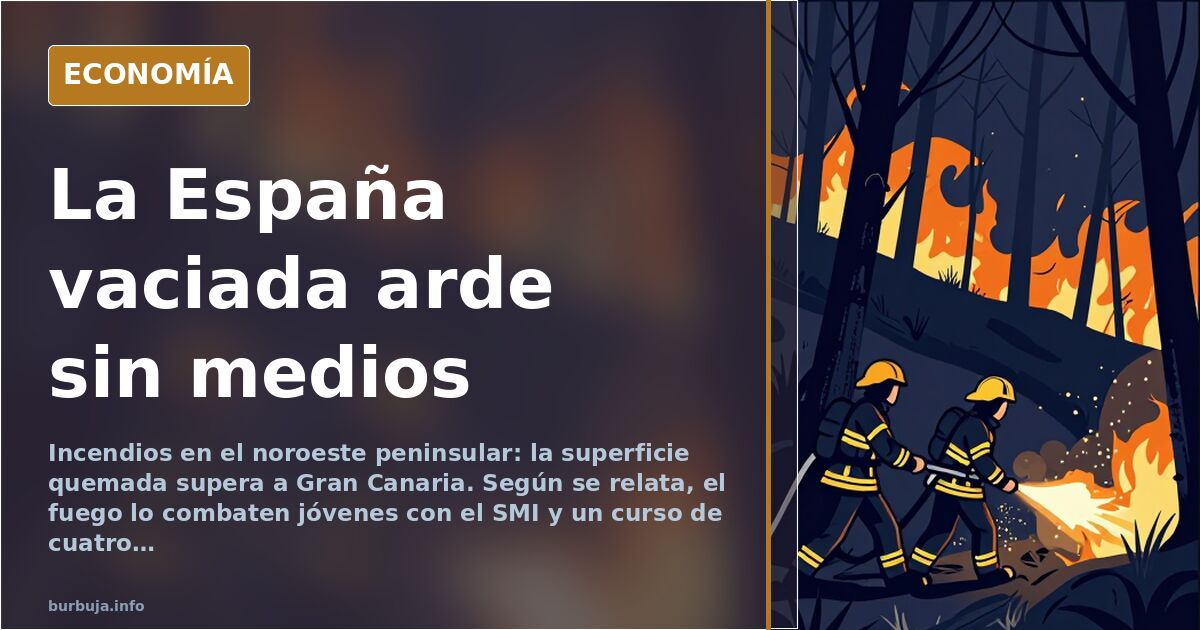
Depopulated Spain burns: Wildfires without resources in the northwest
The wildfires that ravaged the northwest of the Iberian Peninsula left an image that sums up the problem: in Asturias, it was almost nightfall at five in the afternoon due to ash arriving from León and Zamora. The burned area, adding all fire spots, already exceeds that of an island like Gran Canaria, about 1,600 square kilometers. Much of what is scorched are areas of great value: Las Médulas, Somiedo, the surroundings of Plasencia, where the fire threatened the city's suburbs. The subsequent discussion was not about the climate, but about who extinguishes the forest and with what.
Who fights wildfires in depopulated Spain?
The picture drawn in testimonials is uncomfortable. According to reports, young people earning the minimum wage and armed with a can of sardines, after a four-hour extinction course, fight the fires. That is the level of professionalization they are willing to pay for the territory. The comparison with California's supertankers appears in more than one message, between irony and rage.
The underlying problem is forest management. Some argue that the abandonment of the countryside turns every summer into a trap: accumulated undergrowth is tinder, and with heat waves and sudden dryness, any spark finds fuel. The paradox is that rains months earlier generate more vegetation, which then dries out and feeds the fire. Without cleaning, the forest becomes a ticking time bomb.
The water business and disappearing villages
One of the most circulated episodes was that of Palacios de Jamuz, in León. According to messages, Grupo Pascual (Bezoya) had interests in setting up a water bottling plant in the area. Neighbors were protesting. Now, it is said, there is no village left. They will no longer protest. Green light for the bottler. The denunciation is clear: Spain is destroyed, the territory is emptied, and water is commodified.
The connection with the fire is not casual in the narrative. It is pointed out that there are cleaning plans that demand backbreaking work without economic return, or giving away valuable firewood in exchange for reducing the fire load. The equation does not add up for the forest owner, who sees their land become a zero-cost playground for others, while they assume the risk.
Depopulated Spain and voting: Who to blame?
The conversation drifted toward politics. Some argue that Asturians have been voting the same way for four decades and now must enjoy what they voted for. Others respond that VOX governed León until yesterday, and hired bullfighters do not put out fires better than California's supertankers. The debate gets heated: the State is accused of being ineffective, of extracting record taxes and not protecting the territory.
The data hovering over the discussion is tax pressure. It is claimed that the State has never handled so many resources and is more ineffective than ever: cold fronts, wildfires. Fiscal Liberation Day, August 18, is cited as a symbol. The conclusion drawn is that money does not reach the forest, or goes elsewhere.
Bottled water and the future business
There is an underground thread running through the discussion: water. It is warned that the 2030 goal is that water must be consumed bottled and tolls paid. It will not be mineral spring water, but the same we consume now, purified, but priced as spring water. There are already large manufacturers selling bottled tap water, and for now, they have to disclose it. The denunciation is that a basic resource is being commodified.
The connection with wildfires is twofold: on one hand, the bottler in Palacios de Jamuz; on the other, drought and water management. Fire and water are two sides of the same coin: the territory as a business, not as a place to live.
The closing: The question nobody answers
In the end, the discussion does not reach a consensus. Some blame the Government for provoking wildfires to build smart cities and data centers. Others point to rural abandonment and lack of resources. And some simply say that Spain is occupied and governed by its enemies. What remains clear is that the forests burn, villages empty out, and those who stay see their land turn to ash or business. The question nobody answers is how much we are willing to pay so this does not happen.
The wildfires that ravaged the northwest of the Iberian Peninsula left an image that sums up the problem: in Asturias, it was almost nightfall at five in the afternoon due to ash arriving from León and Zamora. The burned area, adding all fire spots, already exceeds that of an island like Gran Canaria, about 1,600 square kilometers. Much of what is scorched are areas of great value: Las Médulas, Somiedo, the surroundings of Plasencia, where the fire threatened the city's suburbs. The subsequent discussion was not about the climate, but about who extinguishes the forest and with what.
Who fights wildfires in depopulated Spain?
The picture drawn in testimonials is uncomfortable. According to reports, young people earning the minimum wage and armed with a can of sardines, after a four-hour extinction course, fight the fires. That is the level of professionalization they are willing to pay for the territory. The comparison with California's supertankers appears in more than one message, between irony and rage.
The underlying problem is forest management. Some argue that the abandonment of the countryside turns every summer into a trap: accumulated undergrowth is tinder, and with heat waves and sudden dryness, any spark finds fuel. The paradox is that rains months earlier generate more vegetation, which then dries out and feeds the fire. Without cleaning, the forest becomes a ticking time bomb.
The water business and disappearing villages
One of the most circulated episodes was that of Palacios de Jamuz, in León. According to messages, Grupo Pascual (Bezoya) had interests in setting up a water bottling plant in the area. Neighbors were protesting. Now, it is said, there is no village left. They will no longer protest. Green light for the bottler. The denunciation is clear: Spain is destroyed, the territory is emptied, and water is commodified.
The connection with the fire is not casual in the narrative. It is pointed out that there are cleaning plans that demand backbreaking work without economic return, or giving away valuable firewood in exchange for reducing the fire load. The equation does not add up for the forest owner, who sees their land become a zero-cost playground for others, while they assume the risk.
Depopulated Spain and voting: Who to blame?
The conversation drifted toward politics. Some argue that Asturians have been voting the same way for four decades and now must enjoy what they voted for. Others respond that VOX governed León until yesterday, and hired bullfighters do not put out fires better than California's supertankers. The debate gets heated: the State is accused of being ineffective, of extracting record taxes and not protecting the territory.
The data hovering over the discussion is tax pressure. It is claimed that the State has never handled so many resources and is more ineffective than ever: cold fronts, wildfires. Fiscal Liberation Day, August 18, is cited as a symbol. The conclusion drawn is that money does not reach the forest, or goes elsewhere.
Bottled water and the future business
There is an underground thread running through the discussion: water. It is warned that the 2030 goal is that water must be consumed bottled and tolls paid. It will not be mineral spring water, but the same we consume now, purified, but priced as spring water. There are already large manufacturers selling bottled tap water, and for now, they have to disclose it. The denunciation is that a basic resource is being commodified.
The connection with wildfires is twofold: on one hand, the bottler in Palacios de Jamuz; on the other, drought and water management. Fire and water are two sides of the same coin: the territory as a business, not as a place to live.
The closing: The question nobody answers
In the end, the discussion does not reach a consensus. Some blame the Government for provoking wildfires to build smart cities and data centers. Others point to rural abandonment and lack of resources. And some simply say that Spain is occupied and governed by its enemies. What remains clear is that the forests burn, villages empty out, and those who stay see their land turn to ash or business. The question nobody answers is how much we are willing to pay so this does not happen.
Summary of a discussion on Burbuja.info - Foro de economía, actualidad y política., translated from Spanish and reviewed before publication. Read the full discussion (155 replies).
More summaries
-
Basque Country tourism outpaces Castilla y León
Forum debate compares Basque tourism with Castilla y León, citing French border proximity and high prices as key factors.
-
León Gains Territory from Asturias: Border Adjusted
An 1788 decree resolves the border dispute between León and Asturias, awarding 700 hectares to León and forcing a map update.
-
Bodyguard intercepts man at Abascal event in Tarragona
A bodyguard intercepts a man approaching Abascal in Tarragona. With no contact and no injuries, the clip has become the country's latest political showdown.
-
Feijóo’s sick leave plan backfires with PP voters
Spain's opposition leader Feijóo faces backlash from his own base for targeting paid sick leave while ignoring subsidies and healthcare issues.
-
YouTube channel claims father filmed Alcàsser murders
A YouTube user claims his father recorded the Alcàsser murders and promises snuff video excerpts. No evidence provided, only narrative and technical analysis.
-
Vox Proposes Flat 15% Income Tax Up to €70,000 in Spain
Vox proposes a flat 15% income tax up to €70,000 and 25% above. Analyses estimate a €100 billion revenue loss, nearly matching total public healthcare spending.