
Ruby cargo ship with Russian ammonium nitrate stranded off Kent
The Ruby, carrying 20,000 tonnes of Russian ammonium nitrate, remains anchored off Kent after being rejected by multiple ports. Its tugboat has vanished.
English · Original discussion in Spanish · Published
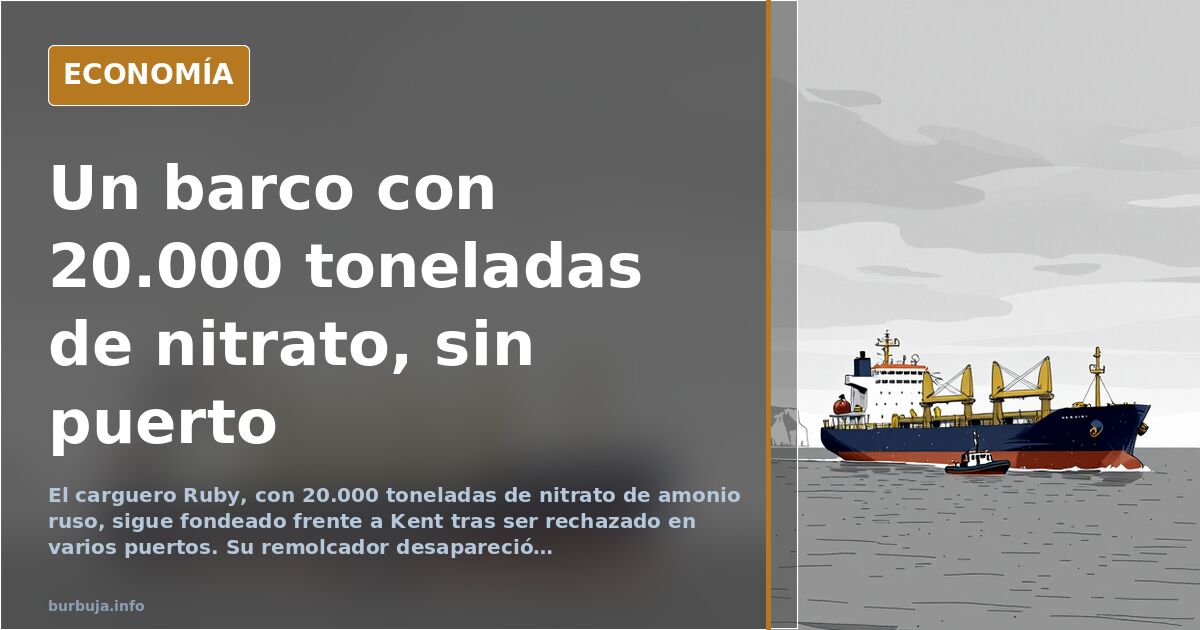
The Ruby cargo ship, loaded with 20,000 tonnes of Russian ammonium nitrate, remains anchored off Kent after being refused entry in several countries
What is a vessel doing with 20,000 tonnes of ammonium nitrate—the same compound that devastated Beirut in 2020—moored off the British coast, without a tug and with a damaged hull? The Ruby, flying the Maltese flag and carrying Russian cargo, has been a diplomatic and logistical problem for weeks that no one wants to take on. Cracked ballast tanks and a broken propeller shaft left it adrift in the North Sea. Since then, it has been turned away by various ports, and its acompañante tug disappeared overnight. The UK Coastguard maintains contact with the ship, but a solution remains elusive.
What is ammonium nitrate and why is it concerning?
Ammonium nitrate is a common fertilizer, but also a potential explosive if mixed with fuel. The comparison with Beirut is inevitable: there, 2,750 tonnes of the same compound caused an explosion that killed more than 200 people. Here we are talking about 20,000 tonnes, seven times more. A calculation circulating in the analysis of the case suggests that, in the worst-case scenario, the detonation could be equivalent to a small atomic bomb. This is not gratuitous alarmism: the figure is on the table and explains why no port wants it nearby.
The legal and diplomatic maze of a ship with opaque ownership
The Ruby is a puzzle of opaque ownership. Maltese flag, Russian cargo, registered owner in Dubai based in Syria, and leased to another Dubai-based company with Russian links. Flags of convenience, like Malta's, serve to evade responsibilities, and this is evident here. Norway considered it seaworthy but expelled it from Tromsø. The Baltic closed its entrance. The UK keeps it anchored off Kent but does not accept it in port. Meanwhile, the tug that was escorting it vanished. The question is who pays the bill for a ship that no one claims.
The risk of sabotage and the shadow of hybrid warfare
In the context of the war in Ukraine, the possibility of Russian sabotage hangs over the case. There is no proof, but the combination of opaque flag, explosive cargo, and "accidental" damage fuels the theory. A drifting ship, out of control, can be a weapon if someone decides to detonate it. The UK Coastguard is monitoring, but the hypothesis of a false-flag attack is not dismissed in discussions. The irony is that, if it explodes, no one will know whether it was an accident or intent.
Options on the table: unload the cargo or let it rot
The most logical solution would be to bring the Ruby into a port, unload the nitrate, and then repair the hull in dry dock. But no one wants to assume the risk of an explosion during the maneuver. Another option is to repair it at sea, which would take weeks and incur enormous costs. Meanwhile, the ship remains anchored in British waters, with high-power tugs nearby just in case. The international maritime community looks the other way. The problem is not technical, it is political.
The precedent of the Cabo Machichaco and other floating bombs
History has examples of ships with explosive cargo that ended badly. The Cabo Machichaco exploded in the port of Santander in 1893, leaving hundreds dead. The Ever Given blocked the Suez Canal and paralyzed world trade. The Ruby does not block a route, but it is a floating bomb in one of the busiest areas on the planet. The difference is that now we know what it carries and yet no one wants to unload it. Bureaucracy and antiestéticar can be more dangerous than the nitrate itself.
The Ruby remains there, rocked by the waves, with its lethal cargo and crew on board. No one wants to take charge. And while governments debate, the ship waits. If something goes wrong, it will not be for lack of warnings.
Also available in: Deutsch
Summary of a discussion on Burbuja.info - Foro de economía, actualidad y política., translated from Spanish and reviewed before publication. Read the full discussion (108 replies).
More summaries
-
Spain's Guardia Civil faces scrutiny over coastal tech spending
Analysis of the controversy surrounding the Guardia Civil's coastal surveillance center and doubts about its actual effectiveness.
-
Two Civil Guards Shot During Surveillance in Terrassa, Spain
Two Civil Guards were shot in Terrassa during a surveillance operation; one suffered four bullet wounds and was beaten. The incident highlights security concerns in Spain.
-
30 Young Africans Attack 15-Year-Old British Girl, Leaving Her in a Coma
Violent attack on a teenager in London leaves lasting consequences. The incident, attributed to a group of Africans, reopens the debate on security.
-
Montse Mínguez's 7,000 m² luxury villa linked to a fund
Montse Mínguez shares a luxury villa on a 7,000 m² plot with her partner, with ownership attributed to the Nest Life fund, according to El Español.
-
Fabian socialism: the gradual path that shaped Wells and Orwell
The Fabian Society was founded in 1884 as a breakaway from a utopian group and went on to create the Labour Party. Its coat of arms features a wolf in sheep's clothing.
-
The AI hoax claiming God is being built and we're trapped inside it
An unproven message claims an elite is using AI to build a simulated reality. The conversation drifts toward Sumerians, the Antichrist and distrust of financial power.