
Rotisserie chicken: the margin eaten up by overheads
A forum user calculates a 700% margin on a roast chicken, but others point to fixed costs of €3,500 a month that swallow it up.
English · Original discussion in Spanish · Published
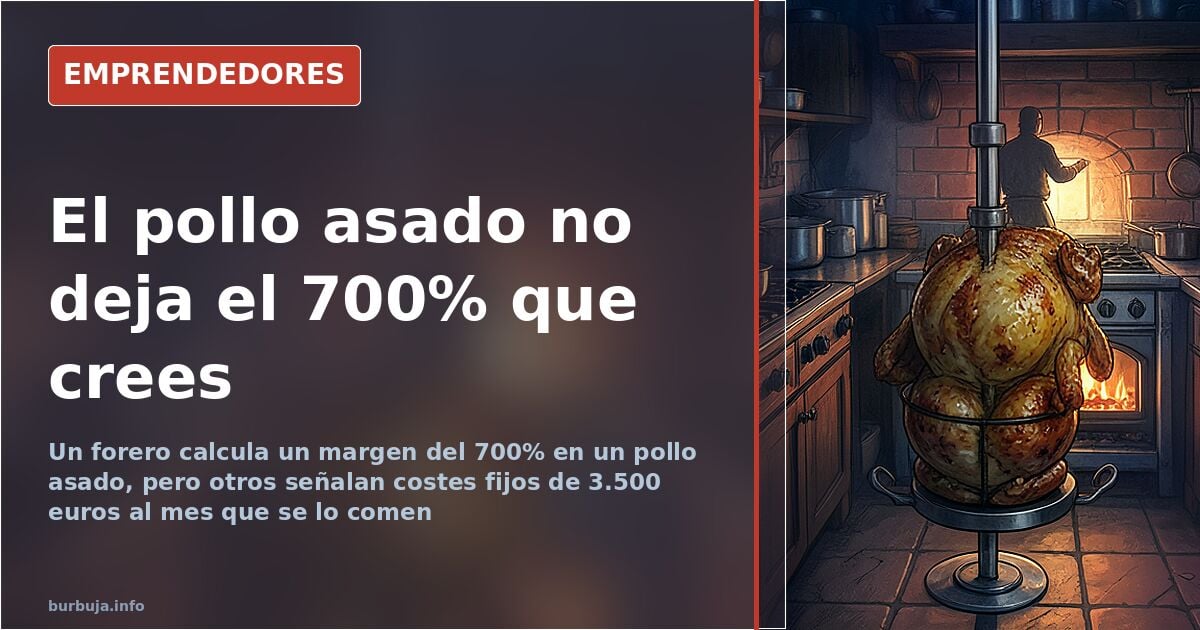
Rotisserie chicken: the margin eaten up by overheads
How much does someone really make selling a roast chicken for 8 euros? The math seems simple: if the chicken cost the rotisserie owner around 1 euro, the apparent margin is roughly 700%. That calculation, raised on an entrepreneurship forum by a father who wants to set up a chicken shop for his unemployed daughter, is the starting point of a discussion that dismantles the business arithmetic piece by piece, exposing what almost never gets counted: the structure of fixed costs.
The breakdown that emerges in the exchange is devastating for the initial enthusiasm. Between the self-employed social security contribution, electricity, water, municipal fees, rent, a renovation signed off by a licensed architect, advertising and insurance, one forum user argues that a chicken shop can face fixed outgoings of €3,500 to €4,000 a month. Covering that would require revenue of €6,000 to €7,000, which means selling around 800 or 900 chickens a month. In weekly terms: about 200 chickens. Several participants doubt that is possible outside an iconic location, with home delivery and a captive customer base.
Why are chickens only sold at the weekend?
Weekly seasonality is the second blow. Several participants point out that roast chicken consumption is concentrated on Saturdays and Sundays because the product is designed for four or more diners, and on weekdays families don't all sit down at the table at the same time. Selling 20 chickens on Saturday and 20 on Sunday leaves €320 gross a week, a figure that, according to the forum user who started the thread, cannot sustain a business with street-level premises. The suggested solution —offering half a chicken with a side for 3 or 4 euros to attract people living alone— runs into the reality of the average ticket: someone buying half a chicken spends less and takes up the same counter space.
Some argue that chicken is not the business, but the draw. The real margin lies in the extras: croquettes, Spanish omelettes, peppers, potatoes and ready-made dishes. The rotisseries that survive are usually butchers or takeaway food shops that add chicken as an extra service, not single-product establishments. The experience of a neighbourhood chicken shop selling half a chicken with potatoes for €6.50 and a set lunch menu at €3.99 points in the same direction: the chicken attracts customers, but the business is sustained by what is sold around it.
Flavour and fruta matter more than price
The factor that is quantified least is the one that weighs most. A rotisserie with a recognisable seasoning can draw customers from entire neighbourhoods, even from other towns, while standard chicken barely distinguishes one shop from another. Fruta takes years to build and is lost with one bad service. In a wide radius with no direct competition, a chicken shop can work; with three competitors on the same street, the margin narrows until it disappears. The key is not the price, which tends to converge downward, but getting customers to come back.
Neighbour issues add a layer almost nobody considers before signing the lease. A rotisserie needs a flue, and a flue generates smoke, smells and conflicts with the homeowners' association. Cases of closure over extraction problems or fires in the installation are not isolated incidents. The estimated initial investment —a 10-square-metre premises and a butane rotisserie oven for about €2,000— falls short once the space has to be adapted to regulations.
Are there rotisserie chicken franchises?
Yes, rotisserie chicken chains exist in other countries, with models combining roast, fried and sauced options to widen the customer base beyond the weekend. The reference mentioned in the conversation is charcoal-grilled chicken with an intense marinade, a format that in Spain is associated with Latin American immigrant-run shops and has proven its pulling power in specific neighbourhoods. The franchise solves the product problem, but not that of the premises, the flue or the seasonality.
The alternative that slips into the discussion is the churro shop. Several participants agree that the churros and hot chocolate business has more stable demand: breakfasts, deliveries to bars, late-night and weekend customers. Raw materials are cheap and the average ticket holds up. The drawback is the same as always: getting up early and working on your feet in front of a fryer. Nothing new under the sun.
The conclusion of the exchange is uncomfortable for anyone looking for an easy business. Roast chicken is not a money-printing machine: it is a weekend product, with high fixed costs, local competition and a margin that evaporates as soon as you add up the items that don't appear in the shop window. The full calculation, item by item, yields a difference that surprises anyone who only looks at the price of chicken in the supermarket.
Also available in: Deutsch
Summary of a discussion on Burbuja.info - Foro de economía, actualidad y política., translated from Spanish and reviewed before publication. Read the full discussion (69 replies).
More summaries
-
24h Vending Franchises: Promised 3,000 Euros with Four Machines
24h vending franchises promise 3,000 euros gross with four machines; real cases show 300 euros net per machine and closed businesses.
-
Pica Pica 24 Hours: What the Franchise Promises vs. What the Franchisee Gets
Pica Pica 24 Hours markets itself as a turnkey vending business, but in one case cleaning and neighbor complaints fell to the franchisee.
-
ADE or Law: Which Degree Doesn't Guarantee a Decent Salary
ADE vs Law: a double graduate claims only 0% to 10% of practicing lawyers live well
-
Running an online store: freelancer status, own hosting or hiring it out?
Domain and hosting in your own name, freelancer registration thresholds discussed in a forum, and conversion rates of 1% to 5%: the keys to running an online store without losing control.
-
Wurth: 750 euros a month to learn to sell screws
Wurth offers 750 euros net for 3 months of training, then commissions. Several accounts point to salaries that never exceed 1,200 euros and high staff turnover.
-
Smart self-defense spray: Europe's new business niche
A self-defense spray with GPS, Bluetooth and a 130dB alarm promises to revolutionize personal safety. We look at its legality and business potential in Spain.