
Smart self-defense spray: Europe's new business niche
A self-defense spray with GPS, Bluetooth and a 130dB alarm promises to revolutionize personal safety. We look at its legality and business potential in Spain.
English · Original discussion in Spanish · Published
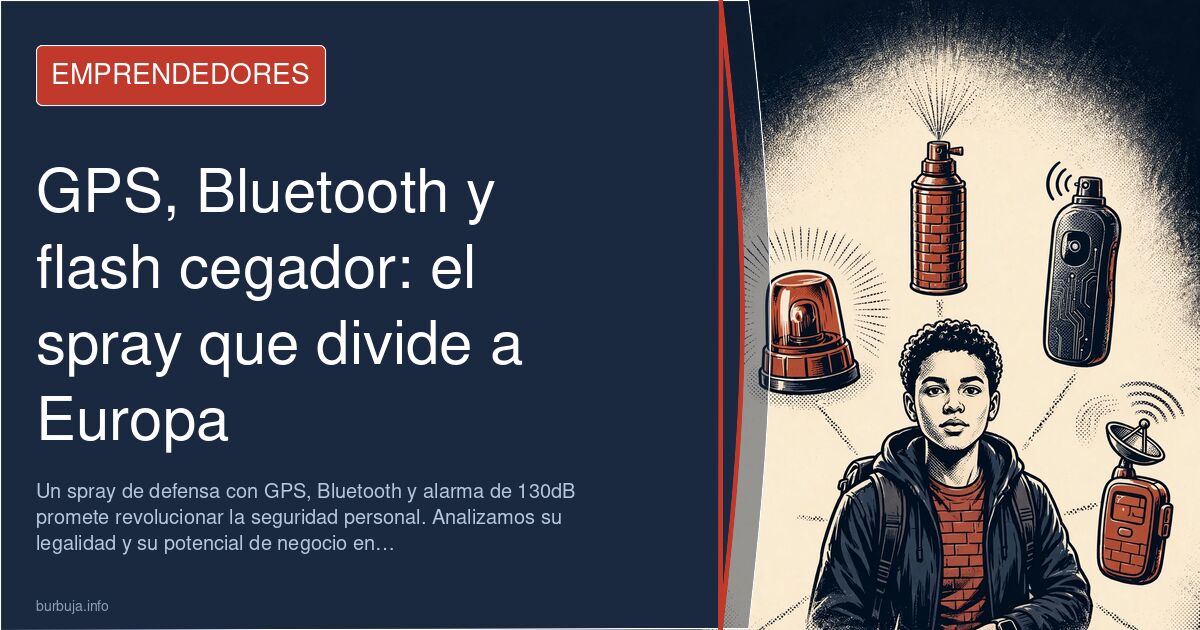
The smart self-defense spray promising GPS, alarm and flash: business opportunity or legal risk?
The personal safety market has found a new goldmine: self-defense sprays with Bluetooth connectivity, GPS tracking, a 130-decibel alarm and a blinding flash. A product that promises to revolutionize personal protection, but which in Spain exists in a legal grey area. The question is whether we are looking at an emerging business or a gadget that will never pass certification.
A gadget with all the antiestéticatures
The device, of Swedish origin, combines several technologies in a single package. Besides the irritant spray, it includes a Bluetooth module that connects it to an app, a GPS locator that sends your position to private contacts, a 130 dB alarm and a blinding flash. According to its promoters, it is easily exportable to other European countries "multiculturally enriched", a euphemism that hides a far from negligible potential market. The idea is not new: variants already exist with tasers or with 3D-printed exoskeletons that attach to conventional sprays.
Legality, the biggest hurdle
In Spain, the sale and use of non-certified self-defense sprays is prohibited. The debate has been compared to the V-16 beacon, a device mandatory for vehicles for a few years now. The key difference is that the V-16 is compulsory and its location map is public, while the spray would be voluntary and would send the position only to chosen contacts. However, some argue that carrying a GPS can work against you: if the device is used, the location could give the bearer away to the authorities. The discussion over privacy and voluntariness thus becomes a minefield.
The business: cheap hardware and proprietary software
For entrepreneurs, the appeal is obvious. Existing hardware can be leveraged: low-cost Bluetooth buttons (around 1 euro) normally used for selfies, adapted with proprietary software. It has even been suggested to 3D-print the casing in the shape of a cigarette pack to disguise it. The initial investment is minimal and the potential margin high. In countries like Poland or Hungary, where immigration is more controlled, the product would have less traction, but in southern Europe the growth prospects are notable.
The controversy: privacy and misuse
GPS is the thorniest issue. While some see it as an advantage so contacts know where you are, others warn that geolocation can be used against you. The debate extends to who the product is aimed at: some argue it is a legitimate self-defense tool, while others consider that marketing it borders on incitement to hatred. The reality is that the personal safety market is growing, and technology is making these devices increasingly accessible.
The future of this product will depend on regulation and demand. Meanwhile, the debate over its use remains open. What is clear is that personal safety has become a market in which technology plays an increasingly important role.
Also available in: Deutsch
Summary of a discussion on Burbuja.info - Foro de economía, actualidad y política., translated from Spanish and reviewed before publication. Read the full discussion (62 replies).
More summaries
-
AI tool promises to cancel traffic fines in 10 days
A free tool uses AI to analyse traffic fines for procedural flaws. Its creator claims it got an M30 fine cancelled in ten days.
-
ADE or Law: Which Degree Doesn't Guarantee a Decent Salary
ADE vs Law: a double graduate claims only 0% to 10% of practicing lawyers live well
-
Running an online store: freelancer status, own hosting or hiring it out?
Domain and hosting in your own name, freelancer registration thresholds discussed in a forum, and conversion rates of 1% to 5%: the keys to running an online store without losing control.
-
Wurth: 750 euros a month to learn to sell screws
Wurth offers 750 euros net for 3 months of training, then commissions. Several accounts point to salaries that never exceed 1,200 euros and high staff turnover.
-
Emgoldex: €150, two referrals and €3,500 per cycle
Emgoldex promises €3,500 per cycle for just €150 and two referrals. The problem is mathematical: recruitment trees cannot grow forever.
-
Alibaba: how to buy from China without getting burned
Alibaba is not Amazon: no Paypal payments, 21%+3% customs charges and scams. Aliexpress escrow does not cover wholesale purchases. A look at the risks and alternatives.