
Roomba 630 at 300 euros: a Christmas gift that vacuums by itself
A Roomba 630 for 299.12 euros divides buyers: effortless daily cleaning versus batteries that fail after six months and a cost that never seems to end.
English · Original discussion in Spanish · Published
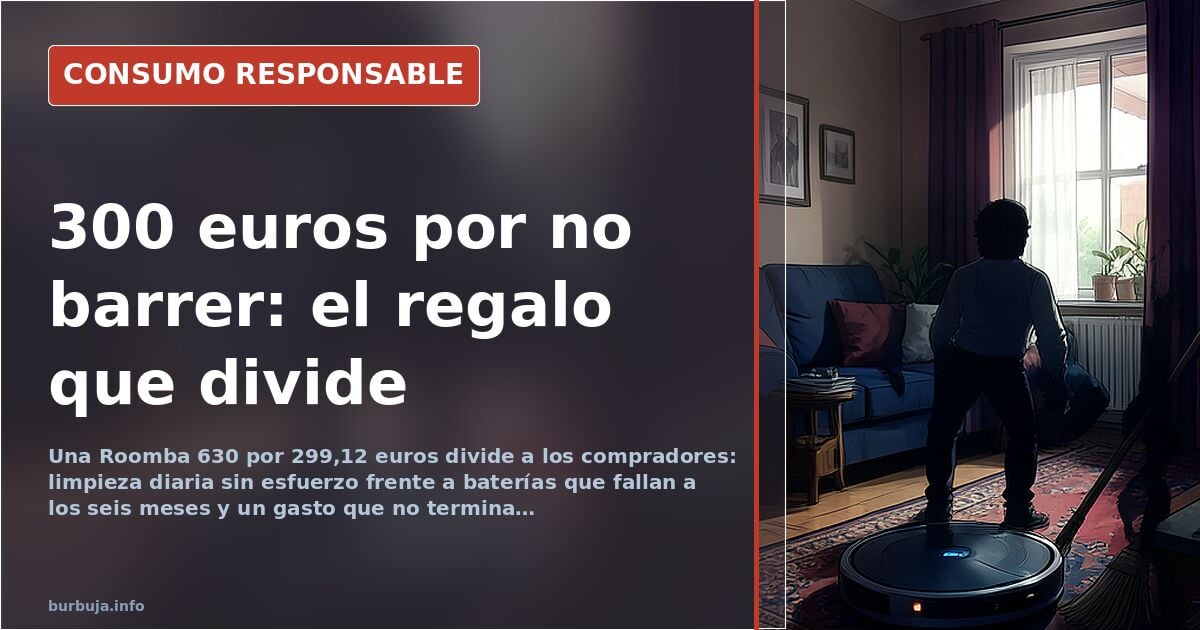
300 euros not to sweep: the Christmas gift that vacuums by itself
A man decides to give his vvife an iRobot Roomba 630 for 299.12 euros. It is not an impulse purchase: the couple has long been skipping typical Christmas gifts in favor of useful things. The machine, which he saw working at a friend's house, won him over. What started as a question about where to find it cheapest ended up as a discussion of nearly a hundred replies about whether a robot vacuum is worth its price, whether it really cleans and — mind you — whether that even counts as a gift.
How much it costs and where to find it cheaper
The starting price is 299.12 euros at an online store. One participant recalls paying 399 euros for the same model two years earlier at El Corte Inglés. The range therefore runs between 300 and 400 euros depending on the channel and the moment. For those looking at alternatives, there are references to Ayerbe's Deepoo models, an LG Hombot for 409 euros at PCComponentes with a mop attachment, and a discontinued LG VR 5902 LVM S. One participant claims that below 200 euros there are models that leave the house half-vacuumed.
Does it vacuum or just sweep? What owners say
The technical doubt runs through the whole conversation. An owner of the 550 confirms that after a year it has given no problems and that he would buy it again. Another, with six days of use of the 630, calls it a great purchase: effective and reliable. Against that, a user with three robots — a Discovery SE, a 560 and a generic model — declares that these gadgets should not cost more than 100 euros because they are nothing more than a second-year electronics student's rover and a powerless vacuum. The disagreement is not minor: defenders talk about clean floors without effort; critics, about an expensive toy.
Hardwood, carpet, rugs and pet hair: the real limits
On hardwood floors, the reported experience is positive: no deterioration detected. With carpet, the answer is more lukewarm, although it is noted that the device detects surfaces. It does not clean corners perfectly, even with the side brushes. And pet hair is the big test: a golden retriever owner warns that if the animal sheds, better look for another gift. A cat owner, on the other hand, is delighted that the robot picks up lint daily. The practical conclusion: it works as maintenance between deep cleans, not as a replacement for the big vacuum.
The battery, the filter and the maintenance nobody mentions when buying
Wear arrives sooner than expected. One documented case: battery replaced after two years, out of warranty. Another, harsher: at six months it barely lasted a couple of passes. The replacement costs around 79 euros. Add to that the HEPA filter, recommended for those with allergies or pets, and the mandatory emptying of the bin as soon as lint builds up. The total cost of ownership, therefore, does not end at the 299.12 euros of the box.
The gift that was not for her
The conversation drifts toward a domestic matter that goes beyond technology. Several voices point out that a robot vacuum is not a gift for the vvife, but household equipment, and that it should come with a separate present. The buyer's answer is pragmatic: in his house gifts are useful, and her mobile phone is only good for calls. The irony about the division of chores hangs in the air, unresolved.
Responsible consumption: convenience or dependence?
The subforum where this is discussed is about responsible consumption, and that is where sparks fly. One camp argues that spending 300 euros on a gadget that consumes resources to be made and energy to be used is irresponsible consumerism, and that it also erodes the ability to do things yourself. The reply: responsible consumption is not synonymous with extreme penny-pinching, but with consuming as reasonably as possible without giving up comforts one can afford. The debate remains open, like almost everything that has to do with money.
One fact remains baffling: the same device that some defend as the best investment in years is, for others, 300 euros in the trash. And neither side has changed its mind after reading the other.
Also available in: Deutsch
Summary of a discussion on Burbuja.info - Foro de economía, actualidad y política., translated from Spanish and reviewed before publication. Read the full discussion (97 replies).
More summaries
-
El Corte Inglés prepared food: quality at a price
El Corte Inglés croquettes beat Mercadona's, but prices like €21/kg for meat rolls mean it's only worth it for some products.
-
Cheap clothes in physical stores: Primark, Kiabi and El Corte Inglés outlets
Primark, Kiabi, Lefties and El Corte Inglés outlets: a guide to buying cheap clothes in physical stores, and why cost per wear changes the calculation
-
Helmeca: nearly €5,000 for a German course and a promised job
Helmeca offers jobs in Germany to early childhood educators but ends up selling a German course for almost €5,000 for a B2 level that many doubt is achievable.
-
Shopper finds worms in blue whiting bought at €2.5/kg in Spain
A shopper in Spain reports worms in blue whiting bought at €2.5/kg, reopening the debate about anisakis in fish sold as fresh.
-
The 3-euro duty making AliExpress shopping more expensive
The EU applies a 3.63-euro charge per imported item, and some estimate prices have risen by 50%. What used to cost 2 euros now costs 5, and the corner shop wins.
-
Cheap diesel vs Repsol: 0.3 litres and a feeling
A test comparing Bon Area diesel with Repsol shows 5.5 litres versus 5.2 per 100 km. The saving tops 1,200 euros over 240,000 km, but the measurement isn't conclusive.