
Roast Chicken Price Jumps to 12.99 Euros, Customers Pay for the Bag
A roast chicken meal now costs 12.99 euros without sides, plus 10 cents for the plastic bag, reflecting Spain's food inflation and 'reflation' tactics.
English · Original discussion in Spanish · Published
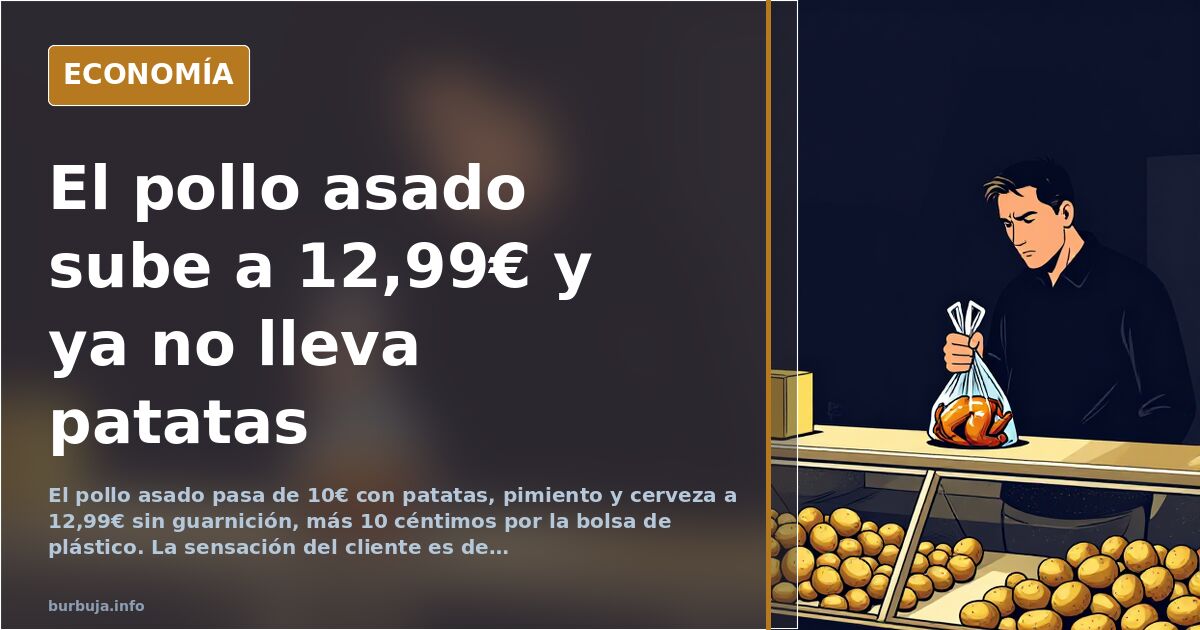
Roast chicken: from 10 euros with sides to 12.99 euros with nothing
A roast chicken has ceased to be Sunday's cheap meal. In the same establishment where, at the beginning of the year, customers paid 10 euros for a chicken with homemade fries, fried peppers, and a liter of beer, the latest purchase came to 12.99 euros without sides, without peppers, and without beer, plus 10 cents for the plastic bag. In total, 13.09 euros. The person recounting it summarizes the situation with a phrase that is not about savings: it's not about the money, it's about the feeling of being ripped off. The price of roast chicken has become the most visible thermometer for food basket inflation.
The numbers of the escalation: 10 euros, 10.50 euros, and 12.99 euros
The sequence is documented step by step. First, 10 euros with homemade fries, peppers, and a liter of beer. Then, 10.50 euros maintaining the content. In June, the same bill but with homemade fries replaced by frozen ones. On the last visit, the jump: 12.99 euros, and everything that accompanied the chicken disappears from the bag and is sold separately. The portion of French fries—which are still frozen—costs 4.30 euros.
The bill is not just from one roast chicken shop. Cases circulating online depict the same pattern in various locations: some have seen the large chicken with sides rise from 11 euros to 13 euros, and others have verified that the bird that used to serve four diners now barely reaches two. The reduction is not on the label, it is in the size.
How much does a roast chicken really cost? The costs cited by roast chicken shops
The sector's defense relies on raw materials. Data handled by those who have worked in food distribution are conclusive: chicken has gone from 2.40 euros/kg to 3.50 euros/kg, the 25-kilo sack of potatoes from 10 euros to 27 euros, and propane gas has become 250% more expensive. Added to this are oil, beer, wages, and VAT. With this cost picture, they argue, expecting 2019 prices is to have understood nothing.
The problem is that this argument clashes with competitive evidence. A raw two-kilo chicken already exceeds 6 euros in stores, yes, but this also reveals the margin of those selling roast chicken at 13 euros without accompaniment. The question no one in the sector fully answers is why the extra cost falls entirely on the final customer rather than being shared between supplier and business.
The same chicken for 5 euros at the supermarket: the homemade alternative
Facing the nearly 13 euros from the roast chicken shop, the homemade calculations circulating are ruthless. A whole supermarket chicken costs around 5 euros, two large cans of beer at 50 cents each, and bread complete a meal for four people for 7 or 8 euros. Seasoned with salt, pepper, rosemary, thyme, and a little oil, and put in the oven with water in the tray, the result is nothing to envy from many chicken shops, according to those who practice it.
The sector's price range is, in any case, disconcerting. A renowned Madrid roast chicken shop charges 8.50 euros for a chicken with four fries and its little pot of mojo picón sauce. The reference supermarket chain sells its roast chicken for seven euros and a bit. And in A Coruña, a classic establishment keeps the chicken at 30 euros for more than a year. The same product, prices that multiply by six.
Smaller chicken, higher price
There is a part of the price hike that does not appear in any index: size. Roasting chickens are small birds, just over one kilo. A diner with an appetite eats half a whole chicken and is still hungry with a quarter, because once the bones are removed, there is barely any meat. If before one chicken covered four people and now you have to buy two, the real price per portion has skyrocketed much more than the label suggests.
The majority diagnosis points to a strategy: remove sides, shrink the product, and maintain or raise the bill. The profit is not noticeable on the bill, but it is in the perception of the payer. And the customer's response is the most effective of all: stop going.
From the 500 pesetas menu to the 14 euro chicken
The historical comparison is what best measures the gap. In 1991, a menu with veal tongue in sauce, squid in its ink, dessert, and house wine cost 500 pesetas, about 3 euros, equivalent to about 7.5 euros today. Today, that same menu is no less than 25 or 30 euros. Another calculation points to the effect of the currency change: a menu of 800 pesetas that went on to cost 1 euro dragged an inflation of 66% that was never recovered in wages.
The pattern repeats at every link in the food chain, and the conclusion shared by analyses of very different stripes is uncomfortable: restaurant prices have risen significantly above the general CPI. Arguing whether it is the gas's fault, the supplier's, or greed is a luxury that does not change anyone's bill.
One question remains unanswered in this entire chain: if chicken with sides cost 10 euros and now, with nothing, costs 12.99 euros, what is the fair price for someone else to cook it for you? No one has given the figure. Only the bag.
A roast chicken has ceased to be Sunday's cheap meal. In the same establishment where, at the beginning of the year, customers paid 10 euros for a chicken with homemade fries, fried peppers, and a liter of beer, the latest purchase came to 12.99 euros without sides, without peppers, and without beer, plus 10 cents for the plastic bag. In total, 13.09 euros. The person recounting it summarizes the situation with a phrase that is not about savings: it's not about the money, it's about the feeling of being ripped off. The price of roast chicken has become the most visible thermometer for food basket inflation.
The numbers of the escalation: 10 euros, 10.50 euros, and 12.99 euros
The sequence is documented step by step. First, 10 euros with homemade fries, peppers, and a liter of beer. Then, 10.50 euros maintaining the content. In June, the same bill but with homemade fries replaced by frozen ones. On the last visit, the jump: 12.99 euros, and everything that accompanied the chicken disappears from the bag and is sold separately. The portion of French fries—which are still frozen—costs 4.30 euros.
The bill is not just from one roast chicken shop. Cases circulating online depict the same pattern in various locations: some have seen the large chicken with sides rise from 11 euros to 13 euros, and others have verified that the bird that used to serve four diners now barely reaches two. The reduction is not on the label, it is in the size.
How much does a roast chicken really cost? The costs cited by roast chicken shops
The sector's defense relies on raw materials. Data handled by those who have worked in food distribution are conclusive: chicken has gone from 2.40 euros/kg to 3.50 euros/kg, the 25-kilo sack of potatoes from 10 euros to 27 euros, and propane gas has become 250% more expensive. Added to this are oil, beer, wages, and VAT. With this cost picture, they argue, expecting 2019 prices is to have understood nothing.
The problem is that this argument clashes with competitive evidence. A raw two-kilo chicken already exceeds 6 euros in stores, yes, but this also reveals the margin of those selling roast chicken at 13 euros without accompaniment. The question no one in the sector fully answers is why the extra cost falls entirely on the final customer rather than being shared between supplier and business.
The same chicken for 5 euros at the supermarket: the homemade alternative
Facing the nearly 13 euros from the roast chicken shop, the homemade calculations circulating are ruthless. A whole supermarket chicken costs around 5 euros, two large cans of beer at 50 cents each, and bread complete a meal for four people for 7 or 8 euros. Seasoned with salt, pepper, rosemary, thyme, and a little oil, and put in the oven with water in the tray, the result is nothing to envy from many chicken shops, according to those who practice it.
The sector's price range is, in any case, disconcerting. A renowned Madrid roast chicken shop charges 8.50 euros for a chicken with four fries and its little pot of mojo picón sauce. The reference supermarket chain sells its roast chicken for seven euros and a bit. And in A Coruña, a classic establishment keeps the chicken at 30 euros for more than a year. The same product, prices that multiply by six.
Smaller chicken, higher price
There is a part of the price hike that does not appear in any index: size. Roasting chickens are small birds, just over one kilo. A diner with an appetite eats half a whole chicken and is still hungry with a quarter, because once the bones are removed, there is barely any meat. If before one chicken covered four people and now you have to buy two, the real price per portion has skyrocketed much more than the label suggests.
The majority diagnosis points to a strategy: remove sides, shrink the product, and maintain or raise the bill. The profit is not noticeable on the bill, but it is in the perception of the payer. And the customer's response is the most effective of all: stop going.
From the 500 pesetas menu to the 14 euro chicken
The historical comparison is what best measures the gap. In 1991, a menu with veal tongue in sauce, squid in its ink, dessert, and house wine cost 500 pesetas, about 3 euros, equivalent to about 7.5 euros today. Today, that same menu is no less than 25 or 30 euros. Another calculation points to the effect of the currency change: a menu of 800 pesetas that went on to cost 1 euro dragged an inflation of 66% that was never recovered in wages.
The pattern repeats at every link in the food chain, and the conclusion shared by analyses of very different stripes is uncomfortable: restaurant prices have risen significantly above the general CPI. Arguing whether it is the gas's fault, the supplier's, or greed is a luxury that does not change anyone's bill.
One question remains unanswered in this entire chain: if chicken with sides cost 10 euros and now, with nothing, costs 12.99 euros, what is the fair price for someone else to cook it for you? No one has given the figure. Only the bag.
Also available in: Deutsch
Summary of a discussion on Burbuja.info - Foro de economía, actualidad y política., translated from Spanish and reviewed before publication. Read the full discussion (315 replies).
More summaries
-
Mercadona vs. traditional Spanish bars: is price winning over tradition?
Inflation squeezes traditional Spanish restaurants, while Mercadona's integrated ready-meal model competes on price and speed with local bars.
-
Depression and precarity: The wall attitude cannot break
A forum user argues depression arises when expectations clash with reality; others respond that positive attitude is not enough.
-
Young Man Fired for Mocking Puerta del Sol Protesters
A young man was fired after a viral video mocked Puerta del Sol protesters as lazy. The case sparks debate on fair dismissal and free speech in Spain.
-
Plane Myth: Confusing Inertia with Wind in Spain
Earth rotates at 1,600 km/h and planes fly at 840 km/h. The error is forgetting that air rotates with the planet.
-
Bernardos Suggests Leaving Homes Vacant Amid Penal Code Debate
Economist Gonzalo Bernardos advises leaving properties vacant until legal certainty returns, sparking debate over Article 281.1 of the Spanish Penal Code.
-
Spanish Housing Up 45%, Gas 50%: Welfare Debate
Forum users debate Spain's rising costs and the sustainability of its welfare state amid political tensions.