
Retiring with Paid Home and €150k: The €300k Threshold
Paid home, €150k invested, age 30: calculations for quitting work fall short, pushing the most cited threshold to €300k.
English · Original discussion in Spanish · Published
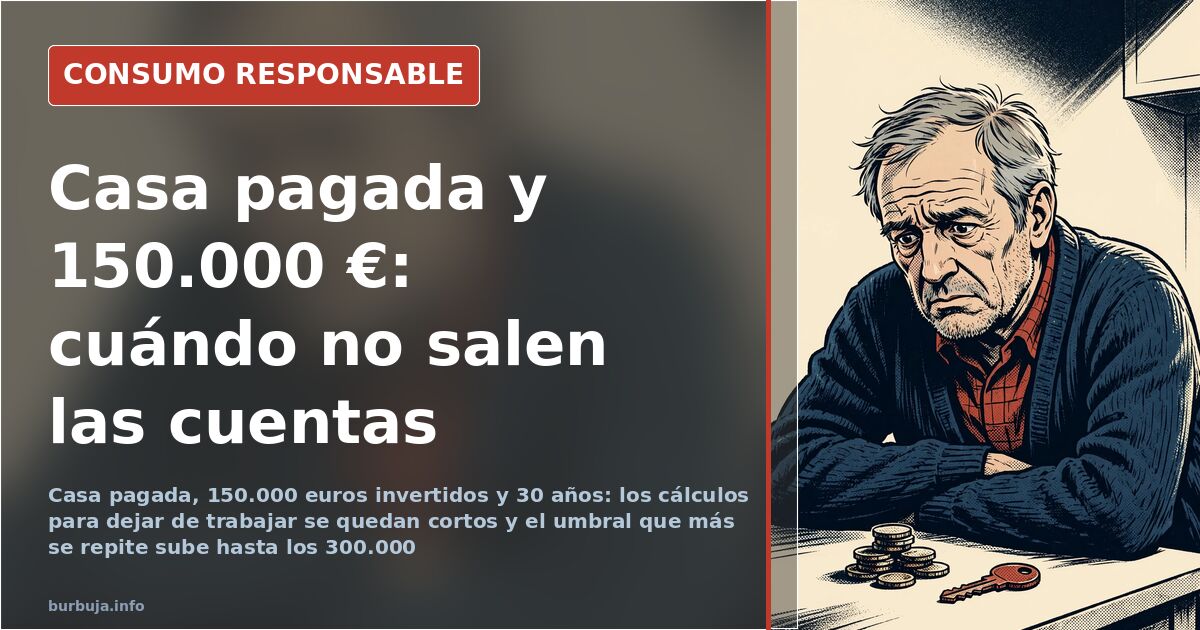
Paid Home and €150k at 30: The Threshold is €300k
A 30-year-old man with a paid-off house, no children, and €150,000 in funds and stocks has run the numbers. He works ten hours a day —from 9:00 to 20:00, including lunch— and earns between €3,000 and €4,000 net per month as a middle manager. He wants to stop grinding. Not entirely, he clarifies: his plan is to invest that capital and combine it with part-time work or a hobby until he reaches €700-1,000 monthly, which he calculates is enough to live on.
The starting figure is €150,000. The problem is how long it lasts.
High Salary That Doesn't Buy Time
His argument isn't laziness, it's arithmetic: if expenses haven't risen with salary, earning four times more adds nothing but fatigue. "I have a paid-off house, no kids, I'm 30, and all I do is work," he summarizes. He lives on less than €1,000 a month: console games, old friends, beers, board games, bike, and dog. No whims or luxuries. With this spending structure, he argues, €3,000 net a month is worth exactly the same as €1,000.
The first cold shower arrives immediately. €150,000 for one person isn't much: that's the conclusion of conservative calculations. The prudent scenario assumes about €900 a month for bills and living costs for someone living alone, and with that figure, the cushion runs out before retirement.
How Much Does It Cost to Live Alone with a Paid Home?
Here the issue becomes useful, because there are itemized budgets. One of the most detailed, from someone in a similar situation, totals €200 for utilities —electricity, water, fuel, mobile, internet, property tax, and home insurance—, €300 for food and cleaning, €50 for tobacco, and €50 for unforeseen events, with community fees at zero. Total around €600 monthly for a person owning their home with no debts.
With less than €1,000 a month, one can live in much of the country. However, whether that spending level withstands a broken car, a special assessment, or a year without income is another matter. The difference between living and surviving is exactly what separates a €150,000 asset from a €300,000 one.
The Recurring Threshold: €300,000 and a Paid Home
On this point, rarely agreeing stances coincide. With the home paid off, €300,000 appears again and again as the boundary between tightening belts and breathing easily. The most cited case is that of a thirty-something who did it with less: paid-off house and €290,000. Ten years later, according to the circulating story, he had more money than at the start and still didn't regret it. The attributed recipe fits in four letters: stocks.
It's not the only high asset on the table. In another case, more than €500,000 in funds and deposits are declared, with a paid-off apartment and two children. Their conclusion isn't freedom, but burden: children completely change the equation.
Stocks, Real Estate, or Part-Time: The Options Pool
The considered exits are few and all have drawbacks. First: invest the €150,000 at 3% annual return and draw part of the expenses from it. Second: buy small properties to rent, with two apartments of €75,000 each generating about €500 a month as an example. Third: work part-time and supplement with rental income.
Real estate receives the harshest criticism. It is argued that it is an investment for the very poor or the very rich, and no one else in between: high buying and selling costs, taxes paid regardless of profit or loss, special assessments, renovations, and maintenance that accumulates precisely in the long term. Those who always get paid, it is insisted, are the notary, the registry, and the tax authorities (Hacienda). This explains, according to this reading, the Spanish obsession with real estate as the only significant investment accessible to those who don't have capital upfront.
Part-time work enjoys better press. A declared case: 36 years old, paid-off house, €100,000 saved, and a job four hours a day Monday to Friday, with €850 net in 14 payments and 0% income tax (IRPF). Also mentioned are reduced working hours for family care to cut hours without losing the position, translation and subtitling from home, and remote work in the tech sector, where €2,000 a month is cited with training and experience.
The Warning Nobody Wants to Hear: 30 Is Too Early
Against all calculations lies an uncomfortable argument: comparing today's €150,000 with the 10 million pesetas of thirty years ago. That seemed like a fortune then; today it doesn't buy an apartment. At 30, this current argues, closing the chapter on your career is precipitous; it would be reasonable to hold on until 40 and retire then without shocks. The proposed middle path is a civil service exam (oposición): once passed, after five years you can request leave, leaving a hard-to-match professional parachute.
There are also those proposing more exotic solutions: renting out the home and moving to a village or abroad to live off that income, with a garden and quiet life, not touching the cushion until at least 50. And an option the protagonist himself put on the table —finding a partner who contributed household income— was instantly discarded due to asset risk.
The disorienting data isn't any projection. It's that the most cited case of all, the thirty-something who stopped working with €290,000 and a paid-off house, didn't just lose money over ten years: he ended up with more than he started with.
A 30-year-old man with a paid-off house, no children, and €150,000 in funds and stocks has run the numbers. He works ten hours a day —from 9:00 to 20:00, including lunch— and earns between €3,000 and €4,000 net per month as a middle manager. He wants to stop grinding. Not entirely, he clarifies: his plan is to invest that capital and combine it with part-time work or a hobby until he reaches €700-1,000 monthly, which he calculates is enough to live on.
The starting figure is €150,000. The problem is how long it lasts.
High Salary That Doesn't Buy Time
His argument isn't laziness, it's arithmetic: if expenses haven't risen with salary, earning four times more adds nothing but fatigue. "I have a paid-off house, no kids, I'm 30, and all I do is work," he summarizes. He lives on less than €1,000 a month: console games, old friends, beers, board games, bike, and dog. No whims or luxuries. With this spending structure, he argues, €3,000 net a month is worth exactly the same as €1,000.
The first cold shower arrives immediately. €150,000 for one person isn't much: that's the conclusion of conservative calculations. The prudent scenario assumes about €900 a month for bills and living costs for someone living alone, and with that figure, the cushion runs out before retirement.
How Much Does It Cost to Live Alone with a Paid Home?
Here the issue becomes useful, because there are itemized budgets. One of the most detailed, from someone in a similar situation, totals €200 for utilities —electricity, water, fuel, mobile, internet, property tax, and home insurance—, €300 for food and cleaning, €50 for tobacco, and €50 for unforeseen events, with community fees at zero. Total around €600 monthly for a person owning their home with no debts.
With less than €1,000 a month, one can live in much of the country. However, whether that spending level withstands a broken car, a special assessment, or a year without income is another matter. The difference between living and surviving is exactly what separates a €150,000 asset from a €300,000 one.
The Recurring Threshold: €300,000 and a Paid Home
On this point, rarely agreeing stances coincide. With the home paid off, €300,000 appears again and again as the boundary between tightening belts and breathing easily. The most cited case is that of a thirty-something who did it with less: paid-off house and €290,000. Ten years later, according to the circulating story, he had more money than at the start and still didn't regret it. The attributed recipe fits in four letters: stocks.
It's not the only high asset on the table. In another case, more than €500,000 in funds and deposits are declared, with a paid-off apartment and two children. Their conclusion isn't freedom, but burden: children completely change the equation.
Stocks, Real Estate, or Part-Time: The Options Pool
The considered exits are few and all have drawbacks. First: invest the €150,000 at 3% annual return and draw part of the expenses from it. Second: buy small properties to rent, with two apartments of €75,000 each generating about €500 a month as an example. Third: work part-time and supplement with rental income.
Real estate receives the harshest criticism. It is argued that it is an investment for the very poor or the very rich, and no one else in between: high buying and selling costs, taxes paid regardless of profit or loss, special assessments, renovations, and maintenance that accumulates precisely in the long term. Those who always get paid, it is insisted, are the notary, the registry, and the tax authorities (Hacienda). This explains, according to this reading, the Spanish obsession with real estate as the only significant investment accessible to those who don't have capital upfront.
Part-time work enjoys better press. A declared case: 36 years old, paid-off house, €100,000 saved, and a job four hours a day Monday to Friday, with €850 net in 14 payments and 0% income tax (IRPF). Also mentioned are reduced working hours for family care to cut hours without losing the position, translation and subtitling from home, and remote work in the tech sector, where €2,000 a month is cited with training and experience.
The Warning Nobody Wants to Hear: 30 Is Too Early
Against all calculations lies an uncomfortable argument: comparing today's €150,000 with the 10 million pesetas of thirty years ago. That seemed like a fortune then; today it doesn't buy an apartment. At 30, this current argues, closing the chapter on your career is precipitous; it would be reasonable to hold on until 40 and retire then without shocks. The proposed middle path is a civil service exam (oposición): once passed, after five years you can request leave, leaving a hard-to-match professional parachute.
There are also those proposing more exotic solutions: renting out the home and moving to a village or abroad to live off that income, with a garden and quiet life, not touching the cushion until at least 50. And an option the protagonist himself put on the table —finding a partner who contributed household income— was instantly discarded due to asset risk.
The disorienting data isn't any projection. It's that the most cited case of all, the thirty-something who stopped working with €290,000 and a paid-off house, didn't just lose money over ten years: he ended up with more than he started with.
Also available in: Deutsch
Summary of a discussion on Burbuja.info - Foro de economía, actualidad y política., translated from Spanish and reviewed before publication. Read the full discussion (106 replies).
More summaries
-
Trade Republic: 2.25% interest or simplicity with a catch?
Trade Republic pays 2.25% on cash and 3% to new customers, but the app's simplicity hides fees, poor service and issues with business accounts.
-
20-Cent Bags: The Tax That Fails to Stop the Dumping
Bags cost 20 cents, yet 95% of ocean plastic comes from only 10 rivers: the true cost of this 'green gesture' doesn't match the propaganda.
-
Elon Musk’s appearance sparks debate: does the founder’s body matter?
Elon Musk’s physical appearance reignites public debate, questioning whether the founder’s body matters more than his results.
-
The ultimate budget cars: from Toledo TDI to C15
From a 450,000 km Toledo TDI to a 540,000 km Córdoba SDI, these are the most indestructible and low-maintenance used cars.
-
82 euros a month for a used car with 100,000 km
A 2010 diesel Megane with 100,000 km costs just €81.92 per month including fuel, excluding the initial purchase price.
-
The German Abendbrot debate: bread, cold cuts, and no cooking
The German Abendbrot consists of bread and cold cuts with no cooking involved. A debate arises over why Germany eats cold dinners.