
The ultimate budget cars: from Toledo TDI to C15
From a 450,000 km Toledo TDI to a 540,000 km Córdoba SDI, these are the most indestructible and low-maintenance used cars.
English · Original discussion in Spanish · Published
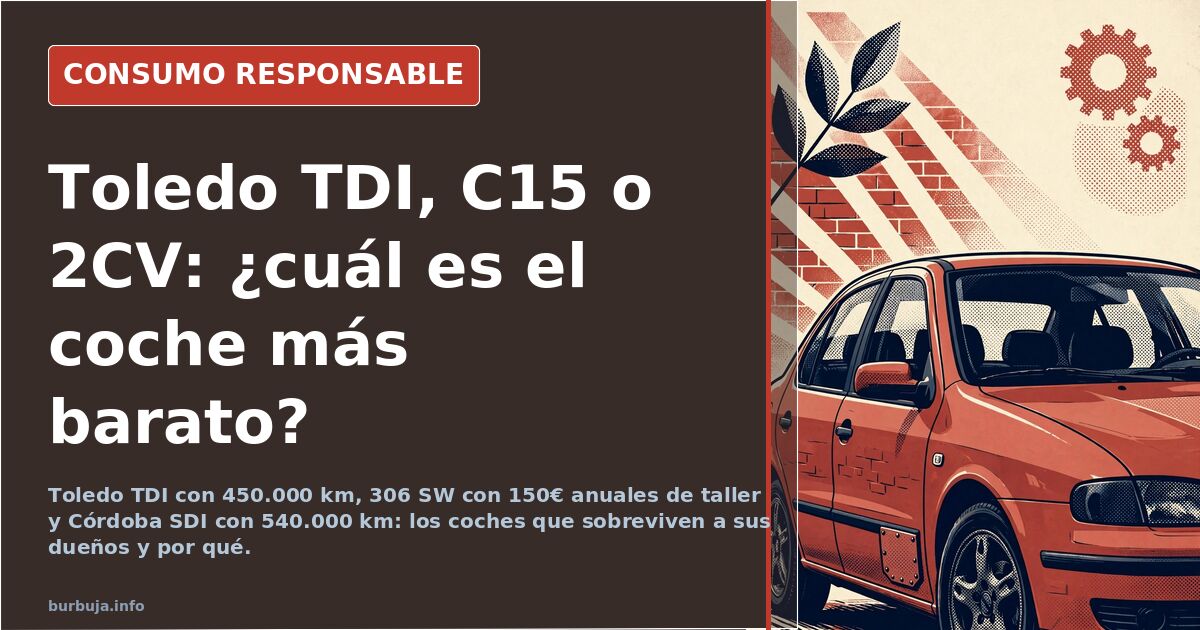
The ultimate budget cars in history: from Toledo TDI to C15
What is the cheapest car to run in history? There are more answers than you might think. A 90 CV Toledo TDI with 450,000 km, a Golf MK3 consuming 5 liters per 100 km, a 306 SW with 350,000 km and only €150 in annual workshop costs, a C15, a 2CV, a Beetle, or a Xsara HDI with 750,000 km. The list is long and the figures don't always add up. What does add up is the pattern: the cars that outlive their owners are the ones with the least technology.
The 90 CV Toledo TDI and the era of indestructible engines
The first 90 CV Toledo TDI appears in the conversation as the ultimate budget car: spacious, with a great boot, and tough as nails. One owner drove it to 450,000 kilometers on the original clutch and newly replaced pads before crashing it into a roundabout. In the summer, it reportedly took more sunflower oil than diesel—a joke that sums up the whole philosophy.
The same pattern repeats with the 1997 Golf MK3 1.6 GT Special: 30 km highway commutes, 5 real liters per 100 km, and an average of 4.6 on the alucinación computer. In seven years, the only issue was a cracked coolant hose costing 15 euros. The 306 SW estate has accumulated 350,000 km with an average annual workshop spend of 150 euros over the last decade, including the original clutch, and has overtaken much more powerful cars on mountain passes.
Some argue that the VAG 1.9 TDI until the year 2000 is the pinnacle of this category: it sounds like a tractor, consumes almost nothing, maintenance is negligible, and it has a massive kick when warm. The Skoda Octavia 1.9 TDI is cited as capable of exceeding a million kilometers without breaking a sweat. The Córdoba SDI, without a turbo, has reached 540,000 km, and its owner plans to keep it for five more years, driving 140 kilometers daily.
Why do naturally aspirated diesels last longer than turbos?
The technical argument is simple: without a turbo, there is nothing to break. The Seat Ibiza 1.9 TD with the AAZ engine—no digital ECU, no EGR valves, and no strange sensors for soot—is described as an immortal car with 280,000 km. The 1993–1996 Córdoba Mk1, with a 68 CV naturally aspirated engine, is seen as the totem of budget driving: it is cheaper on the used market than the Ibiza and offers interior space close to the Toledo. It gets you to the same place, albeit at a snail's pace, with the same consumption and less mechanical complexity.
Against this trend, some defend that the Renault 4 latas (old Renaults) have always been king, or that the 2CV and the Beetle are the holy grails of mass consumption. The rebuttal is quick: the 2CV consumed more than a 127, fits only two people very tightly, and breaks down every two days due to starter motors, solenoids, carburetors, windows, and doors. Anyone who has repaired two claims the locks are a nightmare, the roof leaks, and the bodywork rots. The classic Beetle is neither cheap to buy nor to maintain, with four drum brakes that need adjusting every few miles and a 6V electrical system that many convert to 12V.
The Xantia, the C15, and the van as an alternative
Citroën's hydractive suspension is described as a marvel of comfort, albeit with maintenance requirements. A 90 CV Xantia was once sold for 17 years and 900 euros, consuming 5 real liters per 100 km and being more spacious than a Mercedes C200. Liquid cooling requires care, but one owner of 17 years claims they never lost braking power or suffered a pressure regulator failure. The front-axle handbrake, a Citroën quirk, allows for use if the hydraulic system fails.
A small diesel van in passenger version, bought used at 4 or 5 years old with less than 100,000 km, is presented as a rational option if it doesn't depreciate much—a Mercedes Citan, for example. The 1992 Opel Corsa 1.5 diesel still runs like it did on day one. The Hyundai Atos is mentioned for being ugly but budget-friendly. The Tata Nano, the world's cheapest car, scored zero in European safety tests and, according to one forum user, would kill all occupants, disqualifying it for regular driving.
In the end, the most honest answer is that the ultimate budget car is the one you get for free. Or the one you buy at a clearance sale from a dealership for less than 10,000 euros. Everything else is just negotiating with nostalgia.
What is the cheapest car to run in history? There are more answers than you might think. A 90 CV Toledo TDI with 450,000 km, a Golf MK3 consuming 5 liters per 100 km, a 306 SW with 350,000 km and only €150 in annual workshop costs, a C15, a 2CV, a Beetle, or a Xsara HDI with 750,000 km. The list is long and the figures don't always add up. What does add up is the pattern: the cars that outlive their owners are the ones with the least technology.
The 90 CV Toledo TDI and the era of indestructible engines
The first 90 CV Toledo TDI appears in the conversation as the ultimate budget car: spacious, with a great boot, and tough as nails. One owner drove it to 450,000 kilometers on the original clutch and newly replaced pads before crashing it into a roundabout. In the summer, it reportedly took more sunflower oil than diesel—a joke that sums up the whole philosophy.
The same pattern repeats with the 1997 Golf MK3 1.6 GT Special: 30 km highway commutes, 5 real liters per 100 km, and an average of 4.6 on the alucinación computer. In seven years, the only issue was a cracked coolant hose costing 15 euros. The 306 SW estate has accumulated 350,000 km with an average annual workshop spend of 150 euros over the last decade, including the original clutch, and has overtaken much more powerful cars on mountain passes.
Some argue that the VAG 1.9 TDI until the year 2000 is the pinnacle of this category: it sounds like a tractor, consumes almost nothing, maintenance is negligible, and it has a massive kick when warm. The Skoda Octavia 1.9 TDI is cited as capable of exceeding a million kilometers without breaking a sweat. The Córdoba SDI, without a turbo, has reached 540,000 km, and its owner plans to keep it for five more years, driving 140 kilometers daily.
Why do naturally aspirated diesels last longer than turbos?
The technical argument is simple: without a turbo, there is nothing to break. The Seat Ibiza 1.9 TD with the AAZ engine—no digital ECU, no EGR valves, and no strange sensors for soot—is described as an immortal car with 280,000 km. The 1993–1996 Córdoba Mk1, with a 68 CV naturally aspirated engine, is seen as the totem of budget driving: it is cheaper on the used market than the Ibiza and offers interior space close to the Toledo. It gets you to the same place, albeit at a snail's pace, with the same consumption and less mechanical complexity.
Against this trend, some defend that the Renault 4 latas (old Renaults) have always been king, or that the 2CV and the Beetle are the holy grails of mass consumption. The rebuttal is quick: the 2CV consumed more than a 127, fits only two people very tightly, and breaks down every two days due to starter motors, solenoids, carburetors, windows, and doors. Anyone who has repaired two claims the locks are a nightmare, the roof leaks, and the bodywork rots. The classic Beetle is neither cheap to buy nor to maintain, with four drum brakes that need adjusting every few miles and a 6V electrical system that many convert to 12V.
The Xantia, the C15, and the van as an alternative
Citroën's hydractive suspension is described as a marvel of comfort, albeit with maintenance requirements. A 90 CV Xantia was once sold for 17 years and 900 euros, consuming 5 real liters per 100 km and being more spacious than a Mercedes C200. Liquid cooling requires care, but one owner of 17 years claims they never lost braking power or suffered a pressure regulator failure. The front-axle handbrake, a Citroën quirk, allows for use if the hydraulic system fails.
A small diesel van in passenger version, bought used at 4 or 5 years old with less than 100,000 km, is presented as a rational option if it doesn't depreciate much—a Mercedes Citan, for example. The 1992 Opel Corsa 1.5 diesel still runs like it did on day one. The Hyundai Atos is mentioned for being ugly but budget-friendly. The Tata Nano, the world's cheapest car, scored zero in European safety tests and, according to one forum user, would kill all occupants, disqualifying it for regular driving.
In the end, the most honest answer is that the ultimate budget car is the one you get for free. Or the one you buy at a clearance sale from a dealership for less than 10,000 euros. Everything else is just negotiating with nostalgia.
Also available in: Deutsch
Summary of a discussion on Burbuja.info - Foro de economía, actualidad y política., translated from Spanish and reviewed before publication. Read the full discussion (103 replies).
More summaries
-
Volkswagen cuts Golf price by nearly €5,000 to halt decline
The Volkswagen Golf drops almost €5,000, restoring four cylinders and physical buttons. Starting at €27,845, it faces pressure from Chinese brands and Dacia.
-
Mercadona's Hacendado Yogurt Made in France, Not Toledo
Hacendado natural yogurt comes from a French plant in Jouy, not Toledo. Mercadona’s supplier shift also affects mustard and sunflower seeds.
-
Lidl's frozen sardines at €3.90/kg vs. fresh ones
A kilo of frozen sardines costs €3.90 compared to €9-€10 for fresh ones in Madrid. The question is whether the flavor holds up after freezing.
-
Nootropics: The Silicon Valley pills used to boost performance
Since the synthesis of piracetam in 1972, nootropics have been marketed as cognitive shortcuts despite a lack of regulation and scientific evidence.
-
Quitting smoking: vaping, sunflower seeds, or willpower
Quitting smoking: nicotine withdrawal lasts days, but the habit lasts years. Exploring vaping, patches, and other methods to quit for good.
-
Fuel prices in Spain vary from €1.25 to €1.64
With fuel averaging €1.46 per litre, consumers are frustrated by price gaps between €1.29 and €1.64 as oil nears $90 a barrel.