
Resisting arrest: the growing divide between citizens and police
Alcohol, drugs, and a decline in respect for authority: why resisting a police arrest leads to serious legal consequences.
English · Original discussion in Spanish · Published
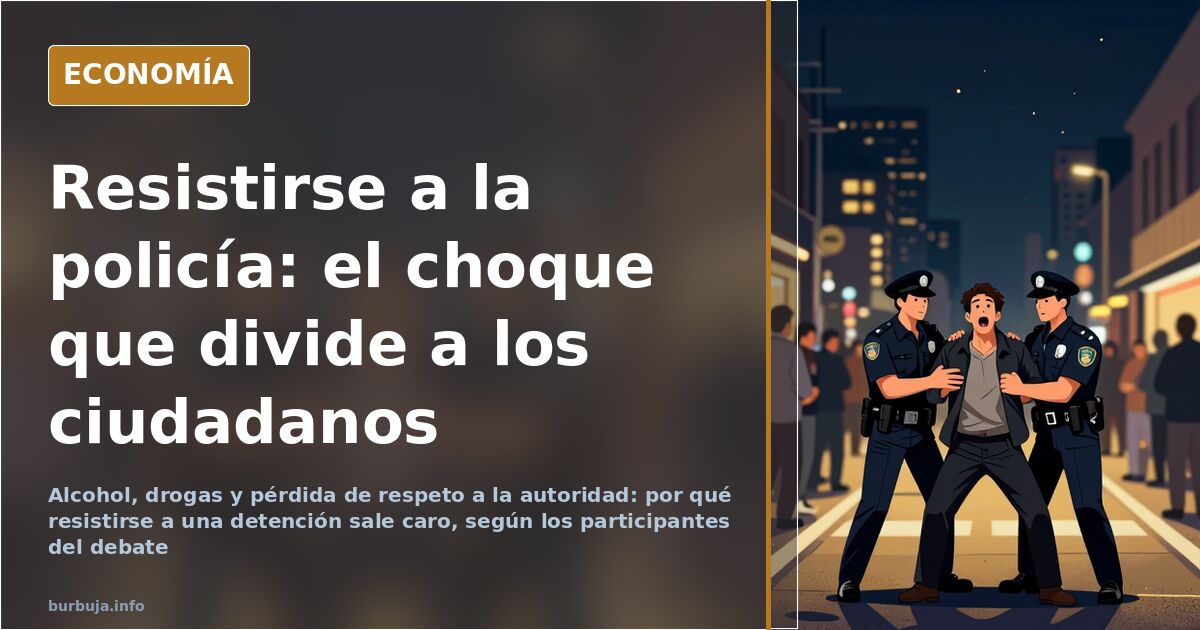
Resisting arrest: the growing divide between citizens and police
Resisting arrest is not a calculated act of rebellion: according to several debate participants, it is the result of a cocktail of adrenaline, alcohol, drugs, and a widespread perception among some that authority has lost its respect for the citizen. This is the core of a discussion that has gathered over a hundred responses and, far from closing, has grown more heated with every new testimony. The fundamental question raised by some is not why someone rebels, but why a segment of the population believes they have nothing left to lose when facing an officer.
The profile of those who resist: drunk, high, or simply cornered
The most frequent explanation is the simplest: alcohol, drugs, and lack of impulse control. Several participants agree that those who rebel are often people who have had too much to drink, are under the influence, or are unaccustomed to dealing with the police. Added to this is the element of surprise: someone who has never had a confrontation with an officer reacts instinctively, much like many people end up shouting over a simple fine.
Some add an evolutionary nuance, arguing that aversion to violence is more marked in certain profiles than others. The discussion then drifts into biological and gender-related territory that should be taken with a grain of salt: these are opinions, not data. What does emerge as a repeated pattern is the idea that those who resist do not think about the legal consequences until their public defender explains them, by which time they have already incurred aggravating circumstances.
Loss of respect for authority: cause or excuse?
A majority view holds that the problem lies not with the citizen, but with the change in the police themselves. It is argued that two or three decades ago, security forces commanded respect and provided safety, that one could greet an officer on the street, and that their presence deterred incivil. Today, according to this version, they have become fine collectors and a figure that many prefer to avoid.
The criticism extends to doctors and teachers: there is talk of a general loss of respect for all authority figures. Conversely, another group reduces it to an issue of individual upbringing: those who did not learn in childhood who is in charge end up clashing with the system. And some remind us that the police are not there to be liked, but to deal with the toughest parts of society.
Resisting is costly: aggravating factors, jail, and trial
The strongest consensus is practical: resisting does not help you get off free. If you are arrested, resistance adds aggravating circumstances that will be weighed in court, while cooperation usually results in less hostile treatment. Fleeing only makes sense if there is a real chance of escaping before more officers arrive, and today, with cameras and media everywhere, that window has narrowed.
The exception cited is the old cases in large cities, where someone rebelled, assaulted, and was never identified. Those were different times. The modern version of the calculation is different: allow yourself to be arrested, do not get agitated, and argue whatever it may be before a judge. As the saying goes, those who persist in resistance end up behind bars as repeat offenders.
The pandemic factor: when masks broke social cohesion
Several testimonies place the breaking point during health restrictions. Officers are described as getting out of cars shouting to demand masks from people walking by, treating someone who had done nothing like a incivil. Those recounting the experience claim they had never had a conflict with the police until then and opted for a diplomatic approach to avoid ending up in a holding cell.
The discussion becomes heated when accusations of assaults during restrictions cross paths with cases of arrests for resistance. Each side has its own video. What is clear is that the pandemic left a mutual distrust that has not dissolved, and many citizens continue to view officers with suspicion.
The generational clash: from the officer you greeted to the one with a hard stare
Nostalgia plays a central role. Officers from the eighties and nineties are remembered as figures who fought against organized crime and terrorism and inspired safety. Today, according to this view, they patrol less and issue more fines, and their presence is associated with sanctions rather than protection.
Not everyone shares this diagnosis. Some respond that society has also changed, that conflict has skyrocketed, and that the police are simply managing a violence that already existed before they arrived. The discussion, in any case, leaves an uncomfortable fact: trust in security forces has become a matter of political leaning rather than evidence.
With this level of mutual distrust, some participants expect an increase in conflicts during arrests. There is no data in the material to confirm or deny this trend.
Also available in: Deutsch
Summary of a discussion on Burbuja.info - Foro de economía, actualidad y política., translated from Spanish and reviewed before publication. Read the full discussion (101 replies).
More summaries
-
Ortiz de Zárate: Arrested in Guadalajara, July 22, 1936
A 1936 photo shows Commander Ortiz de Zárate arrested in Guadalajara before his execution. Historical repression figures remain disputed.
-
Koldo García, former Ábalos aide, arrested over mask contracts
Spain's Civil Guard arrests Koldo García, ex-advisor to José Luis Ábalos, for alleged illegal commissions in pandemic mask purchases and property holdings.
-
Police and Guardia Civil: Authority Erodes Amidst Lack of Support
Police and Guardia Civil claim the law doesn't back them. From lockdowns to ITV fines, the debate over fading authority.
-
Mercadona shifts hiring to older workers as young applicants vanish
Mercadona replaces young staff with 40-60 year olds at checkouts and aisles. Gross salaries of €26,000 and a corporate culture no one can stand.
-
Immigration and crime in Spain: the data that breaks the simple story
2024 data: Africans commit 3.5 times more crimes than their population share; EU citizens, 2x. But the fine print dismantles the easy headlines.
-
Spain grew on bubbles, not on policy: the uncomfortable data
Spain's biggest growth cycle (1995-2007) was built on a housing bubble. The post-pandemic rebound repeats the pattern: without productivity gains, there is no…