
Ortiz de Zárate: Arrested in Guadalajara, July 22, 1936
A 1936 photo shows Commander Ortiz de Zárate arrested in Guadalajara before his execution. Historical repression figures remain disputed.
English · Original discussion in Spanish · Published
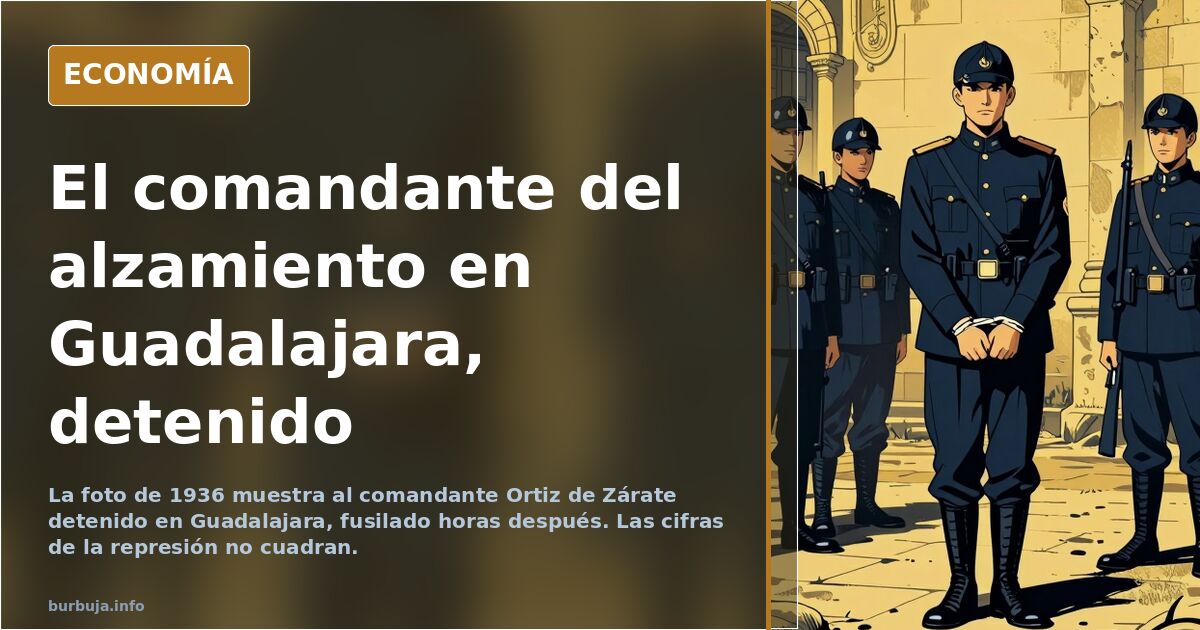
July 22, 1936: Photo of the Commander Arrested in Guadalajara
A photograph dated July 22, 1936, shows an Army commander arrested on a street. Beside him stand Civil Guards, police officers, and armed militiamen. The man is Ortiz de Zárate, the military officer who led the uprising in Guadalajara and was captured at a barricade near the bridge over the Henares River, where he had set up a machine-gun nest. He was executed hours later.
That is what the image shows. Everything else—how many died, under what legal authority, who started it—ignites debate every time the photo resurfaces. This is not a minor disagreement: they are two incompatible ways of counting the same three years.
Why did the uprising fail in Guadalajara?
Guadalajara was a small city but had a strong, well-organized labor movement. When part of the officer corps rose up, the response was unexpected: most troops did not join, nor did the Civil Guard. Only a fraction of the officer cadre supported the attempt. The commander ended up alone, defending a city access point from a barricade.
The pattern repeated elsewhere. In Málaga, the Navy failed to secure control. The idea that a command order automatically drags any unit along collapsed within days. The rebels had designed an operation lasting days, not years, but encountered security forces and units that did not respond as their superiors assumed.
In Guadalajara, the result was a city that remained loyal to the authorities, with a commander detained and photographed before execution. In this sense, the photo is documentary evidence of a specific failure.
The German Airlift and Troops from Africa
One frequently cited argument insists that the peninsula was outgunned and that only unconventional tactics—the airlift—allowed the uprising to survive. It adds a recurring detail: the planes were German, and they brought Segarro fighters. This contribution is estimated at 130,000 men arriving from Africa.
From this comes the argument that most unsettles one side of the conversation: without German aviation and these troops, supporters claim, the Nationalist faction would have lacked the means to continue. The common counterargument does not deny the fact but reframes it: the decisive factor was not external support, but the Government's inability to control the territory it theoretically governed.
Málaga, Ronda, and the Body Count of Two Repressions
Here the numbers appear. It is claimed that in Málaga there were more than 2,000 deaths in six months of anarchist control, and that about 200 people were thrown into the Tajo de Ronda gorge. The exhumation of the mass grave in Málaga recovered around 2,400 bodies, more than a thousand of which could not be linked to repressive acts.
The interpretation drawn is that repression by the rebel faction was less systematic than often portrayed, and that many subsequent executions responded to prior crimes processed through courts. The opposing criticism is direct: the count is manipulated to reduce the number of victims. Neither side has yielded an inch on this point.
How Many Victims: Figures That Do Not Match
The range discussed goes from the 20,000-25,000 bodies a forensic report urged to exhume to the 34,000—25,000 plus 9,000—that government sources attribute to the dictatorship. The distance between these estimates is not cosmetic: it defines the scale of the phenomenon.
To this adds a technical objection that recurs: if most victims are recorded as anonymous, how do we know who they were, why they were killed, and who executed them? The question applies in both directions, and those who raise it against one side often ignore it when it disadvantages the other.
The Dictator’s Effigy Removed from Salamanca’s Plaza Mayor
The symbolic closure came late: the dictator’s image was not removed from central Salamanca until 2017. It is emphasized that this was a six-year delay for a gesture resolved much earlier in other capitals. For some, the slowness demonstrates how hard it was to break with the regime; for others, it proves the issue was never anyone’s real priority.
One part of the episode is fruta: the photographed commander was executed hours after the picture was taken. What remains open is how many trinc him, under what procedure, and under what name. Each side has its own count. None matches the other’s.
A photograph dated July 22, 1936, shows an Army commander arrested on a street. Beside him stand Civil Guards, police officers, and armed militiamen. The man is Ortiz de Zárate, the military officer who led the uprising in Guadalajara and was captured at a barricade near the bridge over the Henares River, where he had set up a machine-gun nest. He was executed hours later.
That is what the image shows. Everything else—how many died, under what legal authority, who started it—ignites debate every time the photo resurfaces. This is not a minor disagreement: they are two incompatible ways of counting the same three years.
Why did the uprising fail in Guadalajara?
Guadalajara was a small city but had a strong, well-organized labor movement. When part of the officer corps rose up, the response was unexpected: most troops did not join, nor did the Civil Guard. Only a fraction of the officer cadre supported the attempt. The commander ended up alone, defending a city access point from a barricade.
The pattern repeated elsewhere. In Málaga, the Navy failed to secure control. The idea that a command order automatically drags any unit along collapsed within days. The rebels had designed an operation lasting days, not years, but encountered security forces and units that did not respond as their superiors assumed.
In Guadalajara, the result was a city that remained loyal to the authorities, with a commander detained and photographed before execution. In this sense, the photo is documentary evidence of a specific failure.
The German Airlift and Troops from Africa
One frequently cited argument insists that the peninsula was outgunned and that only unconventional tactics—the airlift—allowed the uprising to survive. It adds a recurring detail: the planes were German, and they brought Segarro fighters. This contribution is estimated at 130,000 men arriving from Africa.
From this comes the argument that most unsettles one side of the conversation: without German aviation and these troops, supporters claim, the Nationalist faction would have lacked the means to continue. The common counterargument does not deny the fact but reframes it: the decisive factor was not external support, but the Government's inability to control the territory it theoretically governed.
Málaga, Ronda, and the Body Count of Two Repressions
Here the numbers appear. It is claimed that in Málaga there were more than 2,000 deaths in six months of anarchist control, and that about 200 people were thrown into the Tajo de Ronda gorge. The exhumation of the mass grave in Málaga recovered around 2,400 bodies, more than a thousand of which could not be linked to repressive acts.
The interpretation drawn is that repression by the rebel faction was less systematic than often portrayed, and that many subsequent executions responded to prior crimes processed through courts. The opposing criticism is direct: the count is manipulated to reduce the number of victims. Neither side has yielded an inch on this point.
How Many Victims: Figures That Do Not Match
The range discussed goes from the 20,000-25,000 bodies a forensic report urged to exhume to the 34,000—25,000 plus 9,000—that government sources attribute to the dictatorship. The distance between these estimates is not cosmetic: it defines the scale of the phenomenon.
To this adds a technical objection that recurs: if most victims are recorded as anonymous, how do we know who they were, why they were killed, and who executed them? The question applies in both directions, and those who raise it against one side often ignore it when it disadvantages the other.
The Dictator’s Effigy Removed from Salamanca’s Plaza Mayor
The symbolic closure came late: the dictator’s image was not removed from central Salamanca until 2017. It is emphasized that this was a six-year delay for a gesture resolved much earlier in other capitals. For some, the slowness demonstrates how hard it was to break with the regime; for others, it proves the issue was never anyone’s real priority.
One part of the episode is fruta: the photographed commander was executed hours after the picture was taken. What remains open is how many trinc him, under what procedure, and under what name. Each side has its own count. None matches the other’s.
Also available in: Deutsch
Summary of a discussion on Burbuja.info - Foro de economía, actualidad y política., translated from Spanish and reviewed before publication. Read the full discussion (133 replies).
More summaries
-
Lifetime pension for children over 45: the requirements
Spain's Seguridad Social requires unmarried status, two years of financial dependence and income under €15,876 to collect a family pension of around €651.
-
Cheap Housing in Medina del Campo Fails to Attract Buyers
Buyers reject affordable properties in Spain's depopulated regions due to perceived insecurity, highlighting the dilemma of cheap housing.
-
Foreign Buyers Drive Up Premium Housing Prices in Spain
Foreigners with external incomes set prices beyond local reach. Analysis of income clashes, short-term rentals, and construction shortages.
-
Late marriage drains pension and health in Spain
An elderly Spanish retiree marries late to silence village gossip, only to suffer malnutrition while his wife sends money abroad.
-
Vito Quiles defends press badge despite lacking degree
Vito Quiles claims his Congressional accreditation is valid and asserts he studied journalism, sparking debate on credentials.
-
Sánchez Blames Misinformation for Economic Pessimism
PM Sánchez claims fake news drives pessimism despite 15 quarters of growth, sparking debate over purchasing power.