
Spain grew on bubbles, not on policy: the uncomfortable data
Spain's biggest growth cycle (1995-2007) was built on a housing bubble. The post-pandemic rebound repeats the pattern: without productivity gains, there is no…
English · Original discussion in Spanish · Published
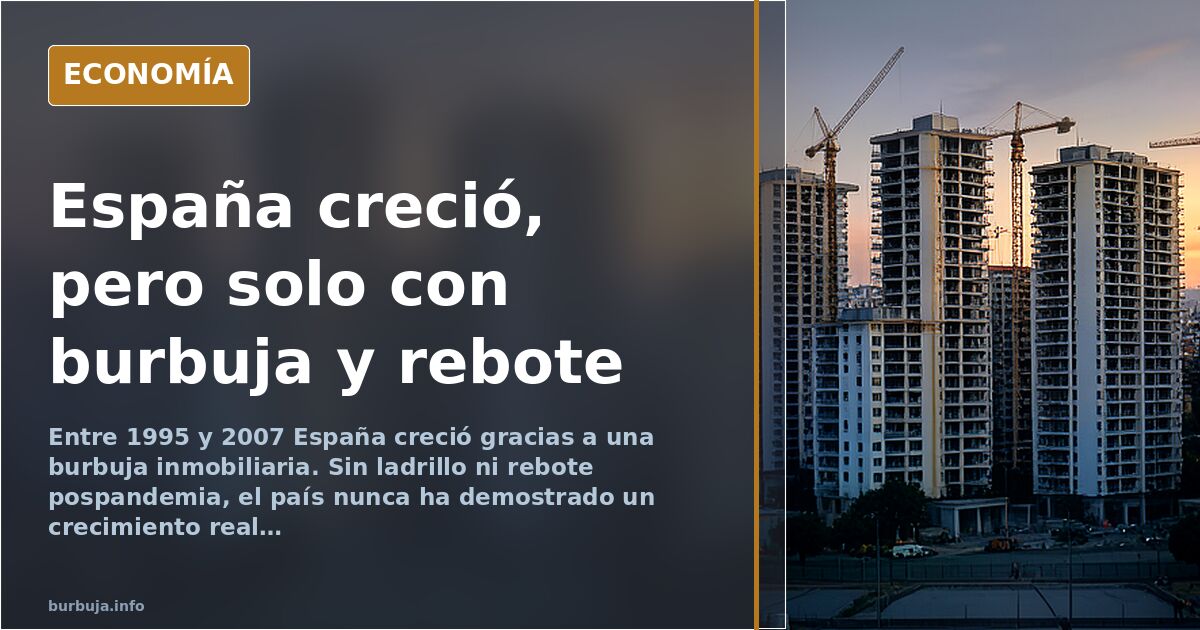
Spain has only grown on bubbles: 1995-2007 and the Elbichito rebound
Between 1995 and 2007 Spain enjoyed the longest growth cycle of its democracy: two Aznar governments and the first Zapatero term. The fact is undeniable. The interpretation is less so: that boom rested on a property and speculative bubble, not on sustained productivity gains. And recent years, far from breaking the pattern, confirm it: the post-pandemic rebound inflates the figures without anyone having solved where the next engine of growth will come from.
The paradox at the heart of the issue is uncomfortable for both sides. If the PP governed during the brightest stretch, it was with a tailwind it did not create. If the PSOE has accumulated more years in power, none of them coincide with a comparable expansion. On that basis, crediting political management becomes an act of faith rather than accounting.
Francoism as the recurring crutch
The conversation soon drifts toward the development decades. Some argue that the previous regime lifted the country out of hunger with roads, dams and an emerging middle class. The nuance comes immediately: the technocrats who designed the economic miracle were economists with no confessional ideology, linked to Opus Dei, and their recipe relied on cheap labour, low wages, workplace discipline and the massive inflow of foreign currency from tourism and emigration. Autarky, the regime's genuine contribution, was precisely what sank the country until opening up rescued it.
The counterpoint is just as forceful: Western Europe, all of it democratic, grew just as intensely during postwar reconstruction. Confusing correlation with causation is a textbook error. The oil crisis swept away that shoddy prosperity and exposed the model's feet of clay.
Housing: building a million homes won't fix GDP
The classic proposal comes up: build a million homes to create jobs and wealth. The calculation has a catch. Spain has around 28 million homes for a population of roughly 30-35 million Spaniards, according to the figure used in the discussion itself. The problem is not the stock, it is distribution and the price of land. Some suggest the state could provide free land and remove the tax burden on primary residences, which would cut prices by more than half. It is not done, the argument goes, because politicians have other priorities.
The demographic objection is the most uncomfortable: without a young population willing to buy, building more only inflates the construction sector without solving the underlying issue. And the underlying issue is that the country lives on tourism, football and low value-added services.
Speculation is not a sin, it is the market
Against the narrative of the bubble as an anomaly, another school argues that so-called speculation is simply how an economy works: anticipating prices, allocating capital, taking risk. Viewed through that lens, the growth of 1995-2007 was no mirage, but the rational response to an environment of low rates and abundant credit. The problem was not the mechanism, but that nobody put a brake on it in time.
The figure that unsettles everyone: the 1984-1992 period also saw growth, sustained then by the public works bubble. And the last four years, with inflation devouring wages, show an expansion many read as mere statistical recovery after the collapse. Every cycle has its alibi.
The Thatcher case and the uncomfortable mirror
The conversation jumps to the United Kingdom. The 1986 financial deregulation consolidated a services and finance model that wiped out northern industry and left a regional inequality that persists today. A prosperous south, depressed former mining basins. Here, it is pointed out, such an experiment would trigger social revolt.
The lesson crosses borders: when growth is concentrated in a speculative sector, the subsequent adjustment is paid for by the regions and workers who did not share in the boom. Spain is not an exception, just another case from the same manual.
The question remains unanswered: if every Spanish expansion has needed a bubble as fuel, is there a formula for real growth that does not involve inflating prices, or is the country doomed to wait for the next bubble?
Also available in: Deutsch
Summary of a discussion on Burbuja.info - Foro de economía, actualidad y política., translated from Spanish and reviewed before publication. Read the full discussion (154 replies).
More summaries
-
Aznar's Spain: Economic Miracle or Housing Bubble?
Debate contrasts Aznar's economic miracle (1996-2004) with the housing bubble thesis starting in 1999. No consensus found.
-
AI as an economic engine: bubble or structural shift?
Economic analysis of AI: Is it the growth engine or a speculative bubble? Energy costs and business adoption are examined.
-
Eva Cárdenas and the property business dragging Feijóo into the spotlight
A company set up with €3,000 in capital and €300,000 in annual profits: Eva Cárdenas's property business reopens the debate on real estate and politics in Spain.
-
Pope Leo XIV warns that "tyrants are ravaging the world"
Pope Leo XIV warns about tyrants ravaging the world, drawing accusations of hypocrisy and conspiracy theories. A message aimed at Trump?
-
Pentagon weighs pushing Spain out of NATO
A leaked Pentagon email reported by Reuters reveals options to punish Spain for refusing to back the war with Iran, including suspending it from NATO.
-
Spain's old aristocracy and its future: a satirical take on the new elite
An analysis of the future of Spain's old-money aristocracy through a symbolic story: offensive humility, symbolic power and the new paradigm of the elite.