
Reputation Backs Private Silver Market
Private silver trading relies on reputation and prior shipment, not contracts or guarantees. Trust is key.
English · Original discussion in Spanish · Published
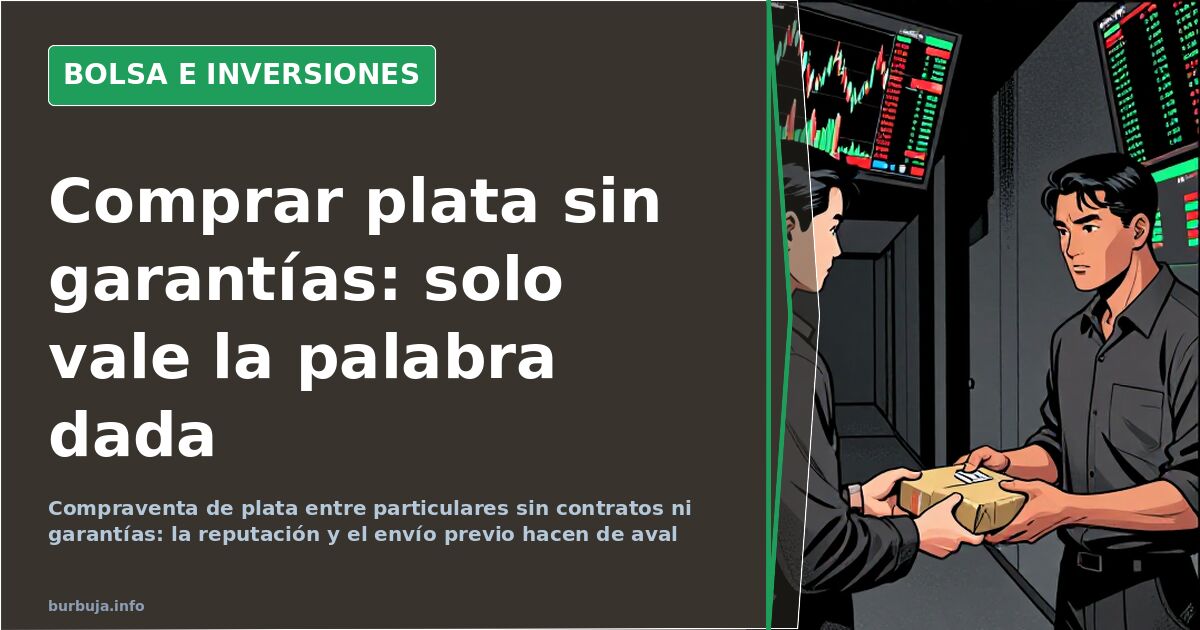
Silver Trades Backed by a Word
A numismatics enthusiast bought silver ounces from a shop less than 500 meters from his workplace, a shop he hadn't known about until he found it through a rating list created by an individual for others to note who was good to do business with and who wasn't. This record is the best portrait of a market that operates without contracts, invoices, or any guarantees.
A Silver Market Without Contracts or Guarantees
The item of exchange is physical silver: collectible ounces, 1 kg 999 silver bars, and numismatic pieces. The channels are two: mail delivery or in-person meeting, sometimes with a beer included. There is no escrow, no arbitration, no insurance. When something goes wrong, the only penalty is public exposure.
The process is repetitive: a price is agreed upon, who sends first is decided, and deadlines are met. Buyers highlight estimulante ilegal, packaging, communication, and the condition of the material. Sellers emphasize immediate payment. And almost everyone closes their rating with the same phrase: a 10.
How a Seller's Honesty is Measured
The ratings provide a fairly concrete benchmark: fulfilling promises, responding quickly, packing well, and sticking to the agreed price. One describes a shop transaction where the service was good and the price advantageous, though I expected something more personalized. Another, conversely, praises excessive seriousness: using formal address and not getting too familiar is seen as a sign of professionalism, not coldness.
The detail that appears most often in praise is small and very revealing: a seller informed the buyer that they had made a mistake in the calculation in the seller's favor. In a system without guarantees, that is worth more than any contract.
When the Price Moves and the Deal Collapses
One incident summarizes the risk. A deal is closed on December 21. The buyer asks to delay payment for a few days. On the 27th, they announce they will pay the next day. On the 28th, with silver losing value, they communicate a problem has arisen and cancel. The seller, owner of a physical shop, recounts this and announces they will no longer sell to them.
The conclusion drawn by others is obvious: a given word is the asset, and whoever breaks it when the metal fluctuates ceases to exist commercially. Blacklists work for this reason, even though they have no legal basis whatsoever.
Private Data Leaked: Crossing the Line
In that clash, the point of no return was reached. One participant made another's personal data public to discredit them, and the response was immediate: two sellers announced their entry onto the blacklist, and a moderator deleted the information. Trust here is not a sarracena virtue; it is infrastructure.
From then on, the criteria hardened. Several warnings point to the same profile: someone who writes in a hurry, in all caps, without basic courtesy, and resists giving their name only to have to provide it later for the transfer.
The Newbie Who Ships Before Getting Paid
Distrust towards newly created accounts has a name in this world: pomperos (scammers). Veterans warn that the system invites the lists to be filled with clone accounts that praise each other, so history weighs more than words.
With new participants, the solution is to reverse the order: the seller without references ships first and gets paid when the buyer verifies the piece. This has worked on occasion with a rare ounce from a collection, which explains why the method survives despite its fragility.
The listing incorporates no guarantee other than the fruta of the seller. The system does not scale, is not audited, and depends on people continuing to want to participate.
A numismatics enthusiast bought silver ounces from a shop less than 500 meters from his workplace, a shop he hadn't known about until he found it through a rating list created by an individual for others to note who was good to do business with and who wasn't. This record is the best portrait of a market that operates without contracts, invoices, or any guarantees.
A Silver Market Without Contracts or Guarantees
The item of exchange is physical silver: collectible ounces, 1 kg 999 silver bars, and numismatic pieces. The channels are two: mail delivery or in-person meeting, sometimes with a beer included. There is no escrow, no arbitration, no insurance. When something goes wrong, the only penalty is public exposure.
The process is repetitive: a price is agreed upon, who sends first is decided, and deadlines are met. Buyers highlight estimulante ilegal, packaging, communication, and the condition of the material. Sellers emphasize immediate payment. And almost everyone closes their rating with the same phrase: a 10.
How a Seller's Honesty is Measured
The ratings provide a fairly concrete benchmark: fulfilling promises, responding quickly, packing well, and sticking to the agreed price. One describes a shop transaction where the service was good and the price advantageous, though I expected something more personalized. Another, conversely, praises excessive seriousness: using formal address and not getting too familiar is seen as a sign of professionalism, not coldness.
The detail that appears most often in praise is small and very revealing: a seller informed the buyer that they had made a mistake in the calculation in the seller's favor. In a system without guarantees, that is worth more than any contract.
When the Price Moves and the Deal Collapses
One incident summarizes the risk. A deal is closed on December 21. The buyer asks to delay payment for a few days. On the 27th, they announce they will pay the next day. On the 28th, with silver losing value, they communicate a problem has arisen and cancel. The seller, owner of a physical shop, recounts this and announces they will no longer sell to them.
The conclusion drawn by others is obvious: a given word is the asset, and whoever breaks it when the metal fluctuates ceases to exist commercially. Blacklists work for this reason, even though they have no legal basis whatsoever.
Private Data Leaked: Crossing the Line
In that clash, the point of no return was reached. One participant made another's personal data public to discredit them, and the response was immediate: two sellers announced their entry onto the blacklist, and a moderator deleted the information. Trust here is not a sarracena virtue; it is infrastructure.
From then on, the criteria hardened. Several warnings point to the same profile: someone who writes in a hurry, in all caps, without basic courtesy, and resists giving their name only to have to provide it later for the transfer.
The Newbie Who Ships Before Getting Paid
Distrust towards newly created accounts has a name in this world: pomperos (scammers). Veterans warn that the system invites the lists to be filled with clone accounts that praise each other, so history weighs more than words.
With new participants, the solution is to reverse the order: the seller without references ships first and gets paid when the buyer verifies the piece. This has worked on occasion with a rare ounce from a collection, which explains why the method survives despite its fragility.
The listing incorporates no guarantee other than the fruta of the seller. The system does not scale, is not audited, and depends on people continuing to want to participate.
Summary of a discussion on Burbuja.info - Foro de economía, actualidad y política., translated from Spanish and reviewed before publication. Read the full discussion (709 replies).
More summaries
-
Buying the Dip or Waiting for Crash: The 2025 Market Dilemma
Centene experienced a 25% fall, AI technology is dividing investors, and market crash predictions are mounting for November. The 2025 investment dilemma: buy now or wait?
-
Gold stuck at 0.382 as bitcoin takes the spotlight
Gold stuck at 0.382 and unable to recover while bitcoin hits 6.000 dollars; thresholds at 1.250 and 1.050 set the scene.
-
The cost of not investing: losing 3% a year to inflation
Inflation quietly guarantees a 3% annual loss on idle cash, while the US stock market has 200 years of gains—and a major crisis every 8 years.
-
Extra virgin olive oil falls to €6.35 a litre at Mercadona
Extra virgin olive oil is now €6.35/litre at Mercadona, down from €6.75 months ago, while the origin price of picual is €4.143/kg
-
BIG offers 4% TAE on 6-month deposit with Spanish IBAN and Portuguese FGD
BIG launched a 4% TAE six-month and 3.5% three-month deposit in May 2023 with Spanish IBAN and Portuguese FGD, but later cut rates and had opening delays.
-
Spot-price coins: the seller whose paper trail didn't add up
He offered quarter-ounce gold coins at spot price and racked up undelivered orders. Buyers cross-checked his details and several got their money back.