
Repurposing a broken halogen heater: using one 400W tube
How to test and use the remaining quartz tube of a broken halogen heater without a multimeter or risking short circuits.
English · Original discussion in Spanish · Published
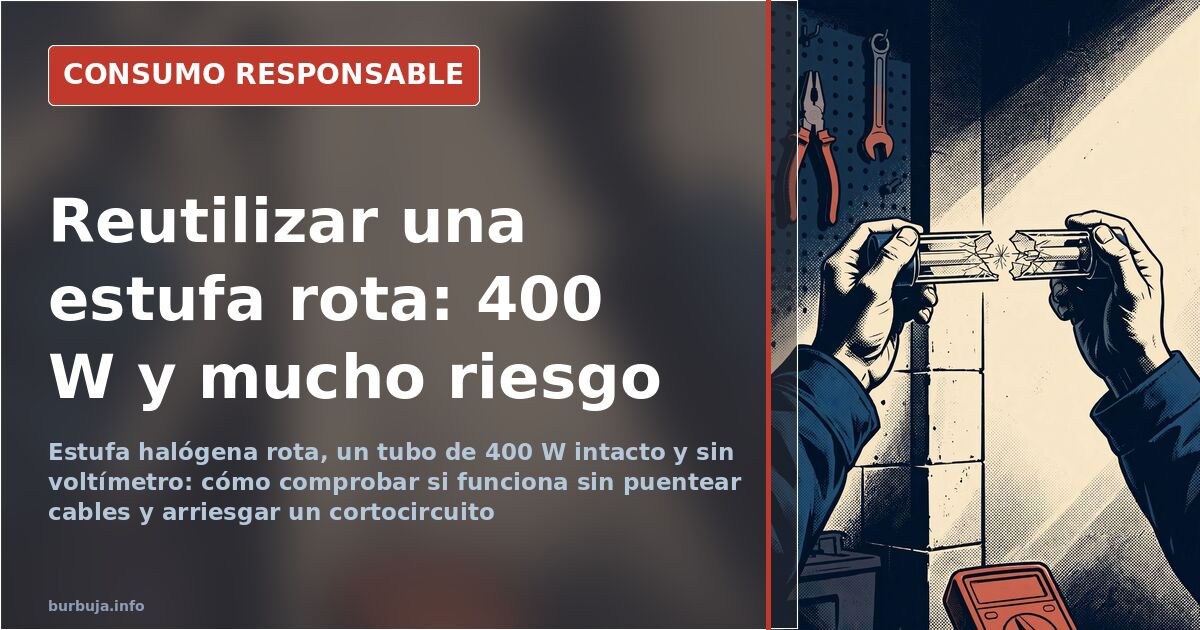
Repurposing a broken heater: 400 W, one tube, no multimeter
Can you reuse a broken halogen heater without a multimeter or buying spare parts? The short answer is yes, but with nuances worth reading before plugging anything in. The setup is simple: a heater with two 400 W quartz tubes, one broken, and the idea of keeping the intact one to warm feet under a table. The problem isn't the tube; it's knowing if it works and how to connect it without tripping the circuit breaker.
The first obstacle is the lack of instruments. Without a multimeter, the only way to check if the surviving tube lights up is to apply voltage and see what happens. The initial proposal involves bridging the gap of the broken tube with a single-strand wire to close the circuit and check if the other illuminates. The technical doubt is reasonable: can a standard wire handle the current of 400 W?
What happens if you bridge the missing tube
Here comes the first serious warning. If the tubes are in series, bridging one with a wire eliminates the voltage drop caused by the other, so the survivor would receive full voltage. If they are in parallel, the bridge doesn't affect the working one. The practical conclusion is clear: don't touch anything. Leave the cables as they are, remove the remains of the broken tube, and test the heater as-is. If the good tube lights up in any regulator position, the heater works. If not, the tube is dead too.
Some argue that the four-position switch isn't a real regulator but a selector combining resistances: off, single resistance, two in series, and two in parallel. If so, the maximum temperature setting connects the tubes in parallel, and the heater should work with just one tube without modification. The test is cheap: plug in, turn, and look.
The bridge wire and short-circuit risk
The idea of replacing the missing tube with a simple wire raises justified concerns. A single-strand wire isn't designed to dissipate heat or withstand the current of a quartz resistor. Those defending the test argue that if the tubes are in parallel, the wire just closes the circuit for the missing tube, causing no harm. Those warning of the risk reply that a poorly calculated bridge leads to a short circuit and a major scare. The most repeated recommendation is to cut the broken tube's wires flush, insulate them with tape, and test only the remaining tube.
The issue with insulation tape in a heater is that heat can degrade it. For a quick daytime test lasting seconds, the risk is limited. For permanent installation, no. The cleanest alternative is removing the broken tube's cables entirely and leaving the good tube's connections in their original position.
Why buying replacements isn't worth it
The economic calculation is relentless. Replacement tubes aren't cost-effective: new halogen heaters start at 8 euros. Add the difficulty of getting the exact size right and the fact that these heaters don't stand alone—they need anchoring. The interest isn't savings; it's the pleasure of repurposing something destined for the trash. That is the real driver.
The same criteria apply to other appliances. A microwave discarded as unrepairable leaves usable sockets, bulbs, plugs, and fans. A router without a charger provides screws, power connectors, and LEDs. An electric radiator without legs can be supported by flat-screen TV mounts and silicone. The logic is always the same: rescue simple parts, avoiding soldering and complex components.
In the end, the heater will either work or not, but the surviving tube has an owner. What we lack is a multimeter and the desire to buy one. Thrifty repurposing is a controlled-risk sport.
Can you reuse a broken halogen heater without a multimeter or buying spare parts? The short answer is yes, but with nuances worth reading before plugging anything in. The setup is simple: a heater with two 400 W quartz tubes, one broken, and the idea of keeping the intact one to warm feet under a table. The problem isn't the tube; it's knowing if it works and how to connect it without tripping the circuit breaker.
The first obstacle is the lack of instruments. Without a multimeter, the only way to check if the surviving tube lights up is to apply voltage and see what happens. The initial proposal involves bridging the gap of the broken tube with a single-strand wire to close the circuit and check if the other illuminates. The technical doubt is reasonable: can a standard wire handle the current of 400 W?
What happens if you bridge the missing tube
Here comes the first serious warning. If the tubes are in series, bridging one with a wire eliminates the voltage drop caused by the other, so the survivor would receive full voltage. If they are in parallel, the bridge doesn't affect the working one. The practical conclusion is clear: don't touch anything. Leave the cables as they are, remove the remains of the broken tube, and test the heater as-is. If the good tube lights up in any regulator position, the heater works. If not, the tube is dead too.
Some argue that the four-position switch isn't a real regulator but a selector combining resistances: off, single resistance, two in series, and two in parallel. If so, the maximum temperature setting connects the tubes in parallel, and the heater should work with just one tube without modification. The test is cheap: plug in, turn, and look.
The bridge wire and short-circuit risk
The idea of replacing the missing tube with a simple wire raises justified concerns. A single-strand wire isn't designed to dissipate heat or withstand the current of a quartz resistor. Those defending the test argue that if the tubes are in parallel, the wire just closes the circuit for the missing tube, causing no harm. Those warning of the risk reply that a poorly calculated bridge leads to a short circuit and a major scare. The most repeated recommendation is to cut the broken tube's wires flush, insulate them with tape, and test only the remaining tube.
The issue with insulation tape in a heater is that heat can degrade it. For a quick daytime test lasting seconds, the risk is limited. For permanent installation, no. The cleanest alternative is removing the broken tube's cables entirely and leaving the good tube's connections in their original position.
Why buying replacements isn't worth it
The economic calculation is relentless. Replacement tubes aren't cost-effective: new halogen heaters start at 8 euros. Add the difficulty of getting the exact size right and the fact that these heaters don't stand alone—they need anchoring. The interest isn't savings; it's the pleasure of repurposing something destined for the trash. That is the real driver.
The same criteria apply to other appliances. A microwave discarded as unrepairable leaves usable sockets, bulbs, plugs, and fans. A router without a charger provides screws, power connectors, and LEDs. An electric radiator without legs can be supported by flat-screen TV mounts and silicone. The logic is always the same: rescue simple parts, avoiding soldering and complex components.
In the end, the heater will either work or not, but the surviving tube has an owner. What we lack is a multimeter and the desire to buy one. Thrifty repurposing is a controlled-risk sport.
Also available in: Deutsch
Summary of a discussion on Burbuja.info - Foro de economía, actualidad y política., translated from Spanish and reviewed before publication. Read the full discussion (137 replies).
More summaries
-
Electric quadricycle vs. EV: can it really save money?
A family with four cars and solar panels considers a small electric quadricycle to cut costs. Does it make sense versus a conventional EV? A cost analysis.
-
Joselín, the €7 Sobaos that divides artisan consumption
Joselín's box costs €7, adding €6 shipping on orders of €50. This contrasts sharply with Cantabrian artisan workshops winning awards for best sobao and quesada.
-
Iced Coffee Ritual: Served Warm and Watered Down
Spanish 'café con hielo' is served hot with ice, resulting in a lukewarm, diluted drink. Critics argue customers pay more for a beverage that fails to cool down.
-
Expired Pantera Rosa: Is It Safe to Eat After 15 Days?
A user finds their Pantera Rosa buns are 15 days past the date. The key lies in the difference between expiration and best-before dates.
-
Gift ideas for a 16-year-old: from archery to shaving kits
A father seeks gift ideas for his phone-addicted 16-year-old son, ranging from archery courses to index funds and classic shaving kits.
-
Valencia in September: Paella, Horchata and Beach
A five-day guide to Valencia in September with teens: where to eat paella, drink horchata in Alboraya, and what to see beyond the Oceanogràfic.