
Gift ideas for a 16-year-old: from archery to shaving kits
A father seeks gift ideas for his phone-addicted 16-year-old son, ranging from archery courses to index funds and classic shaving kits.
English · Original discussion in Spanish · Published
Gift ideas for a 16-year-old: from archery to shaving kits
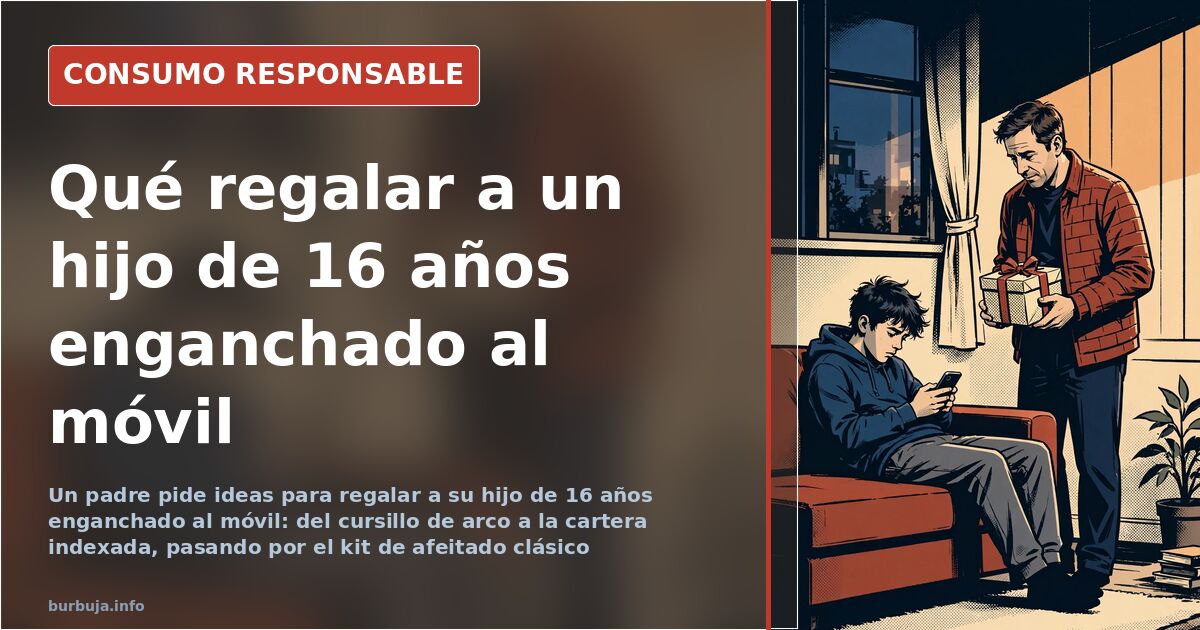
A separated father asks for birthday gift ideas for his son. The teenager does well in high school, leans towards science, plays piano at the Conservatory, and is glued to his phone. He states plainly that he wants something to spark a hobby or encourage initiative. He tried Arduino before without success. This triggers a list of proposals ranging from starter kits to hunting bows, gym memberships, or cash-filled briefcases.
He filters options himself. Netflix is already covered by his mother. So is the laptop. Subscriptions don't appeal. Wireless headphones are considered good since the boy lowers his piano volume to listen to music. He rejects the PS5: no console at home and too much screen time already. His diagnosis of his son mirrors half of Spain: high digital stimulation, low personal initiative.
What to gift a 16-year-old who won't put down their phone
Proposals fall into four categories. The first is tech tinkering: Arduino kits, a Raspberry Pi 400 with a programming manual, a quality microscope. The recurring argument is that electronics don't hook you alone; they engage when there's a group to compete with or a project to finish. Radio control is defended similarly: the car is just an excuse; the hobby starts when you take it to a track and race with others.
The second category involves physical activity and outdoors. Gym, martial arts, archery, fishing, metal detectors, aquariums, ant farms. A common detail emerges: introductory courses cost between 50 and 80 euros, allowing a trial before buying. With archery, a license is required to own and transport the bow, which many overlook. Fishing is pitched as a shared activity: two rods and licenses for weekend bonding.
The third covers culture and craft. A fine-point fountain pen, a classic shaving kit with brush and razor, an electric guitar course, a drawing book. The reasoning is consistent: gift knowledge and skills that stay with you for life. The fountain pen is specifically recommended as a safe bet for a science-oriented teen who will write notes for years.
Money as a gift: index fund or twenty-euro bills
The fourth category is financial, sparking the most debate. Some suggest opening an index fund portfolio tracking the S&P 500 or MSCI World, attaching an accessible investment book. The goal isn't profit, but learning ownership. A more aggressive variant is a crypto platform account with one hundred euros and a promise to double it next year. The skeptical version is simpler: one hundred euros in twenty-euro bills, a hug, and let him go.
The most uncomfortable point arises here. Several replies argue the best gift for a male this age is an initiation experience: taking him to the mountains for a long weekend, making fire with flint, sleeping under stars, and talking man-to-man. Another, harsher current directly advocates paying for a first sensual experience. These are minority views, heavily debated, but present, explaining why the topic overflows the original question.
Why Arduino failed and why Warhammer might work
The most repeated explanation for the Arduino failure is isolation. Solo hobbies struggle against phones. Conversely, a miniature kit like Necromunda, with ten figures and paints, costs about sixty euros and provides weeks of work: assembling, painting, naming, creating lore. Classic Warhammer is seen as expensive, but cheaper alternatives maintain the manual aspect.
The underlying diagnosis is summarized by one intervention: the problem isn't hobby prices, but undervalued leisure time. A sixty-euro kit entertaining for two weeks has a lower hourly cost than any subscription. The counter-argument appears too: if the teen doesn't leave the house, no kit will lift them off the sofa. The gaining recommendation is to ask him directly what he wants, rather than guessing.
The gap between what the father wants to give and what the son wants
The pattern throughout is the distance between educational gifts and desired ones. The father seeks initiative, hobbies, projects. The teen likely wants headphones, money, or a console. Voices warn that forcing a hobby leads to it ending in a drawer. Others respond that at sixteen, few know what they want, and adults are there to propose.
What if the gift was simply accompanying him to choose? The question remains open. The material clarifies that no object solves the core issue alone: a teen with unlimited screen access competes unfavorably against any box with instructions.
A separated father asks for birthday gift ideas for his son. The teenager does well in high school, leans towards science, plays piano at the Conservatory, and is glued to his phone. He states plainly that he wants something to spark a hobby or encourage initiative. He tried Arduino before without success. This triggers a list of proposals ranging from starter kits to hunting bows, gym memberships, or cash-filled briefcases.
He filters options himself. Netflix is already covered by his mother. So is the laptop. Subscriptions don't appeal. Wireless headphones are considered good since the boy lowers his piano volume to listen to music. He rejects the PS5: no console at home and too much screen time already. His diagnosis of his son mirrors half of Spain: high digital stimulation, low personal initiative.
What to gift a 16-year-old who won't put down their phone
Proposals fall into four categories. The first is tech tinkering: Arduino kits, a Raspberry Pi 400 with a programming manual, a quality microscope. The recurring argument is that electronics don't hook you alone; they engage when there's a group to compete with or a project to finish. Radio control is defended similarly: the car is just an excuse; the hobby starts when you take it to a track and race with others.
The second category involves physical activity and outdoors. Gym, martial arts, archery, fishing, metal detectors, aquariums, ant farms. A common detail emerges: introductory courses cost between 50 and 80 euros, allowing a trial before buying. With archery, a license is required to own and transport the bow, which many overlook. Fishing is pitched as a shared activity: two rods and licenses for weekend bonding.
The third covers culture and craft. A fine-point fountain pen, a classic shaving kit with brush and razor, an electric guitar course, a drawing book. The reasoning is consistent: gift knowledge and skills that stay with you for life. The fountain pen is specifically recommended as a safe bet for a science-oriented teen who will write notes for years.
Money as a gift: index fund or twenty-euro bills
The fourth category is financial, sparking the most debate. Some suggest opening an index fund portfolio tracking the S&P 500 or MSCI World, attaching an accessible investment book. The goal isn't profit, but learning ownership. A more aggressive variant is a crypto platform account with one hundred euros and a promise to double it next year. The skeptical version is simpler: one hundred euros in twenty-euro bills, a hug, and let him go.
The most uncomfortable point arises here. Several replies argue the best gift for a male this age is an initiation experience: taking him to the mountains for a long weekend, making fire with flint, sleeping under stars, and talking man-to-man. Another, harsher current directly advocates paying for a first sensual experience. These are minority views, heavily debated, but present, explaining why the topic overflows the original question.
Why Arduino failed and why Warhammer might work
The most repeated explanation for the Arduino failure is isolation. Solo hobbies struggle against phones. Conversely, a miniature kit like Necromunda, with ten figures and paints, costs about sixty euros and provides weeks of work: assembling, painting, naming, creating lore. Classic Warhammer is seen as expensive, but cheaper alternatives maintain the manual aspect.
The underlying diagnosis is summarized by one intervention: the problem isn't hobby prices, but undervalued leisure time. A sixty-euro kit entertaining for two weeks has a lower hourly cost than any subscription. The counter-argument appears too: if the teen doesn't leave the house, no kit will lift them off the sofa. The gaining recommendation is to ask him directly what he wants, rather than guessing.
The gap between what the father wants to give and what the son wants
The pattern throughout is the distance between educational gifts and desired ones. The father seeks initiative, hobbies, projects. The teen likely wants headphones, money, or a console. Voices warn that forcing a hobby leads to it ending in a drawer. Others respond that at sixteen, few know what they want, and adults are there to propose.
What if the gift was simply accompanying him to choose? The question remains open. The material clarifies that no object solves the core issue alone: a teen with unlimited screen access competes unfavorably against any box with instructions.
Also available in: Deutsch
Summary of a discussion on Burbuja.info - Foro de economía, actualidad y política., translated from Spanish and reviewed before publication. Read the full discussion (135 replies).
More summaries
-
Raspberry Pi 400: $70 keyboard computer revives cheap PC era
The Raspberry Pi Foundation launches a complete $70 desktop built into a keyboard, featuring 4GB RAM and 4K output, reigniting the budget computing debate.
-
Dating red flags: tattoos, pets and family filters
Tattoos, dogs, cats or feminism: dating 'red flags' are so exhaustive that almost no one passes the filter before a first date.
-
Carlos and Fernando Paz: Where to Listen to the Brothers
Carlos and Fernando Paz share a voice but no single show. Find their podcasts on YouTube, iVoox, and radio stations.
-
Neighbor Dog Barking: Legal Action or DIY Solutions?
Neighborhood disputes over barking dogs often lead to ineffective police responses, prompting residents to consider ultrasonic devices or legal action.
-
Spain's fixed book price law caps Prime Day discounts at 5%
Sony lens hits lowest price since 2017 and AliExpress coupons drop, but Spain's legal cap limits book deals to 5%.
-
New cars under €15,000: models that deliver
New cars under €15,000 exist, but 1.0L engines and LPG face uphill limits where torque, weight, and gearing decide.