
Report claims Romanov descendant fights on Russian front
A purported Romanov descendant is said to be fighting in Ukraine since day one. Skepticism about the photo's authenticity quickly emerged.
English · Original discussion in Spanish · Published
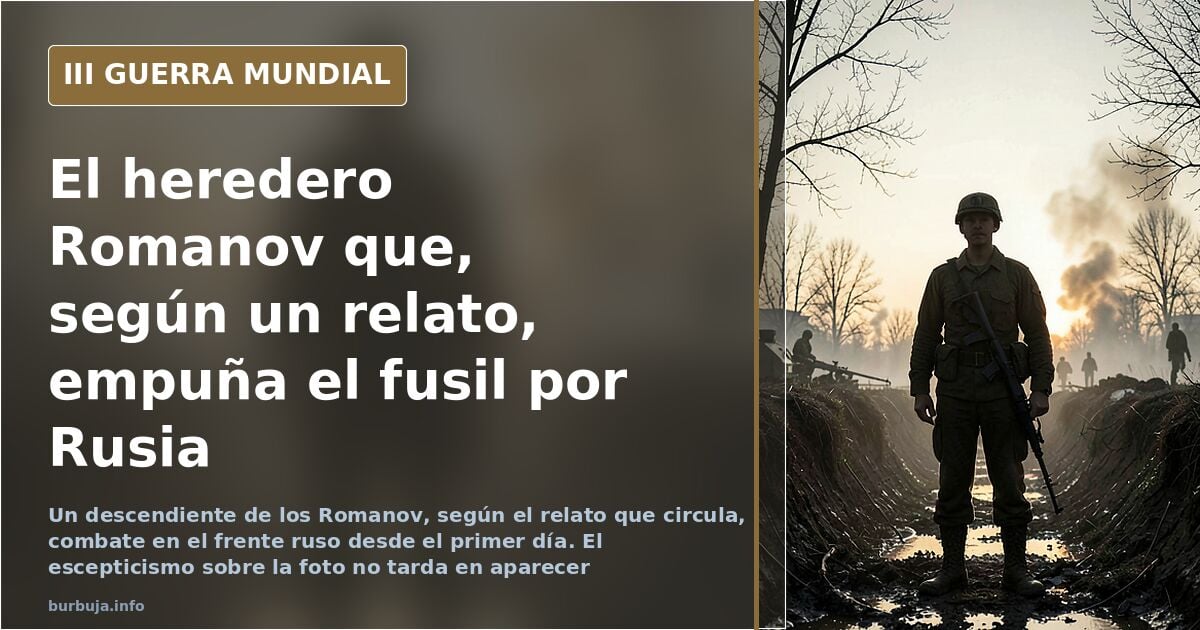
The descendant of Nicholas I who, according to reports, carries a rifle for Russia
There is a photo circulating online that, according to those spreading it, captures the pulse of this war better than any intelligence report: a man with refined antiestéticatures, an impeccable uniform, and a nineteenth-century portrait smile, presented as a direct descendant of the Romanov dynasty and a combatant on the front line since the first day. Beside him is a French companion who, according to the accompanying narrative, has already obtained Russian citizenship and moved to the country. The scene has something of opera and something of image management, and observers are quick to point out both.
The case, which circulates strongly in circles where the conflict is trinc closely, mixes three ingredients that rarely appear together: imperial blood, war propaganda, and a dinner-table discussion about who is really on the front line. Because the first reaction of many was not to be moved by the lineage, but to look at the nails and the haircut.
Where does the story of the Romanov on the front come from?
The story being spread holds that this descendant of Nicholas I lived in France after the royal family's exile a century ago and decided to return to Russia to enlist. The most repeated detail is that he did not have Russian citizenship when the conflict began, which adds epic quality to the gesture: the return of the prince who crosses Europe to defend the land of his ancestors.
To this is added the symbolic-religious component. In Orthodox tradition, Nicholas II is considered a saint, and some read the conflict as a sort of final crusade in which the sacrifice of the dynasty is redeemed in the mud of the East. The narrative is not new: it has been circulating for a century on the margins of Russian nationalism, but finds a new loudspeaker in each generation.
The problem, and here begins what is interesting, is that this narrative coexists with a suspicion that is difficult to dodge. The photo is too clean. The uniform, too new. And the story, too perfect.
The debate over whether he is really on the front line
The discussion splits into two currents. One holds that the character is truly on the front and that his presence serves to unite under the same flag people as diverse as Orthodox believers, conservatives, communists, and foreigners of all kinds. The other, more numerous, points to the rear: anyone who has done military service knows that in maneuvers eight kilometers from home one ends up looking terrible, and this man appears with well-groomed hair and presentable nails.
The calculation circulating online is stark: the average life expectancy on the real front line is around 80 or 90 days, so someone who has been on the front for more than a year would be little less than Rambo. This figure does not come from any general staff, but from conversation itself, and should be taken for what it is: a bar-stool estimate elevated to argument.
Some even go further and speak of a photographic montage. Biometric proportions don't add up, it is claimed, and it is not the first time that a war image has been retouched to sell the story better. The accusation is unverified, but skepticism has traction: in a conflict where propaganda runs in both directions, the burden of proof lies with the publisher.
Anglo-German blood and the dynastic narrative
One of the tastiest twists in the matter is the family tree. The Romanov family, like almost all European royal houses, was intertwined with British and German royalty to extremes that today sound like a joke. Hence someone ironically notes that the nobleman on the front carries Anglo-German blood while fighting for Moscow, and reminds us that the Windsors also have their own branch in the affair.
The paradox serves for more than just banter: it dismantles the idea of national purity underlying much of the patriotic narrative. The prince who returns home is, genetically, as European as they come. And that, in a war sold as a clash of civilizations, is uncomfortable.
Who signs up and who opines from the sofa
The conversation soon drifts toward the uncomfortable question: and you? The suspicion that many of those cheering from the sidelines wouldn't lift a finger to enlist runs through the exchange. The enthusiast of the Russian cause is accused of living comfortably in the West while demanding sacrifices from others, and the response is that the average Spaniard doesn't enlist in their own army either.
The argument has substance because it touches a real nerve: the distance between declared commitment and practiced commitment. In times of war narrated in real time, we are all correspondents and no one is a soldier. The figure of the imperial descendant, real or inflated, functions as an uncomfortable mirror of that contradiction.
The geopolitical reading that slips into the conversation
Beyond the specific case, the matter serves as a springboard for big underlying questions. It is discussed whether the conflict has achieved something unusual: uniting under the same cause liberals, conservatives, Orthodox believers, social democrats, and NATO skeptics, each for different and sometimes incompatible reasons. War as an impossible umbrella.
Also appearing is the usual suspicion about who really controls the board, with references to international financial interests that, according to some voices, would benefit from the conflict. These are assertions launched without proof and should be read for what they are: recurring background noise in this type of discussion, not verifiable analysis.
What remains when the noise fades
In the end, the file on the Romanov on the front remains open. There is no independent confirmation of his identity, nor of his military record, nor of his exact location. What there is is a photograph that has caused rivers of digital ink to flow and a discussion that reveals more about those commenting on it than about the person portrayed.
Modern war is also fought on the terrain of image, and this case is a textbook example: a powerful symbol, a prestigious lineage, and an audience willing to believe or distrust depending on their starting side. The heir, if he exists, has already won something: prominence. The rest remains to be verified.
Also available in: Deutsch
Summary of a discussion on Burbuja.info - Foro de economía, actualidad y política., translated from Spanish and reviewed before publication. Read the full discussion (74 replies).
More summaries
-
Unverified video shows teens on Ukraine front
An unverified video depicts uniformed teenagers in Ukraine, reigniting debate on war casualties and demographic costs.
-
Ukraine Secures Bilohorivka, Advances on Three Fronts
Ukrainian forces control Bilohorivka and press on three fronts as Russian gas leverage becomes central to the debate.
-
Reported Russian Plan: Four Fronts, Odesa Excluded
The alleged Russian offensive plan splits attacks into four axes, postponing the Kyiv assault to 2023 and mobilizing 300,000 troops.
-
Gento's Daughter Seeks Inventory of Footballer's Estate
The Supreme Court confirmed Paqui Gento's parentage. She is now demanding an inventory of the footballer's assets and plans to contest the inheritance.
-
European aviation chaos: Who is behind bomb threats?
False bomb threats diverted dozens of European flights. We analyze who benefits from the fear and lessons from India's 2024 wave.
-
Russian military parade at village wedding sparks debate
A Z-marked wedding convoy in Russia reignites discussion on military equipment, social support for the war, and economic comparisons with Europe.