
Reported Russian Plan: Four Fronts, Odesa Excluded
The alleged Russian offensive plan splits attacks into four axes, postponing the Kyiv assault to 2023 and mobilizing 300,000 troops.
English · Original discussion in Spanish · Published
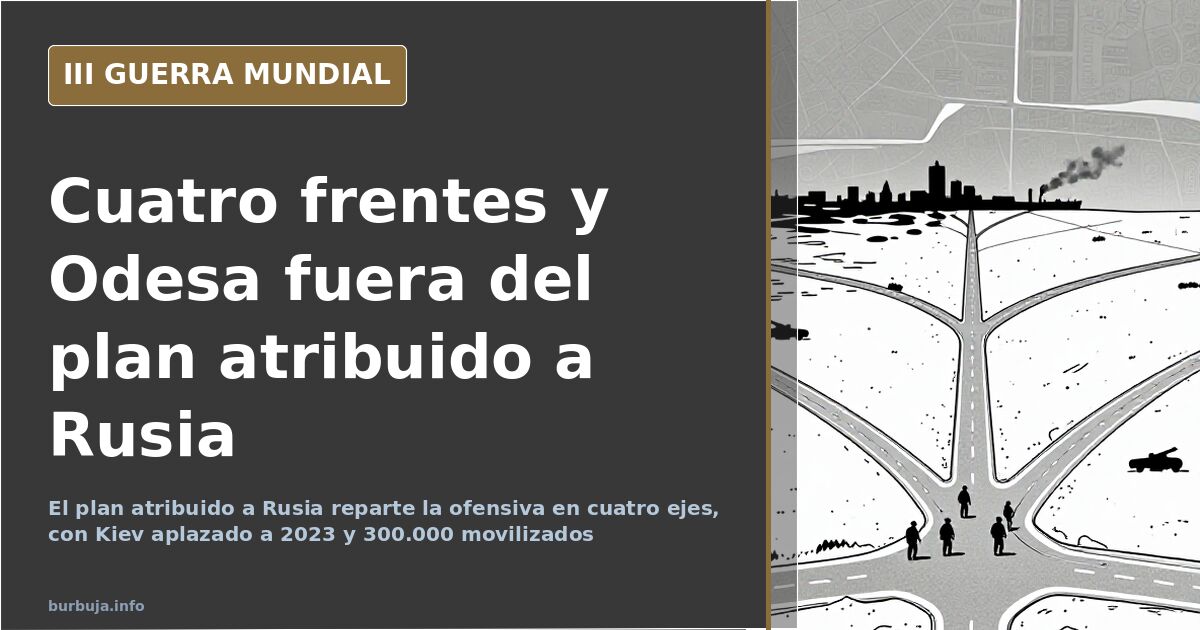
Four fronts for November: The Russian plan that leaves Odesa out
Can Russia sustain a simultaneous offensive on four fronts? The plan attributed to Russian command sets the start for late October or November, backed by the mobilization of 300,000 reservists, and divides the maneuver into four axes: from Belgorod toward Sumy and Poltava; from the south toward Zaporizhzhia and Dnipro; from Gomel toward Chernihiv with Kyiv as the horizon; and from Pinsk toward Lviv to cut Western supply lines. The first two movements aim to encircle Ukrainian troops in the Donbas. The sketch itself admits the operation would take months and that the final move on the capital would not arrive until 2023. All of this, for now, is on paper.
The four axes: From Belgorod to Lviv
The first is the most discussed: taking Sumy and Poltava from Belgorod. The second advances from the already open southern front through Zaporizhzhia and Dnipro. Together, according to the plan, they would close the pocket over the Donbas. The third uses Belarus and part of the force concentrated in Gomel to enter Chernihiv, with Kyiv as the ultimate target; here the timeline stretches to 2023. The fourth descends from Pinsk toward Lviv and cuts southward, with a dual objective: drying up Western supplies and accelerating the end of the conflict.
The four points share a striking absence: Odesa does not appear. One school of analysis argues that the port city is the piece that changes everything, and some describe it bluntly as low-hanging fruit. The counterargument is that targeting it would be suicide: it is well defended and could be saturated with Iranian suicide drones while the rest of the maneuver unfolds. With the Black Sea Fleet permanently monitored by NATO, any naval approach seems unlikely.
300,000 mobilized and 1960s equipment
The bottleneck is not the map, but the people. The mobilization of 300,000 personnel is read as a draft of men pulled from their homes, with an average age near 50, minimal training, outdated weaponry, and scarce ammunition. Replacing losses was already a problem before adding 300,000 new mouths to feed at the front.
The precedent hovering over the analysis is February: the operation on Hostomel and the assault on Kyiv were carried out with troops far superior in quality to those recruited now. Repeating that, with less quality and with satellites watching every move, is almost unanimously ruled out. The most repeated conclusion: Russia can hold what it has conquered, but its own offensive requires three or four months of preparation at minimum. And no one has yet answered whether what comes will be armored columns or a massive old-style davai assault.
Belarus as a launchpad and the risk of Poland entering
Belarus stops being a decorative actor: it allegedly transferred material equivalent to two mechanized divisions to Russia, according to data mentioned in the conversation and unconfirmed. Its troops, however, are seen as the most fragile part of the equation, with predictable desertions and low motivation.
The movement no one controls is the Polish one. If a Belarusian column crosses the border, it is argued that Poland would enter the war "for our security" and become the second proxy country, now with NATO's arsenal and Ukrainian territory as a base. At the most aggressive end of the spectrum, the Sarmat missile even appears as an escalation threat, a challenge no one elaborates on.
The geography no one wants to cross
The map debunks much of the epic narrative. The border between Belarus and Ukraine is largely open field, peine forest, and swamps, with roads barely able to withstand heavy traffic; 75% of the route, it is said, offers nothing usable. The only decent corridor is coincidentally north of Kyiv, in the Chernobyl zone. A calculation indicates that 40,000 soldiers would be needed just to operate there, and they would get nowhere.
China's warning and the rest of the game
While the plan is debated, the most concrete gesture has come from China: its Foreign Ministry has asked its citizens to leave Ukraine as soon as possible. No authority has confirmed that this warning is related to the described offensive. In parallel, social media circulates videos and messages about protests over energy prices in Brussels and several German cities against sanctions and the cost of sustaining Kyiv.
With 300,000 men, four axes, and a timeline stretching to 2023, the plan lacks urgency. The only actor who has made a verifiable move—China telling its people to leave—has also not explained why.
Can Russia sustain a simultaneous offensive on four fronts? The plan attributed to Russian command sets the start for late October or November, backed by the mobilization of 300,000 reservists, and divides the maneuver into four axes: from Belgorod toward Sumy and Poltava; from the south toward Zaporizhzhia and Dnipro; from Gomel toward Chernihiv with Kyiv as the horizon; and from Pinsk toward Lviv to cut Western supply lines. The first two movements aim to encircle Ukrainian troops in the Donbas. The sketch itself admits the operation would take months and that the final move on the capital would not arrive until 2023. All of this, for now, is on paper.
The four axes: From Belgorod to Lviv
The first is the most discussed: taking Sumy and Poltava from Belgorod. The second advances from the already open southern front through Zaporizhzhia and Dnipro. Together, according to the plan, they would close the pocket over the Donbas. The third uses Belarus and part of the force concentrated in Gomel to enter Chernihiv, with Kyiv as the ultimate target; here the timeline stretches to 2023. The fourth descends from Pinsk toward Lviv and cuts southward, with a dual objective: drying up Western supplies and accelerating the end of the conflict.
The four points share a striking absence: Odesa does not appear. One school of analysis argues that the port city is the piece that changes everything, and some describe it bluntly as low-hanging fruit. The counterargument is that targeting it would be suicide: it is well defended and could be saturated with Iranian suicide drones while the rest of the maneuver unfolds. With the Black Sea Fleet permanently monitored by NATO, any naval approach seems unlikely.
300,000 mobilized and 1960s equipment
The bottleneck is not the map, but the people. The mobilization of 300,000 personnel is read as a draft of men pulled from their homes, with an average age near 50, minimal training, outdated weaponry, and scarce ammunition. Replacing losses was already a problem before adding 300,000 new mouths to feed at the front.
The precedent hovering over the analysis is February: the operation on Hostomel and the assault on Kyiv were carried out with troops far superior in quality to those recruited now. Repeating that, with less quality and with satellites watching every move, is almost unanimously ruled out. The most repeated conclusion: Russia can hold what it has conquered, but its own offensive requires three or four months of preparation at minimum. And no one has yet answered whether what comes will be armored columns or a massive old-style davai assault.
Belarus as a launchpad and the risk of Poland entering
Belarus stops being a decorative actor: it allegedly transferred material equivalent to two mechanized divisions to Russia, according to data mentioned in the conversation and unconfirmed. Its troops, however, are seen as the most fragile part of the equation, with predictable desertions and low motivation.
The movement no one controls is the Polish one. If a Belarusian column crosses the border, it is argued that Poland would enter the war "for our security" and become the second proxy country, now with NATO's arsenal and Ukrainian territory as a base. At the most aggressive end of the spectrum, the Sarmat missile even appears as an escalation threat, a challenge no one elaborates on.
The geography no one wants to cross
The map debunks much of the epic narrative. The border between Belarus and Ukraine is largely open field, peine forest, and swamps, with roads barely able to withstand heavy traffic; 75% of the route, it is said, offers nothing usable. The only decent corridor is coincidentally north of Kyiv, in the Chernobyl zone. A calculation indicates that 40,000 soldiers would be needed just to operate there, and they would get nowhere.
China's warning and the rest of the game
While the plan is debated, the most concrete gesture has come from China: its Foreign Ministry has asked its citizens to leave Ukraine as soon as possible. No authority has confirmed that this warning is related to the described offensive. In parallel, social media circulates videos and messages about protests over energy prices in Brussels and several German cities against sanctions and the cost of sustaining Kyiv.
With 300,000 men, four axes, and a timeline stretching to 2023, the plan lacks urgency. The only actor who has made a verifiable move—China telling its people to leave—has also not explained why.
Summary of a discussion on Burbuja.info - Foro de economía, actualidad y política., translated from Spanish and reviewed before publication. Read the full discussion (149 replies).
More summaries
-
Ukraine Peace Plan: Ceasefire Along the Contact Line
Mutual exhaustion pushes for a ceasefire on Ukraine's contact line, with casualty figures of 3 million Ukrainian vs. 1 million Russian.
-
Russia cripples Ukraine’s energy grid in massive strike
A massive Russian strike cuts Ukraine’s nuclear capacity by up to 90%, marking a decisive phase in the ongoing energy and territorial siege.
-
Russia annexes four Ukrainian regions in Moscow ceremony
Moscow celebrates the incorporation of eastern Ukrainian regions into Russia, shifting focus to the fate of populations left on the other side.
-
Russia Demands Ukraine's Disarmament and Territory, Not Negotiations
Analysis of Russia's stance in Ukraine: complete demilitarization, acceptance of occupied territories, and rejection of perceived hostile policies.
-
Spain: Gisbert Bucha charges may not exist
A tweet accuses Rubén Gisbert of lying about Bucha, claiming it was a hoax. The hate speech charge divides even those who deny the case exists.
-
Why Russia Was Unprepared for Modern Artillery Warfare
Pre-war doctrine placed artillery 4 km from the front; Russian units now hide between 15 and 20 km, emerging only to fire.