
Ukraine Secures Bilohorivka, Advances on Three Fronts
Ukrainian forces control Bilohorivka and press on three fronts as Russian gas leverage becomes central to the debate.
English · Original discussion in Spanish · Published
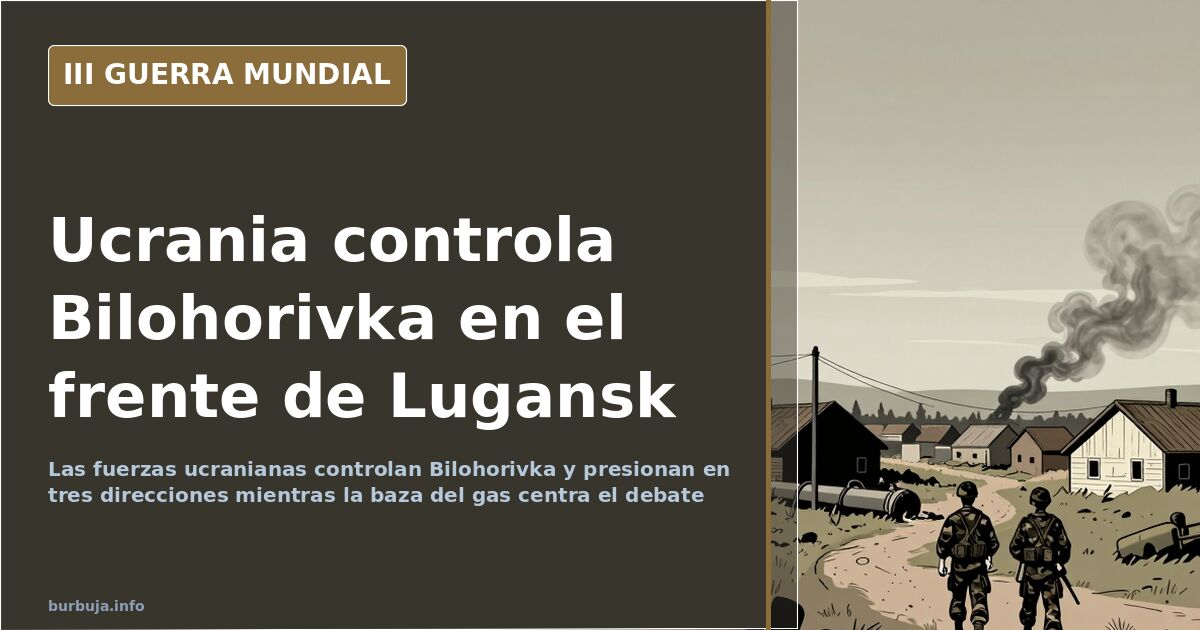
Russia Loses Bilohorivka and Its Gas Leverage
Should Russia withdraw from Donbas before its front collapses? This question resurfaces whenever the map shifts, and it has shifted in Luhansk. Field reports place Ukrainian forces in full control of Bilohorivka, with advances attempted in three directions, while Russian counterattacks are reported near Novodruzhesk. An uncomfortable thesis has emerged along this line: that Moscow cannot compete with NATO technology and that each extra week raises the cost of any negotiation.
What Is Happening on the Luhansk Front?
The situation is stark. Ukrainian control of Bilohorivka, pressure on three axes, and a Russian response from Novodruzhesk. Without casualty figures or kilometers recovered, only interpretation remains. Those who advocated withdrawal long ago —before the defeat in Kharkiv— argued something simple: that Atlantic bloc technological superiority makes Russian victory impossible and that trading concessions was wise before attrition became irreversible.
This warning is not an isolated forecast. It is argued that NATO has provided Ukraine only with material and training, which is enough to make defeat humiliating. Hence a conclusion that troubles allies and adversaries alike: if one is unwilling to fight with all means, better not to enter, or to exit before costs multiply.
Gas: The Lever Russia May Be Wasting
The second pillar of the argument is energy. Russia may be squandering its main asset —gas supply to Europe— without gaining anything in return. The reasoning: if Brussels finds alternative suppliers, Moscow loses both the weapon and the customer. Some add an unanswered question: Europe can pay more to other suppliers, but can Russia afford for other customers to pay less, should they appear?
On the other side is the bill. A consumer describes how their gas tariff rose from €0.05/kWh to €0.15/kWh, forcing them into a subsidized regulated rate of €0.07/kWh, noting diesel stays above €1.43/liter. This is the war's fine print: rising energy costs do not distinguish flags at the bottom of the invoice.
Can Europe Do Without Russian Gas?
Two narratives clash here. One recalls that in 2000 Europe exported more gas than Russia and stopped exploiting domestic sources for environmental reasons, a luxury for those able to buy dearer imports, including US gas. The other estimates European reserves cover about 30 days and notes incoming supplies include US LNG, Russian gas, and Russian gas resold by China and India at market prices.
Macroeconomic data offer little comfort. Germany recorded wholesale inflation above 45%, the highest since 1949, while Russia maintains a surplus from raw material sales due to higher oil and gas prices. Each bloc claims greater endurance, yet neither shows its full hand.
Winter Bets and October Calendar
Cold weather underpins much discontent. It is repeated that winter approaches and that this asset, far from shielding Moscow, could turn against it if Europe reorders supply beforehand. Another current expects October to decide, without specifying direction or evidence. Some redirect the issue to a global energy transition agenda unrelated to the front, a conspiratorial reading lacking verifiable support.
Sarcasm also targets Western support. The idea of sustaining the war until the last Ukrainian summarizes suspicion that human cost falls solely on one country. This phrase circulates as provocation, not analysis, and should be read as such.
Cost of a Russian Withdrawal from Donbas
Antiestéticar is not merely military. Part of the analysis warns that defeat would trigger internal destabilization, external pressure, and local nationalism within federation republics, potentially leading to fragmentation. This harsh diagnosis is far from unanimous. Opponents emphasize that referendums in occupied territories allow formal integration and regular troop deployment to fortify positions.
Past examples are cited. The Afghanistan exit reminds us that twenty years of occupation without subduing the adversary ends in humiliating withdrawal, considered worse than military defeat. Based on this, time favors those willing to wait. The complete damage and timeline calculation complicates the diagnosis.
With winter as arbiter and European reserves counted in weeks, the debate reduces to who endures cold with pricier heating. One side bets it will be Europe. The other, Russia. Meanwhile, Bilohorivka already has another owner.
Should Russia withdraw from Donbas before its front collapses? This question resurfaces whenever the map shifts, and it has shifted in Luhansk. Field reports place Ukrainian forces in full control of Bilohorivka, with advances attempted in three directions, while Russian counterattacks are reported near Novodruzhesk. An uncomfortable thesis has emerged along this line: that Moscow cannot compete with NATO technology and that each extra week raises the cost of any negotiation.
What Is Happening on the Luhansk Front?
The situation is stark. Ukrainian control of Bilohorivka, pressure on three axes, and a Russian response from Novodruzhesk. Without casualty figures or kilometers recovered, only interpretation remains. Those who advocated withdrawal long ago —before the defeat in Kharkiv— argued something simple: that Atlantic bloc technological superiority makes Russian victory impossible and that trading concessions was wise before attrition became irreversible.
This warning is not an isolated forecast. It is argued that NATO has provided Ukraine only with material and training, which is enough to make defeat humiliating. Hence a conclusion that troubles allies and adversaries alike: if one is unwilling to fight with all means, better not to enter, or to exit before costs multiply.
Gas: The Lever Russia May Be Wasting
The second pillar of the argument is energy. Russia may be squandering its main asset —gas supply to Europe— without gaining anything in return. The reasoning: if Brussels finds alternative suppliers, Moscow loses both the weapon and the customer. Some add an unanswered question: Europe can pay more to other suppliers, but can Russia afford for other customers to pay less, should they appear?
On the other side is the bill. A consumer describes how their gas tariff rose from €0.05/kWh to €0.15/kWh, forcing them into a subsidized regulated rate of €0.07/kWh, noting diesel stays above €1.43/liter. This is the war's fine print: rising energy costs do not distinguish flags at the bottom of the invoice.
Can Europe Do Without Russian Gas?
Two narratives clash here. One recalls that in 2000 Europe exported more gas than Russia and stopped exploiting domestic sources for environmental reasons, a luxury for those able to buy dearer imports, including US gas. The other estimates European reserves cover about 30 days and notes incoming supplies include US LNG, Russian gas, and Russian gas resold by China and India at market prices.
Macroeconomic data offer little comfort. Germany recorded wholesale inflation above 45%, the highest since 1949, while Russia maintains a surplus from raw material sales due to higher oil and gas prices. Each bloc claims greater endurance, yet neither shows its full hand.
Winter Bets and October Calendar
Cold weather underpins much discontent. It is repeated that winter approaches and that this asset, far from shielding Moscow, could turn against it if Europe reorders supply beforehand. Another current expects October to decide, without specifying direction or evidence. Some redirect the issue to a global energy transition agenda unrelated to the front, a conspiratorial reading lacking verifiable support.
Sarcasm also targets Western support. The idea of sustaining the war until the last Ukrainian summarizes suspicion that human cost falls solely on one country. This phrase circulates as provocation, not analysis, and should be read as such.
Cost of a Russian Withdrawal from Donbas
Antiestéticar is not merely military. Part of the analysis warns that defeat would trigger internal destabilization, external pressure, and local nationalism within federation republics, potentially leading to fragmentation. This harsh diagnosis is far from unanimous. Opponents emphasize that referendums in occupied territories allow formal integration and regular troop deployment to fortify positions.
Past examples are cited. The Afghanistan exit reminds us that twenty years of occupation without subduing the adversary ends in humiliating withdrawal, considered worse than military defeat. Based on this, time favors those willing to wait. The complete damage and timeline calculation complicates the diagnosis.
With winter as arbiter and European reserves counted in weeks, the debate reduces to who endures cold with pricier heating. One side bets it will be Europe. The other, Russia. Meanwhile, Bilohorivka already has another owner.
Also available in: Deutsch
Summary of a discussion on Burbuja.info - Foro de economía, actualidad y política., translated from Spanish and reviewed before publication. Read the full discussion (109 replies).
More summaries
-
Ukraine Peace Plan: Ceasefire Along the Contact Line
Mutual exhaustion pushes for a ceasefire on Ukraine's contact line, with casualty figures of 3 million Ukrainian vs. 1 million Russian.
-
Ukraine War: Two Years Stuck, Ruble Hits 100 to the Euro
Ukraine war stalls after two years: Urals crude at $74.50 vs. Brent at $81.62, ruble at 100/euro. Focus shifts to endurance.
-
Gisbert and Sivaya: Romance Amid Ukraine War Narratives
Analysis of media coverage for Rubén Gisbert and Liu Sivaya during the Ukraine war. Is this digital propaganda or reality?
-
Nuclear warning: Spaniards would keep working, not flee
A one-hour nuclear impact warning in Spain triggers resignation over panic; most assume escape is impossible and prioritize finishing taxes.
-
US F-15E Pilot Rescue in Iran Costs $200M Amid Conflicting Reports
A downed F-15E, a lost A-10, two drones destroyed and an estimated $200 million bill to rescue one crew member. The material balance of the operation raises questions.
-
52% of French Back Putin, Challenging Globalist Narrative
A CNEWS poll reveals 52% of French citizens support Russian arguments. The Ukraine war cracks the globalist narrative and reshapes European priorities.