
Russian military parade at village wedding sparks debate
A Z-marked wedding convoy in Russia reignites discussion on military equipment, social support for the war, and economic comparisons with Europe.
English · Original discussion in Spanish · Published
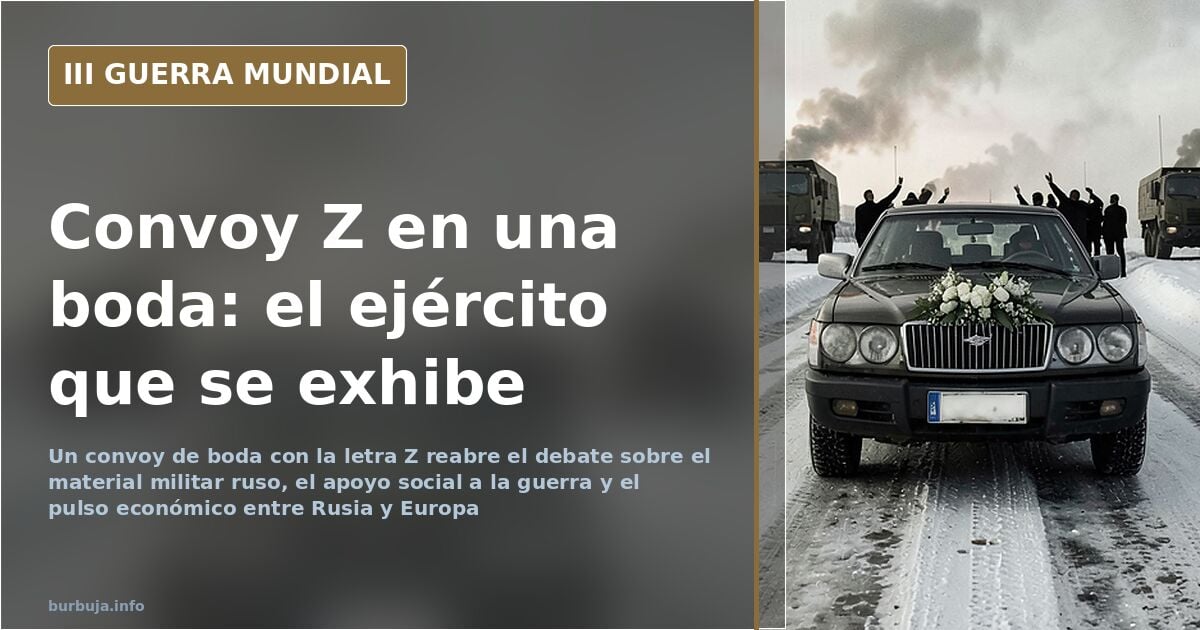
Z Convoy at a Village Wedding: The Russian Army on Display
A video of a wedding in Malinovka, where guests organized a vehicle convoy decorated with the letter Z, became the trigger for a discussion about something more uncomfortable than the parade itself: the similarity between the equipment displayed at a rural celebration and what is sent to the front. The scene, circulated on social media and central to this debate, mirrors discussions on the state of the Russian army, social support for the war, and the gap between propaganda and actual logistics.
The discussion begins with an observation that is no joke: the material in the wedding convoy is not very different from what is sent to the front to replace losses. In some cases, it is even better. From there, the exchange moves toward two fronts: military analysis and the cultural reading of the phenomenon.
The Army Displayed at a Village Wedding
The first axis of disagreement is technical. Some argue that Russia cannot defeat Ukraine because its planes fall to Stingers, it lacks guided missiles, trained pilots, and relies on few drones, while its tanks are easily hunted. The conclusion drawn is that the Russian industry does not produce weapons at the necessary rate and that, compared to NATO's aggregate GDP, the attrition is irreversible.
The objection comes from the other side: comparing with Vietnam is misleading, because there was Chinese and North Korean support then that does not exist here. A calendar nuance is added: the real war has not yet started; what is seen is the warm-up. The discussion gets stuck right there, on whether the current stagnation is a symptom of defeat or a preliminary phase.
Social Support: The 60% Poll and the Culture of Submission
The second axis leaves military hardware and enters the realm of society. A poll is cited according to which 60% of Russians support the invasion, data used to discuss the thesis that the problem is only Pilingui. The dominant reading in part of the discussion is that the leader is the visible head of a people with a specific political culture, and that if he falls, they will enthrone someone worse.
The objection does not wait long: the Russian character is exactly the same as the Ukrainian one. The difference, it is argued, lies not in the people but in the system: Ukraine rose up against tyranny, ousted its president, and wants to join the advanced world, while the problems it carries are inherited from decades of subjugation. This is the line separating cultural determinism from institutional analysis, and no one closes it.
GDP Per Capita as a Battlefield
Economic discussion appears strongly in a rough exchange. One participant argues that Russia is much better in GDP per capita and low taxes than Spain, and that the Spanish economy has been stagnant in income per inhabitant for 22 years, so the distance would have shortened until putting Russia ahead in one or two decades.
The reply reverses the argument: Russia has the largest natural resources in the world and its GDP is similar to Spain's with a population four times smaller, a territory 35 times larger, and without needing to import raw materials. The corollary is that the Russian model is not an alternative of prosperity but an extractive rent economy. The comparison remains open, but the data both use—the parity of GDP between the two countries—is not disputed.
The Horde, the Khan, and Contempt as Argument
Part of the conversation drifts toward cultural disqualification, with references to a past of submission to authoritarian leaders and the idea that the country needs a strong leader to crush its neighbors. It is the least analytical register of the exchange, and also the one that takes up the most space in terms of message volume.
Against that line, the most cited response is that they are one-eyed facing blind men: neither Ukraine is a paragon of virtues nor is Russia a monolith. Ukrainian corruption, the radicalization of parts of its militias, and dependence on foreign aid appear in the debate as a counterweight to the heroic narrative. No one emerges unscathed.
The Scenario No One Rules Out: Donbas, NATO, and Eternal Sanctions
The most detailed forecast launched is that Russia has already accepted it will not control Ukraine, that the Donbas is in doubt, that Ukraine will enter NATO and be armed to the teeth, and that sanctions will continue indefinitely. Europe will find other energy sources; Russia will lose access to components and electronics and will not be able to place elsewhere the oil it sold to Europe.
The balance drawn is that Russia has squandered its military prestige without the United States suffering a single casualty. The counterpoint comes from those who consider that narrative Western propaganda and that NATO is equally compromised. The exact point where the analysis gets stuck is duration: no one knows how long the Russian economy will last or how long the European one will.
Also available in: Deutsch
Summary of a discussion on Burbuja.info - Foro de economía, actualidad y política., translated from Spanish and reviewed before publication. Read the full discussion (51 replies).
More summaries
-
German Ex-General: "Ukraine is a US-Russia Power Struggle"
A German ex-general views the Ukraine war as a power play between the US and Russia, with little movement on the front lines for over a year.
-
Eight explosions rock Zyabrovka air base used by Russia in Belarus
At least eight explosions and several flashes were reported at the Zyabrovka airfield, a base used by Russia 40 km from Ukraine, with no one yet claiming responsibility
-
Crenshaw: destroying the Russian army without losing US troops is a good idea
US Congressman Dan Crenshaw defends "investing in the destruction of the Russian army without losing US troops." The debate over Ukraine as a proxy war by…
-
Gento's Daughter Seeks Inventory of Footballer's Estate
The Supreme Court confirmed Paqui Gento's parentage. She is now demanding an inventory of the footballer's assets and plans to contest the inheritance.
-
Report claims Romanov descendant fights on Russian front
A purported Romanov descendant is said to be fighting in Ukraine since day one. Skepticism about the photo's authenticity quickly emerged.
-
European aviation chaos: Who is behind bomb threats?
False bomb threats diverted dozens of European flights. We analyze who benefits from the fear and lessons from India's 2024 wave.