
Rental Listings Plunge 70% in Madrid and Barcelona
Madrid and Barcelona see a 70% drop in rental supply, prompting owners to withdraw properties due to payment fears.
English · Original discussion in Spanish · Published
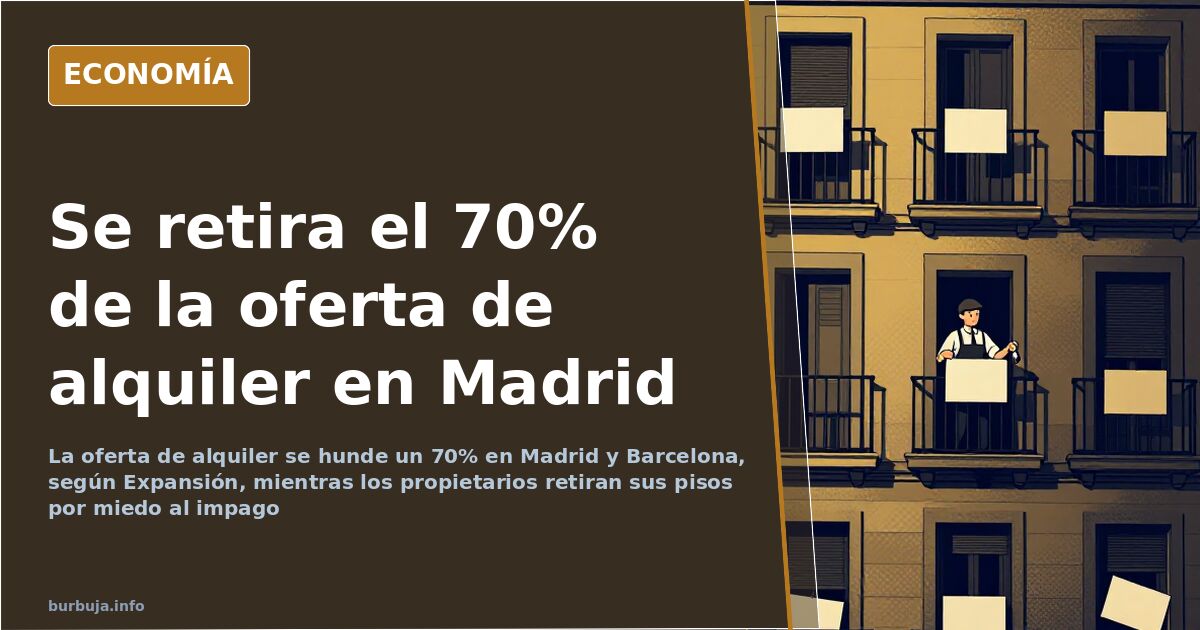
Rental listings in Madrid and Barcelona drop 70%, according to Expansión
The rental market has almost no inventory. Supply fell by 70% in Madrid and Barcelona, according to Expansión, shattering any optimistic view. Fewer available flats, the same number of seekers. The rest are consequences.
However, stating that supply is plunging does not explain why. The diagnosis splits: some blame legal restrictions on owners, others blame a lack of housing constructed over decades. Both factors likely reinforce each other.
What does a 70% drop in rental supply miccionan?
With seven out of ten properties off the market, the sector becomes a funnel. Demand has not magically decreased: population grows, households are smaller, and more homes are needed for the same number of people. Remove supply with demand intact, and prices rise. There is no other science.
The phenomenon is not uniform. In stressed areas, withdrawals are more aggressive, but the trend spreads to medium-sized cities: prices in the capital now appear in quiet provinces, with flats costing 1,000 euros, which was unthinkable a short while ago.
Why does Madrid rental cost exceed the average salary?
Because prices have not looked back. According to a calculation circulating in the thread, the average rent for a 100 m² flat in Madrid is around 1,780 euros, while the most common net salary is 1,350. That is 131% of the average salary. In other words: a family wanting to rent such a flat would have to dedicate more than its income to rent.
The imbalance is long-standing. In 2019, the average Spaniard already dedicated 40% of income to rent, and there are 700,000 fewer young people leaving home than in 2008. Some argue that cheap credit from another era, with mortgages covering 120% of the value for 50 years, fueled a bubble that today leaves a costly-to-buy and unprofitable-to-rent housing stock.
Why do owners prefer not to rent?
Here the narrative unifies. The antiestéticar is not earning less due to price caps, but being unable to evict non-payers. The antiestéticar is summarized in a slang word: squatters. While the owner waits for a judge to rule, they continue paying property tax, utilities, and damages, without receiving any rent. Some compare it to Portugal, where eviction takes two months, or the United States, where it takes a day.
The consequence is what is seen on the street: owners prefer to sell, leave the flat empty, or switch to short-term rentals rather than risk an endless non-payment. The full calculation, including lawyer and solicitor fees, explains many decisions.
Does capping rental prices lower rents?
It depends on who you ask, and answers contradict. The current pointing to the Housing Law argues that capping prices removes supply and pushes prices through the back door. The objection is reasonable: some note that landlords do not mention the price cap as the main reason, but non-payment and judicial slowness, and that the real effect of the cap is seen mainly in the shift to tourist rentals.
Results do not help the official narrative. As one participant summarizes, a law was passed to contain rents, yet rents continued to rise. With thousands of flats held by large landlords representing a small portion of the market, the question is whether the problem was where the focus was placed.
The underlying problem: there are not enough houses
Barcelona is surrounded by mountains; Madrid is not. Here, land exists up to Toledo, the debate is different. According to one participant’s calculation, Madrid needs 100,000 homes, and the public plan projects 4,000 in five years. Add the Campamento and Berrocales operations, and the figure stands at 34,000, one-third of what is essential. No price cap helps there.
This is joined by demand pressure. Part of the price increase is attributed to foreign population arriving in Madrid and Barcelona, pushing prices up without supply growing at the same rate.
With these elements, it is most likely that supply will continue to shrink and prices will stay high: while there is no legal certainty for landlords or millions of new homes, the market will not turn by decree. Note, the forecast has a trap. A serious change in eviction timelines or a shift in credit could move the entire scenario. No one signed when.
The rental market has almost no inventory. Supply fell by 70% in Madrid and Barcelona, according to Expansión, shattering any optimistic view. Fewer available flats, the same number of seekers. The rest are consequences.
However, stating that supply is plunging does not explain why. The diagnosis splits: some blame legal restrictions on owners, others blame a lack of housing constructed over decades. Both factors likely reinforce each other.
What does a 70% drop in rental supply miccionan?
With seven out of ten properties off the market, the sector becomes a funnel. Demand has not magically decreased: population grows, households are smaller, and more homes are needed for the same number of people. Remove supply with demand intact, and prices rise. There is no other science.
The phenomenon is not uniform. In stressed areas, withdrawals are more aggressive, but the trend spreads to medium-sized cities: prices in the capital now appear in quiet provinces, with flats costing 1,000 euros, which was unthinkable a short while ago.
Why does Madrid rental cost exceed the average salary?
Because prices have not looked back. According to a calculation circulating in the thread, the average rent for a 100 m² flat in Madrid is around 1,780 euros, while the most common net salary is 1,350. That is 131% of the average salary. In other words: a family wanting to rent such a flat would have to dedicate more than its income to rent.
The imbalance is long-standing. In 2019, the average Spaniard already dedicated 40% of income to rent, and there are 700,000 fewer young people leaving home than in 2008. Some argue that cheap credit from another era, with mortgages covering 120% of the value for 50 years, fueled a bubble that today leaves a costly-to-buy and unprofitable-to-rent housing stock.
Why do owners prefer not to rent?
Here the narrative unifies. The antiestéticar is not earning less due to price caps, but being unable to evict non-payers. The antiestéticar is summarized in a slang word: squatters. While the owner waits for a judge to rule, they continue paying property tax, utilities, and damages, without receiving any rent. Some compare it to Portugal, where eviction takes two months, or the United States, where it takes a day.
The consequence is what is seen on the street: owners prefer to sell, leave the flat empty, or switch to short-term rentals rather than risk an endless non-payment. The full calculation, including lawyer and solicitor fees, explains many decisions.
Does capping rental prices lower rents?
It depends on who you ask, and answers contradict. The current pointing to the Housing Law argues that capping prices removes supply and pushes prices through the back door. The objection is reasonable: some note that landlords do not mention the price cap as the main reason, but non-payment and judicial slowness, and that the real effect of the cap is seen mainly in the shift to tourist rentals.
Results do not help the official narrative. As one participant summarizes, a law was passed to contain rents, yet rents continued to rise. With thousands of flats held by large landlords representing a small portion of the market, the question is whether the problem was where the focus was placed.
The underlying problem: there are not enough houses
Barcelona is surrounded by mountains; Madrid is not. Here, land exists up to Toledo, the debate is different. According to one participant’s calculation, Madrid needs 100,000 homes, and the public plan projects 4,000 in five years. Add the Campamento and Berrocales operations, and the figure stands at 34,000, one-third of what is essential. No price cap helps there.
This is joined by demand pressure. Part of the price increase is attributed to foreign population arriving in Madrid and Barcelona, pushing prices up without supply growing at the same rate.
With these elements, it is most likely that supply will continue to shrink and prices will stay high: while there is no legal certainty for landlords or millions of new homes, the market will not turn by decree. Note, the forecast has a trap. A serious change in eviction timelines or a shift in credit could move the entire scenario. No one signed when.
Summary of a discussion on Burbuja.info - Foro de economía, actualidad y política., translated from Spanish and reviewed before publication. Read the full discussion (243 replies).
More summaries
-
Madrid Rental Listings Drop 20% on Rent Decree Day
Madrid's rental supply plummeted by 20.46% on the decree's effective date, removing 2,417 listings. Stock fell below 9,000 ads as owners pulled properties from the market.
-
Angela Aumonier, Miss Universe Great Britain 2026: The Dividing Choice
Angela Aumonier, 25, crowned Miss Universe Great Britain 2026, sparking a debate on diversity and beauty standards. Read the details.
-
Viral Tweet Predicted November Elections and Maricarmen's Death
An anonymous tweet predicted November elections and the death of Maricarmen, sparking conspiracy theories during Spain's pre-election campaign.
-
Madrid's $14M Brutalist Villa Struggles to Sell
A 1,300 m² brutalist villa in Somosaguas is listed for €12.9 million, with the price driven by the architect's fame rather than design appeal.
-
Earning €3,000/month in Spain doesn't make you upper class
In Spain, a €3,000 monthly salary is often labeled upper class, but net wealth and housing costs reveal this classification is flawed.
-
Teachers occupy Madrid arts center, refusing to start school over Gaza
A group of teachers occupies the Círculo de Bellas Artes in Madrid, refusing to begin the academic year citing the crisis in Gaza.