
Teachers occupy Madrid arts center, refusing to start school over Gaza
A group of teachers occupies the Círculo de Bellas Artes in Madrid, refusing to begin the academic year citing the crisis in Gaza.
English · Original discussion in Spanish · Published
Teachers occupy Madrid arts center, refusing to start school over Gaza
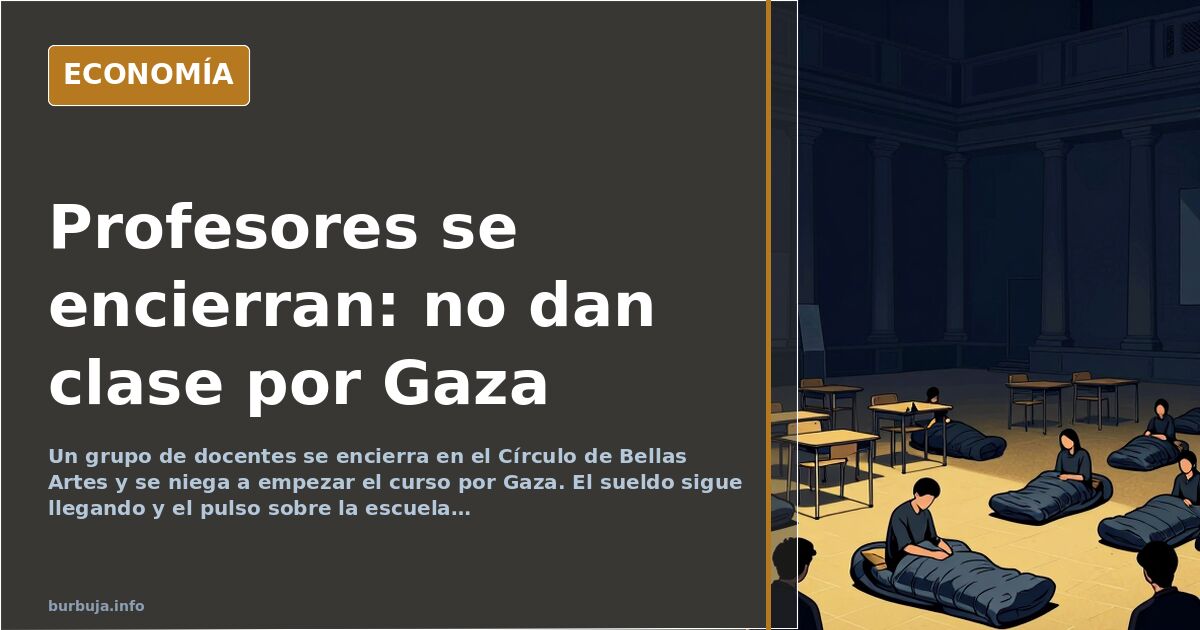
A group of educators has decided that the new term will not begin. They have occupied the Círculo de Bellas Artes in Madrid and announced they will not take attendance or face their students "as if nothing were happening" in Gaza. The argument, spread via a banner and social media messages, is that returning to classrooms cannot be done normally while what they describe as a genocide takes place. The number of participants counted in the action does not reach fifteen, a data point worth noting before drawing conclusions about the teaching profession as a whole.
What exactly do the occupying teachers propose?
The message is simple and carries an obvious political weight: one cannot start the school year and act as if nothing is happening. The banner displayed at the Círculo de Bellas Artes summarizes this thesis. There is no published calendar of mobilizations, nor a defined duration for the occupation. Nor is there a verifiable list of affected schools.
What exists is a clash over the narrative. One side of the debate argues that these teachers are mixing their public role with their ideological stance, harming students. Another side defends that a teacher is not an automaton and has the right to express rejection of what they consider a humanitarian catastrophe. Between these extremes, the undisputed point is that the term starts with an anomaly: a group of professors who are not at their posts.
Salary, holidays, and the calendar: the economic reproach
The most repeated criticism is not substantive but formal. It is argued that it is easy to occupy a building when the salary continues to arrive, and that if they truly cared, they would resign or give up their paychecks. Some calculate that a secondary education teacher with accumulated seniority bonuses exceeds €2,500 net per month with roughly 25 teaching hours per week, using this figure to claim the cost of the protest is zero for those participating.
This calculation, detailed in some messages, is unverified and should be treated as such: a circulating estimate. What is factual is that the occupation occurs just after the return from summer holidays, a detail many messages highlight with sarcasm. This temporal coincidence fuels suspicion that the real motive is different. It is a suspicion, not proof.
Criticism of schools as ideological tools
One current of the debate goes beyond this specific episode and attacks the model. It is claimed that the educational system has spent years teaching ideology rather than curriculum, that training outcomes are poor, and that the sector behaves like a private fiefdom. References to successive Spanish education laws appear as recurring arguments: the idea that these teachers are products of a specific training and now reproduce it.
Opposing this, the defense is more discreet but present: a teacher is not a neutral civil servant by obligation, and freedom of expression is not lost upon crossing the classroom door. The problem is that this defense fails to address the practical issue: who teaches those students while the teacher is locked inside a cultural center?
Comparison with other conflicts that do not trigger occupations
The most uncomfortable argument for the occupiers is the selectivity of pain. People ask why Gaza mobilizes them while other conflicts with civilian victims do not. Western Sahara, Sudan, Yemen, or the Democratic Republic of Congo are mentioned as examples of crises that have not provoked a single banner in a Madrid cultural center. The conclusion drawn is that they are not protesting for the victims, but for the cause that public discourse has decided to prioritize.
This is a difficult reproach to refute without entering into hierarchies of suffering, which is why it works. Suspicion also arises that the occupation responds to a specific political agenda rather than independent analysis. The lingering question is whether these teachers could locate on a map the places they claim to defend.
The occupation as a symptom of a badly started term
Beyond the episode itself, what remains is a term starting with a group of teachers out of the classroom and a poisoned public debate regarding the teaching profession. The actual number of participants is small, but the noise is loud. In terms of perception, this matters more than magnitude.
The prediction, with reservations: if the occupation prolongs without economic cost or administrative consequences, the precedent stands. If it deflates in a few days, it will remain a September anecdote. What will not be resolved is the mutual distrust between part of the teaching staff and part of the families, who have been eyeing each other warily for some time. That is the true collateral damage, and it is not fixed with a banner.
A group of educators has decided that the new term will not begin. They have occupied the Círculo de Bellas Artes in Madrid and announced they will not take attendance or face their students "as if nothing were happening" in Gaza. The argument, spread via a banner and social media messages, is that returning to classrooms cannot be done normally while what they describe as a genocide takes place. The number of participants counted in the action does not reach fifteen, a data point worth noting before drawing conclusions about the teaching profession as a whole.
What exactly do the occupying teachers propose?
The message is simple and carries an obvious political weight: one cannot start the school year and act as if nothing is happening. The banner displayed at the Círculo de Bellas Artes summarizes this thesis. There is no published calendar of mobilizations, nor a defined duration for the occupation. Nor is there a verifiable list of affected schools.
What exists is a clash over the narrative. One side of the debate argues that these teachers are mixing their public role with their ideological stance, harming students. Another side defends that a teacher is not an automaton and has the right to express rejection of what they consider a humanitarian catastrophe. Between these extremes, the undisputed point is that the term starts with an anomaly: a group of professors who are not at their posts.
Salary, holidays, and the calendar: the economic reproach
The most repeated criticism is not substantive but formal. It is argued that it is easy to occupy a building when the salary continues to arrive, and that if they truly cared, they would resign or give up their paychecks. Some calculate that a secondary education teacher with accumulated seniority bonuses exceeds €2,500 net per month with roughly 25 teaching hours per week, using this figure to claim the cost of the protest is zero for those participating.
This calculation, detailed in some messages, is unverified and should be treated as such: a circulating estimate. What is factual is that the occupation occurs just after the return from summer holidays, a detail many messages highlight with sarcasm. This temporal coincidence fuels suspicion that the real motive is different. It is a suspicion, not proof.
Criticism of schools as ideological tools
One current of the debate goes beyond this specific episode and attacks the model. It is claimed that the educational system has spent years teaching ideology rather than curriculum, that training outcomes are poor, and that the sector behaves like a private fiefdom. References to successive Spanish education laws appear as recurring arguments: the idea that these teachers are products of a specific training and now reproduce it.
Opposing this, the defense is more discreet but present: a teacher is not a neutral civil servant by obligation, and freedom of expression is not lost upon crossing the classroom door. The problem is that this defense fails to address the practical issue: who teaches those students while the teacher is locked inside a cultural center?
Comparison with other conflicts that do not trigger occupations
The most uncomfortable argument for the occupiers is the selectivity of pain. People ask why Gaza mobilizes them while other conflicts with civilian victims do not. Western Sahara, Sudan, Yemen, or the Democratic Republic of Congo are mentioned as examples of crises that have not provoked a single banner in a Madrid cultural center. The conclusion drawn is that they are not protesting for the victims, but for the cause that public discourse has decided to prioritize.
This is a difficult reproach to refute without entering into hierarchies of suffering, which is why it works. Suspicion also arises that the occupation responds to a specific political agenda rather than independent analysis. The lingering question is whether these teachers could locate on a map the places they claim to defend.
The occupation as a symptom of a badly started term
Beyond the episode itself, what remains is a term starting with a group of teachers out of the classroom and a poisoned public debate regarding the teaching profession. The actual number of participants is small, but the noise is loud. In terms of perception, this matters more than magnitude.
The prediction, with reservations: if the occupation prolongs without economic cost or administrative consequences, the precedent stands. If it deflates in a few days, it will remain a September anecdote. What will not be resolved is the mutual distrust between part of the teaching staff and part of the families, who have been eyeing each other warily for some time. That is the true collateral damage, and it is not fixed with a banner.
Summary of a discussion on Burbuja.info - Foro de economía, actualidad y política., translated from Spanish and reviewed before publication. Read the full discussion (148 replies).
More summaries
-
Tenant Union of Sol: a network with €3.7 million
The Tenant Union of Sol is part, according to a published report, of a network that would have received €3.7 million from Socialist administrations.
-
Spanish Comedian Quequé Detained in Free Speech Row
Comedian Quequé was detained in Salamanca following a judicial claim, sparking debate on humor limits. He was released hours later.
-
Torrente Presidente: $30M box office, zero laughs
Despite 4 million viewers and €30 million revenue, Torrente President disappoints as a graceless cameo refry and political pamphlet.
-
Spain's demographic shift: immigrant share rises from 2% to 20%
In 1990, only 2% of Spain's population was foreign-born; now it is nearly 20%. Data on demographic replacement and pressure on public services.
-
Spain: Couple's Instagram photo costs €885 in car maintenance
A Madrid driver spent €885 on car repairs and fuel for a beach trip to take his partner’s Instagram photo, sparking debate on relationship economics.
-
Spain's new prosecutor for Ceuta border crisis faces independence doubts
Jesús Alonso takes charge of the Ceuta investigation amid criticism over his impartiality, fueling debate on judicial politicization.