
Madrid's $14M Brutalist Villa Struggles to Sell
A 1,300 m² brutalist villa in Somosaguas is listed for €12.9 million, with the price driven by the architect's fame rather than design appeal.
English · Original discussion in Spanish · Published
Madrid's $14M Brutalist Villa Struggles to Sell
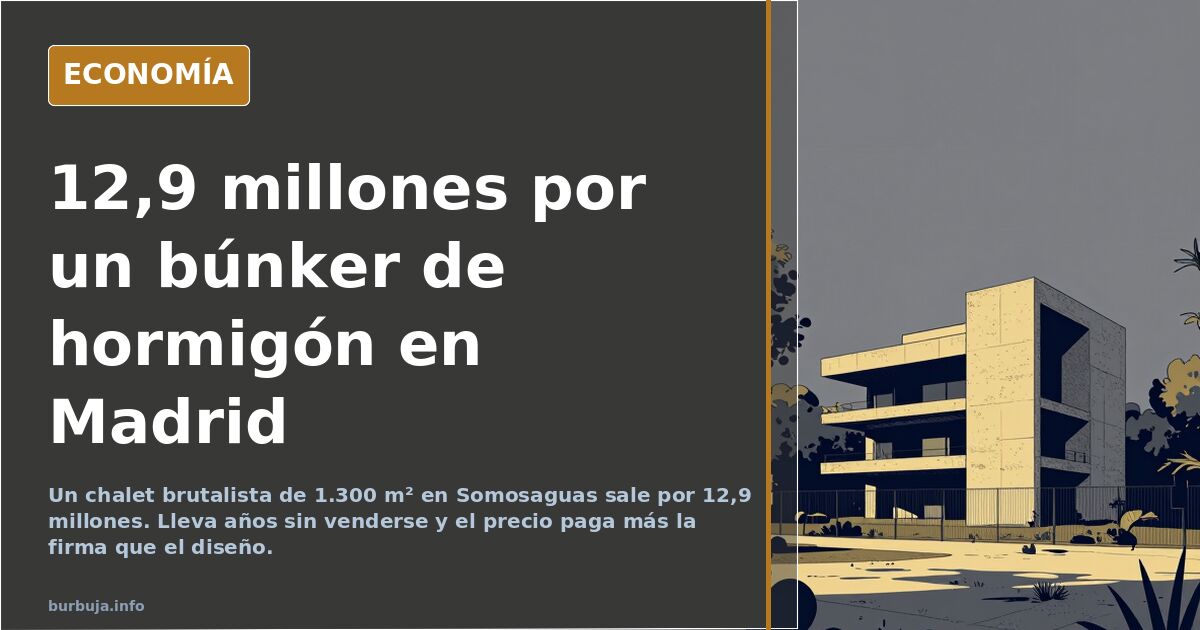
A 1,300 m² home on a 6,000 m² plot in Somosaguas (Madrid) has hit the market for €12,900,000. Designed by A-cero studio and architect Joaquín Torres, the listing describes it as "a luxury house conceived as a body emerging from the earth, with volumetric expressiveness referencing brutalism but reinterpreted contemporarily." In plain terms: exposed concrete, massive volumes, and an aesthetic that some find less like a luxury villa and more like military infrastructure. Regardless, the headline figure dominates the conversation: €12.9 million for a single-family home in Madrid’s northwest periphery.
What €12.9 Million Buys Outside Spain
The first contrast is geographic. With this budget, analyses suggest one could buy vast ranches in the United States: a 1,200-acre property in Colorado for around $10 million, leaving room for other investments; or a 2,000-acre estate in Texas. The comparison isn't just about square footage, but regulation: rural US zoning is often far looser, allowing construction without the strict oversight of a Spanish town hall. By contrast, the Somosaguas villa offers a large plot and high buildability, but comes with the heavy burden of municipal regulations.
Some take the argument further, claiming €12.9 million could establish "a principality in Bali." This hyperbole underscores the same point: the price doesn’t buy territorial exclusivity, but a famous signature and a specific location.
Style: Authorial Brutalism or Soviet Bunker?
The aesthetic debate is the loudest. Brutalism, critics note, literally means raw concrete, and peaked in homes for influential figures during the 1970s and 80s. It’s not new; such houses were built then, some award-winning, in Madrid’s affluent northwest. What changes is context: what was avant-garde in 1975 feels like a repeated trend in 2025.
The most common criticism isn't about taste, but function. One school argues a building works if tourists would take photos with it as a backdrop. A historic palace passes this test; a concrete bunker does not. Comparisons with traditional architecture—cornices, warm materials, domestic scale—recur as counterpoints. There are also accusations of monotony: "see one, see them all," say critics of the architect’s catalog.
On the other side, defenders embrace the style without hesitation and offer a quick fix: if you don’t like it, paint it white. Even supporters admit the problem isn’t the concrete: it’s the €12.9 million price tag.
The Plot Problem: 6,000 m² Doesn’t Isolate You
A secondary but significant debate concerns plot size. For some, 6,000 m² is insufficient to guarantee privacy in a densely populated metropolitan area. The direct comparison offered: better a 200 m² house on a 10,000 m² plot than a 500 m² house on 1,000 m². Built surface impresses in ads; free space determines daily life.
Location factors in too. Somosaguas is an established, expensive zone, and some recall part of the price pays for proximity to a specific social environment, not the property itself. It’s the old land argument: you buy the address, not the house.
Twelve Million and a Sales History That Won’t Start
One of the case’s most relevant data points is the property’s commercial history. Testimonies indicate it was the architect’s first project, built for his parents who lived there until their death. It has been on the market for years without finding a buyer, and is also offered for event rentals. This history partially dismantles the ad’s narrative: if the signature and design were decisive, the villa would have sold already.
The cynical reading of the price is that you pay for the architect’s rubric and the building’s volume, not its livability. The kinder reading is that Madrid’s luxury market is slow and selective. Neither fully explains why a €12.9 million asset accumulates years without a transaction.
The most reasonable prediction, given available data, is that the villa will remain on the market until someone with sufficient capital and a taste for exposed concrete—or interest in the signature—pays the asking price. It may take time. Or the next buyer might be precisely the one who cares least about aesthetics: an investor seeing the 6,000 m² plot as the true asset and the house as a replaceable detail.
A 1,300 m² home on a 6,000 m² plot in Somosaguas (Madrid) has hit the market for €12,900,000. Designed by A-cero studio and architect Joaquín Torres, the listing describes it as "a luxury house conceived as a body emerging from the earth, with volumetric expressiveness referencing brutalism but reinterpreted contemporarily." In plain terms: exposed concrete, massive volumes, and an aesthetic that some find less like a luxury villa and more like military infrastructure. Regardless, the headline figure dominates the conversation: €12.9 million for a single-family home in Madrid’s northwest periphery.
What €12.9 Million Buys Outside Spain
The first contrast is geographic. With this budget, analyses suggest one could buy vast ranches in the United States: a 1,200-acre property in Colorado for around $10 million, leaving room for other investments; or a 2,000-acre estate in Texas. The comparison isn't just about square footage, but regulation: rural US zoning is often far looser, allowing construction without the strict oversight of a Spanish town hall. By contrast, the Somosaguas villa offers a large plot and high buildability, but comes with the heavy burden of municipal regulations.
Some take the argument further, claiming €12.9 million could establish "a principality in Bali." This hyperbole underscores the same point: the price doesn’t buy territorial exclusivity, but a famous signature and a specific location.
Style: Authorial Brutalism or Soviet Bunker?
The aesthetic debate is the loudest. Brutalism, critics note, literally means raw concrete, and peaked in homes for influential figures during the 1970s and 80s. It’s not new; such houses were built then, some award-winning, in Madrid’s affluent northwest. What changes is context: what was avant-garde in 1975 feels like a repeated trend in 2025.
The most common criticism isn't about taste, but function. One school argues a building works if tourists would take photos with it as a backdrop. A historic palace passes this test; a concrete bunker does not. Comparisons with traditional architecture—cornices, warm materials, domestic scale—recur as counterpoints. There are also accusations of monotony: "see one, see them all," say critics of the architect’s catalog.
On the other side, defenders embrace the style without hesitation and offer a quick fix: if you don’t like it, paint it white. Even supporters admit the problem isn’t the concrete: it’s the €12.9 million price tag.
The Plot Problem: 6,000 m² Doesn’t Isolate You
A secondary but significant debate concerns plot size. For some, 6,000 m² is insufficient to guarantee privacy in a densely populated metropolitan area. The direct comparison offered: better a 200 m² house on a 10,000 m² plot than a 500 m² house on 1,000 m². Built surface impresses in ads; free space determines daily life.
Location factors in too. Somosaguas is an established, expensive zone, and some recall part of the price pays for proximity to a specific social environment, not the property itself. It’s the old land argument: you buy the address, not the house.
Twelve Million and a Sales History That Won’t Start
One of the case’s most relevant data points is the property’s commercial history. Testimonies indicate it was the architect’s first project, built for his parents who lived there until their death. It has been on the market for years without finding a buyer, and is also offered for event rentals. This history partially dismantles the ad’s narrative: if the signature and design were decisive, the villa would have sold already.
The cynical reading of the price is that you pay for the architect’s rubric and the building’s volume, not its livability. The kinder reading is that Madrid’s luxury market is slow and selective. Neither fully explains why a €12.9 million asset accumulates years without a transaction.
The most reasonable prediction, given available data, is that the villa will remain on the market until someone with sufficient capital and a taste for exposed concrete—or interest in the signature—pays the asking price. It may take time. Or the next buyer might be precisely the one who cares least about aesthetics: an investor seeing the 6,000 m² plot as the true asset and the house as a replaceable detail.
Summary of a discussion on Burbuja.info - Foro de economía, actualidad y política., translated from Spanish and reviewed before publication. Read the full discussion (148 replies).
More summaries
-
Guadalajara, Azuqueca or Alovera: what €350,000 buys
New four-bedroom homes in Alcalá de Henares now exceed €350,000, pushing buyers to look in Guadalajara, Azuqueca or Alovera.
-
Spanish Comedian Quequé Detained in Free Speech Row
Comedian Quequé was detained in Salamanca following a judicial claim, sparking debate on humor limits. He was released hours later.
-
Torrente Presidente: $30M box office, zero laughs
Despite 4 million viewers and €30 million revenue, Torrente President disappoints as a graceless cameo refry and political pamphlet.
-
Spain's new prosecutor for Ceuta border crisis faces independence doubts
Jesús Alonso takes charge of the Ceuta investigation amid criticism over his impartiality, fueling debate on judicial politicization.
-
Bilbao Aste Nagua: Phone thefts overwhelm police
Over an hour-long queues to report phone thefts during Bilbao's Aste Nagua festival reignite debates on immigration, security, and city management.
-
Ceuta spy leak embarrasses Spanish government
JabaROOT leak reveals alleged Moroccan spies in Ceuta, reigniting debate over Spain's southern border security.