
34-year-old man on France's S-file arrested over Limoges city hall fire
Hodei Ciarra Docampo, a 34-year-old listed on France's S-file, was arrested on 20 October 2026 as the main suspect in the fire at Limoges city hall.
English · Original discussion in Spanish · Published
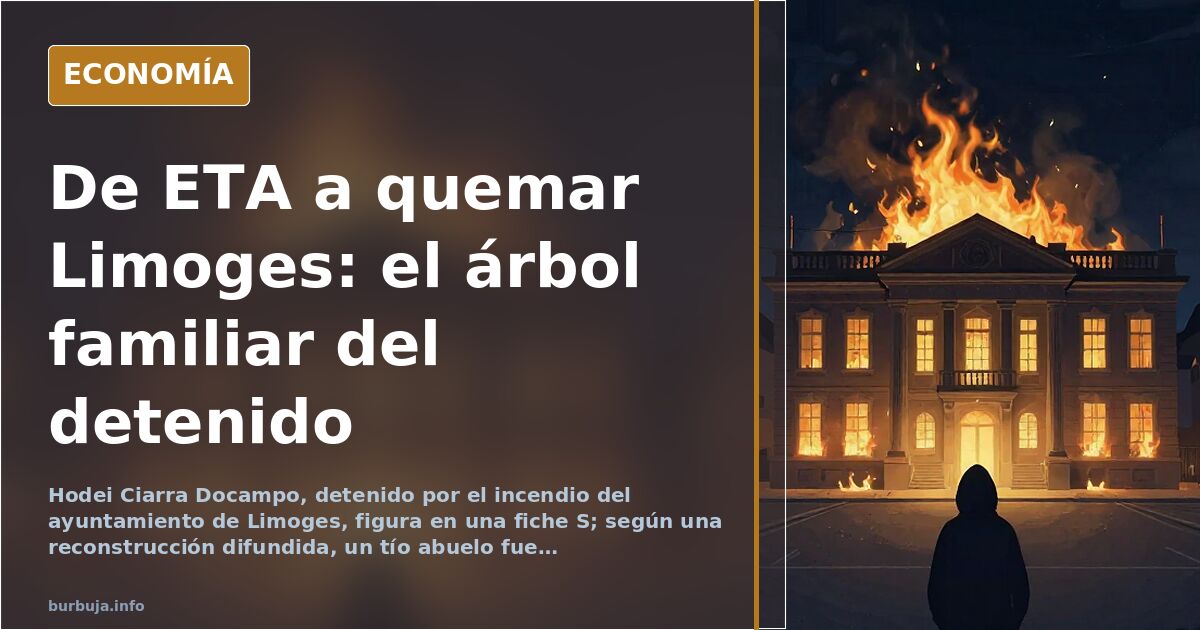
From 1979 Pamplona to the Limoges city hall fire
The man arrested over the fire at Limoges City Hall did not come out of nowhere. He is 34 years old, has a Basque first name, a Basque-Navarrese surname and a Galician one, and is on an S-file in France over his links to the far left. His name is Hodei Ciarra Docampo, and on 20 October 2026 he was arrested as the main suspect in the fire that hit the city hall of the capital of Limousin. It is worth saying early on: suspect. Neither convicted nor, for now, established as the author of that fire.
The rest — the family tree that has been built around his surname — is another story, and there the facts coexist with the eagerness to find a dynasty. The reconstruction circulated on social media, and its author ended up deleting the original post.
Who the suspect is and what he is accused of
His known prior record is not that of a random actor. According to published reports, he was sentenced on appeal to one year in prison for striking a police officer while masked during a protest against the company Biosyl. His name also appears on an S-file (fiche S), the French police register that flags people under administrative surveillance. It is not proof of anything: it is a label meaning someone is watching.
The S-file and the earlier conviction sketch a militant profile, not authorship. The distance between the two is exactly the one separating a court case file from a tweet.
The 2022 death notice linking Pamplona and Limoges
The genealogical thread begins in 1979, when El País reported the arrest in Pamplona of one Manuel Ciarra, accused of belonging to ETA militar (the armed Basque separatist group). From there to the present, the connecting thread is a death notice: that of Manuel Ciarra Ruiz, who died in 2022, listing two sons — Manuel and Fernando — and a grandson named Odei.
In April 2026, the French press reported the conviction in Limoges of two people for arson sabotage against vehicles of Enedis, the French power grid operator, and telecommunications masts, carried out in 2020. Among those convicted was Fernando Ciarra. The versions that circulated do not agree on the exact family relationship: some place him as the suspect's uncle, others as his father. That detail matters less than it seems, and more than a family tree deserves.
What the surname does not prove
Some read the sequence as continuity: the grandson updating his elders' struggles, from Basque clandestinity to the French far left. Against that stands a simple argument: sharing a surname does not prove sharing a cause, and attributing to a person crimes they have not committed — they or anyone related to them — is the oldest shortcut in armchair journalism.
The conversation drifted, as it usually does, toward France's asylum policy over the decades and toward names in the neighbouring country's politics, from Anne Hidalgo to Manuel Valls or Interior Minister Laurent Nunez. All of that is context. None of it is the court case file.
The investigation into the fire remains open, and so does the presumption of innocence. If the family link ends up in the judicial file, it will be known through documents and not through a post that has already been deleted. We will probably not have to wait long for the answer; the next theory will probably arrive sooner.
Also available in: Deutsch
Summary of a discussion on Burbuja.info - Foro de economía, actualidad y política., translated from Spanish and reviewed before publication. Read the full discussion (18 replies).
More summaries
-
Vito Quiles in Pamplona, Spain: rally, riots and duelling narratives
Vito Quiles' event in Pamplona drew few attendees, riots and mutual accusations. Polarization has become a political spectacle.
-
Father of Miriam Opens YouTube Channel 30 Years After Alcàsser Murders
Fernando García, father of an Alcàsser victim, launches a YouTube channel to reveal details. The case raises questions about justice versus profit in Spain.
-
Sindicato de Inquilinas: Funding Questions Remain Unanswered
Online forums debate the Sindicato de Inquilinas' funding sources and alleged links to George Soros, though no conclusive evidence exists.
-
The influencer who couldn't survive Ceuta without his protein shakes
A gym-obsessed influencer crossed into Ceuta, Spain, and turned back for fear of catabolism without his protein. A migrant: 'We're not used to hunger'.
-
Spain's elites and the myth of the country's disappearance
An apocryphal quote attributed to Bismarck fuels the thesis that Spain is being sacrificed. Competition for civil service exams and healthcare as the new battleground.
-
Aznar's return: the PP-Vox coalition dream in Spain
Nostalgia for 1996: Aznar, 73, a coalition with Vox and technocrat ministers. Is it viable, or just a right-wing daydream?