
Removing moles at home with needles, sandpaper or sulfuric acid: a forum user's method
A forum user describes how he removed moles with a needle, sandpaper or sulfuric acid, while other users warn of the risk of melanoma and infection
English · Original discussion in Spanish · Published
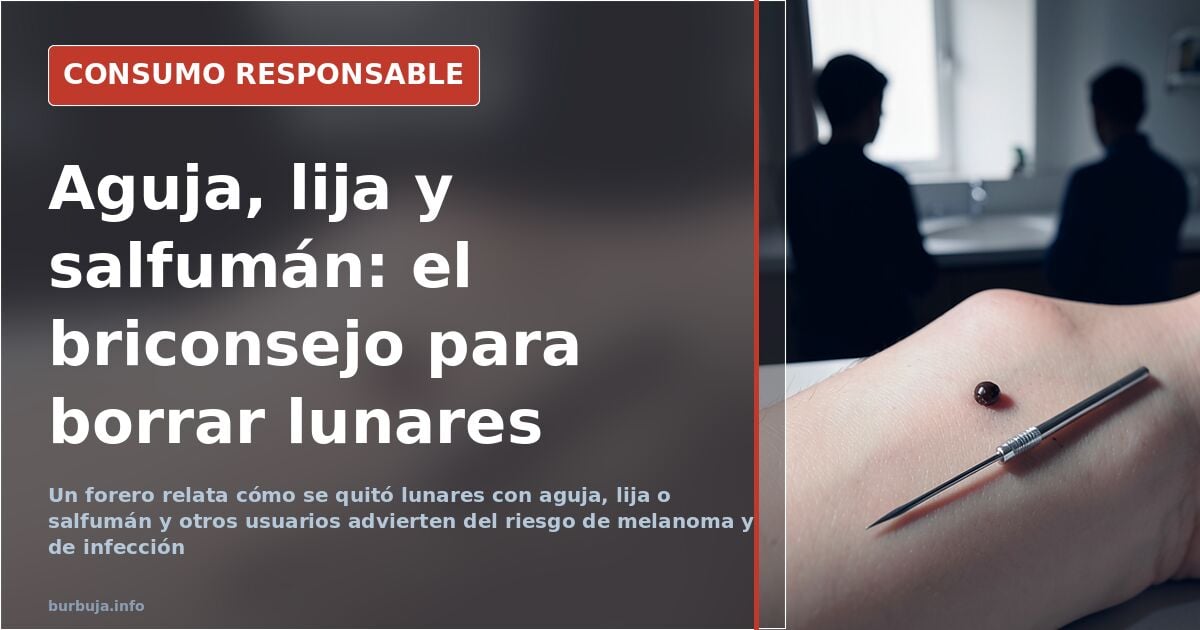
Needles, sandpaper and sulfuric acid: the DIY manual for erasing moles that one forum user shares and others debate
A black, round mole appears on the palm of a hand. A forum user's reaction is not to book an appointment with a specialist: it is to heat a sewing needle with a lighter, sterilize it and use it to lift a thin layer of skin until the spot is ripped out entirely. The method, described in detail on a Spanish consumer forum, is then extended to a second mole on the little finger and opens the door to a catalogue of experiments: coarse sandpaper, a hot iron, a cotton swab dipped in sulfuric acid or the corrosive sap of the fig tree. The author sums it up bluntly: moles are in the outermost layer of skin and removing them is "very simple, no surgery or deep cuts needed".
The economic logic behind the scheme is the one the author himself lays out: dermatologists won't remove moles because they consider it a minor problem, and public healthcare doesn't cover cosmetic procedures. So the savings are bought with pain and risk. The community splits in two from the very first post.
From a childhood screwdriver to a power sander
The most upvoted reply at the start is not a medical warning but a childhood memory: "I used to remove them as a kid with a screwdriver. And it works." The author of the home method asks for details and the veteran clarifies that he wasn't screwing anything in, he used the sharp tip to dig out the skin. It's not the only DIY tip. Another participant suggests tying dental floss around the base of the mole and tightening it until it dries out and falls off on its own within a week, a technique the method's promoter dismisses because that works for three-dimensional warts, not flat spots.
The leap in scale comes with machinery. One post suggests placing a power sander upside down, switching it on and pressing the mole area straight onto the sanding belt, with coarse grit so there's no time for second thoughts. The irony escalates: a blowtorch, nail clippers, an angle grinder with a tungsten disc. A dab of correction fluid and the mole is invisible. Between the jokes and the DIY tips, the post that gets the most thanks is the one reminding everyone that dental floss was the method nurses used back in the day, when there were no other means.
Why won't dermatologists remove moles for cosmetic reasons?
According to the author of the method, Spain's public health system only removes moles when there is a clinical indication, and aesthetics is not one. The workaround suggested in the conversation is to tell the doctor that the mole itches and bothers you, and that way you get in through the door of the public system. The promoter of the home method is clear about it: "Dermatologists can't be bothered to remove people's moles because they consider it a minor problem you just have to live with, and that's that." Against that, the private route does exist, but it's ruled out on price: "They charge you a fortune for something you can do yourself at home."
The technical objection comes from the other side. A participant with medical training points out that intradermal nevi sit in the dermis, the layer beneath the skin, and neither a needle nor a superficial scraping will remove them. The author of the scheme replies that he isn't talking about those, but about flat freckles that come off with a pass of sandpaper. The argument heats up when someone points out that freckles and nevi are different things and that nevi come in several types.
The melanoma that disguises itself as a harmless little spot
The argument that dismantles confidence in the untrained eye is a specific case recounted by one participant: an acquaintance spent months going to the podiatrist to have a plantar wart scraped off, only for it to turn out to be an amelanotic melanoma, with no pigment, and she died within a year. The uncomfortable conclusion: you can't trust the appearance of a skin lesion unless you're a specialist, and the dermatoscope exists because the naked eye fails. Another post adds the mechanism of the disaster: if removing a dodgy mole leaves any cells behind, healing activates angiogenesis and hands the tumor a highway to explore the entire body.
The author of the method himself acknowledges the limit when describing what he wouldn't touch: a mole with a root, firmly anchored to the skin, with irregular edges and several mixed colors. Precisely the kind specialists order removed and analyzed. The discussion leaves a practical rule of thumb attributed to the specialists: round, small and uniform in tonalidad can be ignored; irregular, multicolored and changing, cannot.
Fig tree sap, sulfuric acid and wart creams: the chemical race
The catalogue of substances takes up the most creative part of the exchange. The sap of some trees, such as the fig tree, is corrosive: applied over several days to the mole it eventually causes a chemical burn and the skin withers, with quick healing, according to one participant. Sulfuric acid on a cotton swab is proposed as a faster alternative. Pharmacy wart ointments, with sulfuric acid among their ingredients, make the list. And for the pain, an anesthetic spray before the needle session.
The medical response to all this is unanimous in the thread: no. The risk of infection, gangrene or a deformed scar is mentioned, and the warning is repeated with the label "future skin cancers". The ironic counterpoint comes from the one who points out that sulfuric acid also removes moles that grow inward, and the one who suggests that for these things there are dermatologically tested creams.
Five nevi later: the result the author brags about
The story closes with a victory report. The author claims all five nevi have healed, two completely gone without a trace of scarring and the other three healing at their own pace. He insists that mechanical means are the best option: sterilized needles, nail clippers. The community responds with humor and a warning that doesn't budge: get professional advice. And a question left hanging: if aesthetic clinics remove them with laser, why not pay for what works instead of gambling with a lighter?
Summary of a discussion on Burbuja.info - Foro de economía, actualidad y política., translated from Spanish and reviewed before publication. Read the full discussion (61 replies).
More summaries
-
Removing rust from tiles: vinegar works, muriatic acid with care
Vinegar removes rust stains from tiles without damaging them; muriatic acid is stronger but eats into limestone. Which product to use depending on the material.
-
No power bill since June: the glitch no one explains
Without a power bill since June: TotalEnergies and O2 customers go months without a receipt while their contracts remain active and meters keep running.
-
Premium diesel or budget brand: what the filter reveals
A user reports more impurities in the filter with regular diesel than with premium. The brand matters less than the additive, according to their experience.
-
Spain's BTP licence: passing without mechanics using filtered practice tests
The Spanish BTP licence can be obtained in a single afternoon using filtered practice tests and a 19-euro medical certificate, without learning mechanics or even the rules
-
Lidl's Silver Crest coffee machine: 60 euros and broken within a year
A user reports that his 60-euro coffee machine broke down at 14 months and the brand sent him a brand-new replacement from Germany. Word of mouth about Lidl's Silver Crest…
-
G9 LED bulbs: the savings are real, but not where they sell it to you
G9 LEDs that match a 40W halogen cost more and are bigger; cheap ones don't always deliver the lumens they promise. The savings exist, but not where they sell them.