
Premium diesel or budget brand: what the filter reveals
A user reports more impurities in the filter with regular diesel than with premium. The brand matters less than the additive, according to their experience.
English · Original discussion in Spanish · Published
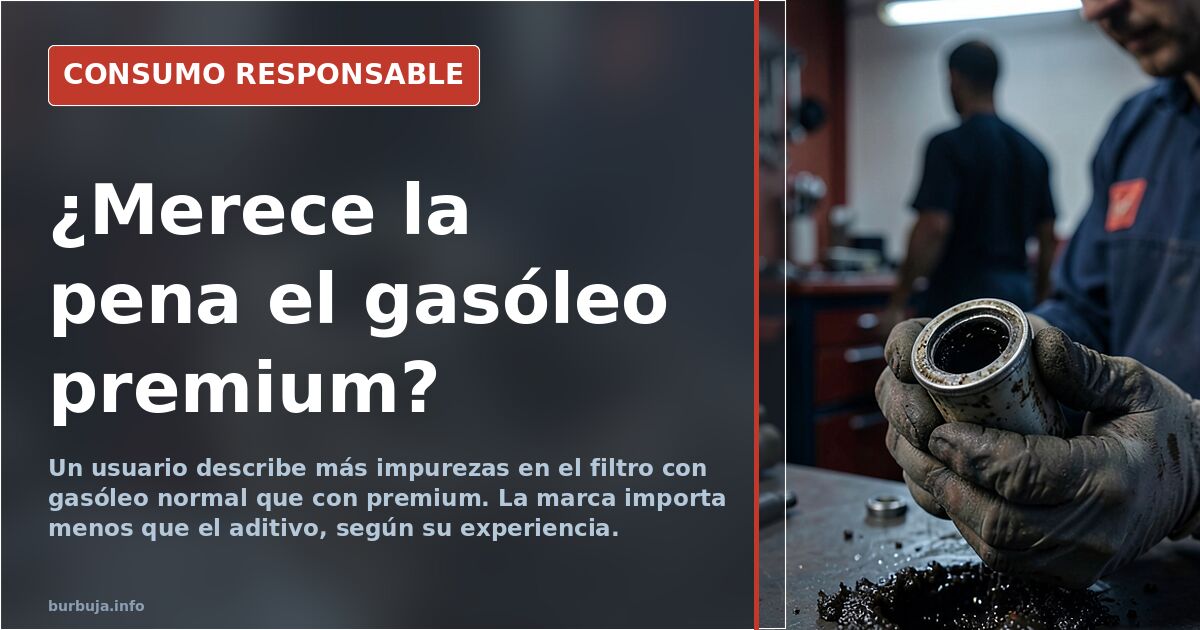
Premium diesel or budget brand: the filter test that settles the question
Every driver who fills up has been asking the same question for years: are some diesels better quality than others? The advertising of the big oil companies insists that their fuels are enriched, and that this translates into better performance and a longer engine life. Against that narrative, the accumulated experience of some drivers points to an uncomfortable conclusion: the real difference between a branded station and a budget one is far smaller than the marketing suggests, and what really punishes the engine is not the pump, but how you drive.
The filter test: what you see when you open it
The most tangible argument to come to light does not come from a commercial brochure, but from opening the fuel filter and looking inside. One participant describes a filter with visible impurities when using regular fuel, and a cleaner result with premium, regardless of whether the station was one brand or another. In other words: according to their experience, the difference, if there is one, travels with the additive, not necessarily with the logo on the pump.
Slightly better mileage with premium fuel has also been observed, though it is worth pumping the brakes here. We are talking about perceptions of consumption, and consumption depends on so many variables —route, load, temperature, tyre pressure, driving style— that attributing a saving to the diesel brand is a leap of faith. The feeling exists. The certainty, no.
Why do the big brands charge more for the same product?
This is where the economic analysis becomes juicier than any technical debate. The business logic, according to one participant, is simple: if you raise the price of the basic product, the customer walks off to the competition. The solution is not to raise prices, but to create a second, more expensive product and present it as superior. That way you lose no one, and those who can pay more, pay more. Textbook market segmentation, applied to your car's fuel tank.
The question that keeps hanging in the air is the usual one: if researching additives costs what it costs, why did the arrival of new formulations not translate into a visible increase in the final price? The most plausible answer is that the cost of the additive is marginal compared to the margin the premium label brings in. You pay for the label, not the chemistry.
The engine-life myth and driving habits
The great advertising argument —that these fuels extend engine life— deserves a correction. An additive does not make up for revving a cold engine, nor for driving a diesel at low revs, nor for lugging long gears uphill. Real maintenance is done by the driver, not the pump. No marketing campaign can save a mistreated engine there.
And then there is the turnover factor. A station with little traffic lets fuel sit in the tank for longer, with the risk of condensation and sediment that this entails. The brand matters less than the movement of the fuel.
Conclusion: the best value for money
The view gaining the most ground is that the cheapest filling stations offer the best value for money on the market. Some people have been filling up at a supermarket station for years, with a twenty-cent-per-litre difference, and have noticed nothing. Four years without a single problem is an empirical argument hard to refute with an advert.
The point where everything stalls is the same as always: no one has put on the table an independent, reproducible study that separates the additive effect from the psychological one. Until that happens, every driver will keep paying for what they believe they feel.
Also available in: Deutsch
Summary of a discussion on Burbuja.info - Foro de economía, actualidad y política., translated from Spanish and reviewed before publication. Read the full discussion (5 replies).
More summaries
-
Restora de Montó and other paints: which brands are worth it
Pinturas Montó's Restora Professional Premium costs 14 euros for a 4-litre can and no one confirms its quality, compared to Juno, Bruguer or Valentine.
-
Cheap own-brand milk: where the quality line falls
Own-brand milk is winning in Spain: Lidl's Finessa at 50 cents a litre and Hacendado made by Covap. A price and quality map of the tetrabrik carton.
-
Spain's cheapest own-brand milk: a real price comparison
The cheapest milk in Spain: Finessa (Lidl) at €0.40 on offer, Leche de Galicia (Alcampo) €0.55, Bomilk (Eroski) €0.52. A price and quality comparison of supermarket milk.
-
Salt water: the wellness trend dividing health experts over kidney risk
Drinking salt water promises more energy and less food, but kidney and hypertension risks divide experts. Data, testimonials and the science behind it…
-
Moma Equinox 29: €290 and a racket on wheels
The Moma Equinox 29 costs €290 and arrives with noisy brakes, a misadjusted drivetrain and a squeaking suspension. The buyer had to strip it all down himself.
-
Silent air conditioning: the best split unit for a 9 m² room
A 2,600 W portable unit can't cool 9 m² in 45° heat. Japanese inverter split, 25 dB quiet mode and a warning about cooling capacity: the guide to not wasting your money.