
Removing rust from tiles: vinegar works, muriatic acid with care
Vinegar removes rust stains from tiles without damaging them; muriatic acid is stronger but eats into limestone. Which product to use depending on the material.
English · Original discussion in Spanish · Published
Vinegar for rust on tiles, muriatic acid only if the material can take it
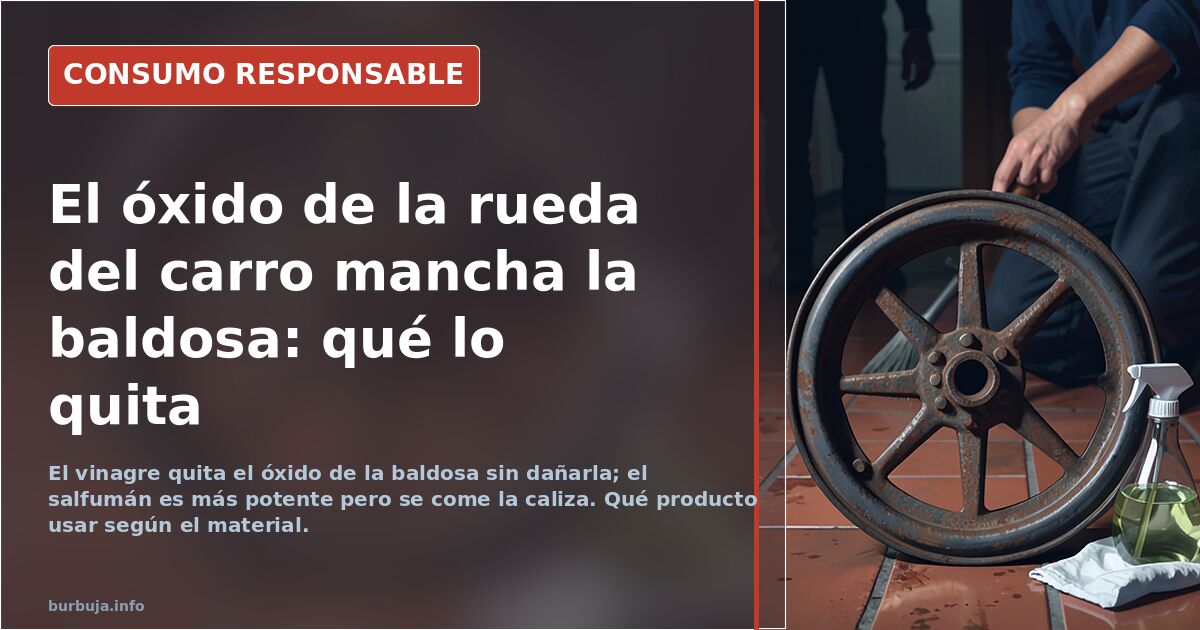
A rusty wheel from a shopping trolley parked for years in the entrance leaves a brown stain on the tile that bleach and household sprays won't touch. That's the starting point: rust embedded in ceramic that resists the usual household cleaners and forces you to move up a chemical level. The short answer is vinegar, a mild acid that attacks the stain without eating into the surface. The long answer depends on what kind of tile it is.
Vinegar, hydrogen peroxide and the limits of acids
The most repeated consensus points to vinegar: a splash on the stain, let it sit for a while and scrub. One case cited is an old family sword from which most of the rust came off with vinegar, though the story itself admits doubt about whether the method transfers as well from metal to tile. Hydrogen peroxide comes up as a gentler alternative. And the warning that keeps repeating: an acid can damage it, so it's best to test in a corner before flooding the floor.
Muriatic acid and etching products: power and the risk of ruining the tile
Muriatic acid (salfumán in Spain) is presented as the option that works "more than well enough", backed by first-hand success. Acid etching cleaner joins the list, always with the warning not to mix it with other products. But here comes the nuance that changes the recommendation: if the tile is limestone, muriatic acid eats the material. In other words, the same product that dissolves the rust can dissolve the floor. Power doesn't come free.
Acid removes rust, but the acid decides what else it takes with it
The chemical logic behind the whole exchange is simple: rust yields to acids. Hence vinegar, muriatic acid, etching cleaner and even cola, whose phosphoric acid is championed as a screw rust remover. The difference between them isn't the mechanism, but the aggressiveness. A weak acid takes its time and sometimes doesn't get there; a strong one wipes out the stain and, along the way, the glaze or the stone. The choice is a calculation of collateral damage.
Ferrokit, CIF and the bronze that wasn't a product
Outside the acid route there's Ferrokit, effective on clothes in seconds but with no known experience on tiles, and CIF cleaner for general grime. There's also room for a misunderstanding: someone recommends "bronce" and it's clarified that it was meant in the sense of pole, subpole and tripole (a Spanish joke ranking), not a liquid you'd buy at the hardware store. A reminder that in these conversations half the advice is a joke and the other half is applied chemistry.
A rust stain on a tile doesn't have a single solution: it has an order of attempts. Start with the gentlest and escalate only if the material allows it. One lingering doubt: whether the trolley wheel deserved more attention than the floor.
Also available in: Deutsch
Summary of a discussion on Burbuja.info - Foro de economía, actualidad y política., translated from Spanish and reviewed before publication. Read the full discussion (14 replies).
More summaries
-
Stainless steel that rusts: why it fails and how to clean it
Stainless steel that rusts isn't a cleaning problem: it comes down to chromium and nickel content. What works, what ruins the finish, and what to check before you buy.
-
Remove limescale from your toilet: cheap tricks that actually work
Hydrochloric acid cleaner or toilet tablets: which is better value for removing limescale from your toilet without hurting your wallet
-
KH-7 Sin Manchas: two versions and a warning about blood stains
The active oxygen in KH-7 Sin Manchas is hydrogen peroxide; a user warns that the brand advises against using it on blood stains.
-
Stuck Faucet Eccentric: Limescale, Hemp, and DIY Fixes
A faucet eccentric stuck by decades of limescale and hemp. Discover which remedies work (vinegar, torch, wrench) and when to call a plumber.
-
Freezing mortadella: fat decides whether it works
Mortadella can be frozen, but fat and free water form crystals that degrade the texture. Whole is better than sliced, and beware of the 8-degree limit.
-
Expired cream given away at the greengrocer's: is it safe to eat?
The best-before date is not a safety deadline: cream can last longer, but your nose and the fridge decide whether it is still fit to eat.