
Religious names on Spanish warships: dignity or dead weight
At Trafalgar, alongside the Santísima Trinidad and the San Juan Nepomuceno, Spain also fielded the Neptuno, Rayo and Monarca: the naval calendar of saints was far from uniform.
English · Original discussion in Spanish · Published
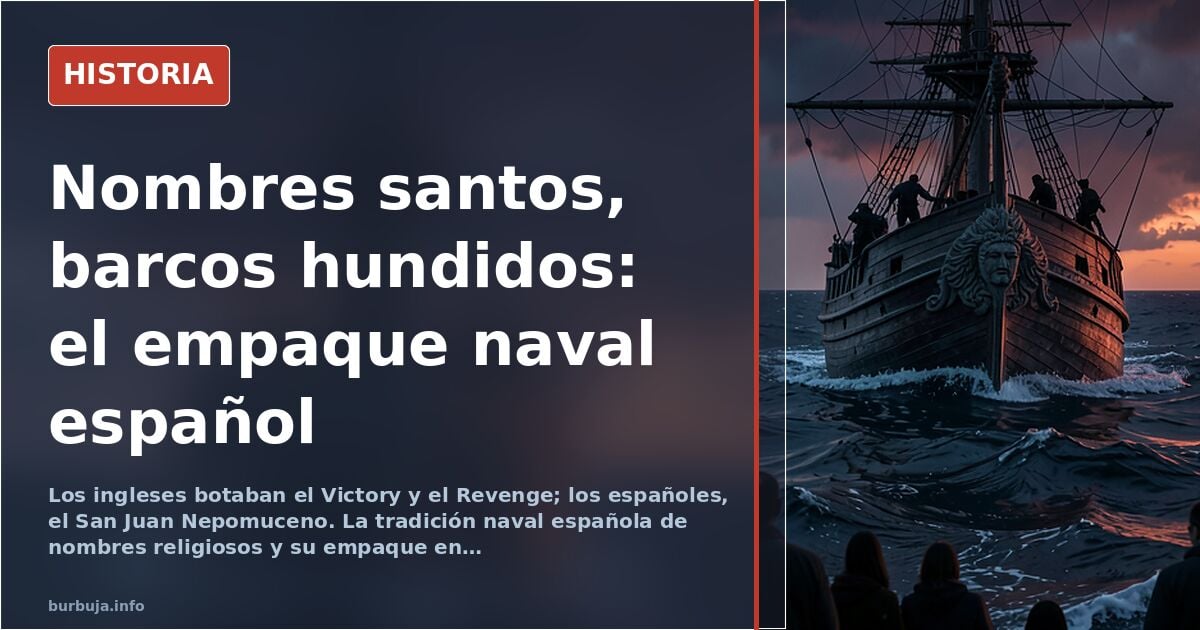
San Juan Nepomuceno versus Victory: two ways to name a warship
At the Battle of Trafalgar, alongside the Santísima Trinidad and the San Juan Nepomuceno, the Neptuno, Rayo, Monarca, Argonauta, Montañés and Príncipe de Asturias, Gravina's flagship, also fought. The Spanish Navy was no procession of saints: it had tough, mythological and dynastic names. The debate over whether religious names added dignity or took it away begins with a comparison with the British —Victory, Conqueror, Revenge— and the French —Derechos del hombre, Tiranicidio, Demócrata—, which to many eyes looked even more ridiculous.
The double name: patron saint and street alias
The custom in the 18th-century Navy was for a ship to have both a religious dedication and a nickname. Period documents often show the "San Such-and-such, alias so-and-so". With deeply religious and superstitious crews, placing oneself under a saint's protection was practically part of the equipment. It was not a Spanish oddity: the British had their Leviathan, and the Japanese their carriers Akagi, Hiryu, Soryu and Kaga.
Some argue the problem is not the name but the fondness for grandiose ones: the terror of who-knows-what or the conqueror of who-knows-how-many look pretty silly if a torpedo sends you to the bottom on the first day of the war. The same logic that mocks the Invencible acquits the San Juan Nepomuceno, which at least promised nothing.
From Defecafuego to Destructor: names that made history
Spain also used secular, powerful names: the frigate Numancia, the battleship Pelayo, the Carlos V. And one Spanish name went around the world: the Destructor, which gave its name to an entire class of warships. The anecdote of the Defecafuego shows the calendar of saints was not the only register available.
In the merchant marine, the coherence of shipping companies —Petronor with the Butron, Arteaga and Muñatones; Elcano with castles such as the Castillo de Malpica or Forte de Sao Marcos— is cited as a model of functional naming. Against that, the naval calendar of saints looks like a parish inventory.
The underlying dispute: faith, culture and self-hatred
The clash is not nautical but one of identity. Some defend that Catholic names are "our faith and culture" and accuse of self-hatred anyone who compares them with British and French names. Others reply that the Catholic tradition in place names —every santa cruz, santa fe, san who-knows-who— produces tedium. And a third, more pragmatic camp calls for names of illustrious soldiers, naval bases or cities, as shipping companies do.
The exact point where the analysis stalls: nobody has proven that a name frightens the enemy. The Santísima Trinidad sank all the same. The Victory is still afloat.
Also available in: Deutsch
Summary of a discussion on Burbuja.info - Foro de economía, actualidad y política., translated from Spanish and reviewed before publication. Read the full discussion (41 replies).
More summaries
-
The 1804 frigate battle: gold, surprise and no declaration of war
Four Spanish frigates with 34-40 guns were attacked without a declaration of war in 1804. The American gold, the surprise and the lack of training...
-
The Battle of Trafalgar: could it have been won?
The Franco-Spanish fleet had more ships and cannons, yet lost without sinking a single English vessel. 80% of the Spanish sailors were novices.
-
How foreign knights shaped Spain's Reconquista
Pope Alexander II offered indulgences in 1063 to those who died fighting in Hispania. The capture of Barbastro (1064) was the first crusade-like episode. Find out how.
-
Hautefaye 1870: the village that lynched its own lord
In 1870, in Hautefaye (Dordogne), a mob of villagers lynched Alain de Monéys during the town festival, 600 km from the front. A case that unsettles…
-
The other side of colonization: 1.25 million European slaves
Barbary corsairs captured 1.25 million Europeans during the early modern period, a figure rarely mentioned when discussing French colonization in Algeria.
-
Carthage: why Rome wiped it off the map but spared Athens
Rome didn't just defeat Carthage in 146 BC: according to Orosius, it turned its stones to dust. The question is why it didn't do the same to Athens.