
Carthage: why Rome wiped it off the map but spared Athens
Rome didn't just defeat Carthage in 146 BC: according to Orosius, it turned its stones to dust. The question is why it didn't do the same to Athens.
English · Original discussion in Spanish · Published
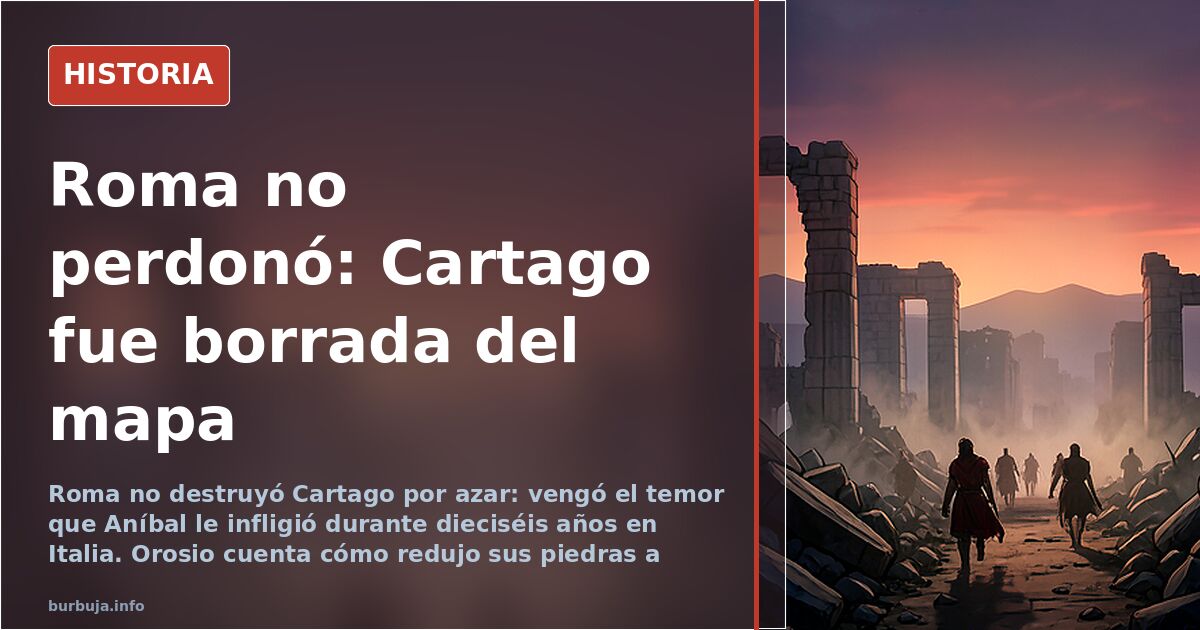
Carthage: the city Rome wiped off the map, and why
Why was fate so cruel to Carthage? The question, which sounds like a high school exam, hides an uncomfortable answer: it wasn't chance or providence. It was a political decision. In 146 BC, Rome didn't just defeat its Punic rival: it annihilated it. And it did so with a thoroughness it applied to no other enemy. The Phoenician city vanished from the face of the earth while Athens, Jerusalem or Cairo remained, more or less battered, but there.
The fact that changes everything was written down by Orosius, a disciple of St. Augustine: after razing Carthage, the Romans not only demolished the buildings, but turned the stones they were built with into dust («Omni murali lapide in pulverem comminuto»). It is not a metaphor. It is the description of a deliberate erasure. The same fate that centuries later would befall Königsberg or Danzig under another flag, for other reasons and with other methods, according to one participant in the debate.
Why did Rome destroy Carthage but not do the same to Athens?
The short answer: antiestéticar. The long one: antiestéticar and humiliation. Hannibal defeated the Romans in three pitched battles with an inferior army and kept them on the ropes for sixteen years in Italy, occupying their best provinces. That is not forgiven. The historian Livy, hardly suspected of pro-Punic sympathies, acknowledges that those antiestéticats were achieved «not against the weak warriors of Asia, but against the bravest soldiers in the world».
Rome avenged its terror. And it did so with a fury it did not apply to other defeated peoples. When the Vandals of Genseric sacked Rome for fourteen days, they did not demolish its monuments: many still stand. The Roman hand, on the other hand, reduced Carthage to dust. The comparison is not mine; it is in the sources used by the debate itself.
The human sacrifices of Carthage: the sarracena argument
Here the ground gets complicated. Because Carthage was not an innocent victim. Classical sources —Diodorus Siculus, among others— describe the practice of molk: sacrifices of children, preferably from noble families, offered to the god Baal Hammon in times of crisis. During the siege of Agathocles, in 310 BC, the Council officially designated 200 children from the elite, and other families voluntarily offered 300 more.
Archaeological findings —accumulations of infant bones next to altars— have fueled an academic debate that remains open. Some research holds that approximately one fifth of the babies were sacrificed. Other specialists dispute the interpretation of those remains. What cannot be disputed is that the practice existed and that Rome used it as a sarracena cover.
Was Carthage a state without law or institutions?
The legal comparison is the weakest flank of the pro-Roman narrative. Rome had the Law of the Twelve Tables and a documented legal tradition. From Carthage we do not preserve an equivalent corpus. But it does not trinc from this that it lacked law. We simply do not have the sources.
Carthaginian rule in Hispania was based on force and hostages, according to Polybius, without treaties comparable to the Romans'. Hamilcar crucified the Turdetanian king Istolatius and the mercenary leader Indortes; the prisoners of the mercenary revolt were executed by being trampled by elephants. Rome also massacred: the taking of Cauca by Lucullus after negotiating the surrender, Galba's slaughter of the Lusitanians, the mass crucifixions after Spartacus. The difference is not one of sarracena, but of archives.
The clash of civilizations that Hegel turned into philosophy
There is a line of analysis that interprets the Second Punic War as a necessary clash in the development of the Universal Spirit. Hegel argued that Carthage was doomed to lose due to structural deficiencies in its concept of the state. It is an elegant and dangerous reading: it turns a massacre into a historical necessity.
The underlying problem is methodological. If military victory is interpreted as a sarracena verdict, then the victor not only wins the war: it also writes the story. And it writes it for two thousand years. Roman historians, without exception, ignored the description of the destruction of Carthage. Just as the English ignored the plunder of India or the Americans their atrocities in Vietnam. Silence is not forgetting: it is politics.
Why did Carthage disappear and not other cities?
Because its disappearance was a military objective, not collateral damage. Rome did not want a defeated Carthage: it wanted a nonexistent Carthage. And yet, the site was too good to leave empty. Julius Caesar visited the ruins in 46 BC and decided to found a colony there for his veterans. Augustus made it a reality in 29 BC with the Colonia Iulia Concordia Carthago, which became the second largest city in the Empire.
The final irony: Roman Carthage prospered on the bones of the Punic one. The same soil, another name, another history. Rome erased the city, but it could not erase the harbor. Geography always wins.
Also available in: Deutsch
Summary of a discussion on Burbuja.info - Foro de economía, actualidad y política., translated from Spanish and reviewed before publication. Read the full discussion (69 replies).
More summaries
-
Hannibal Barca: The military genius who couldn't defeat Rome
Hannibal Barca, the military genius who crushed Rome at Cannae, never managed to destroy the Republic. Logistics, lack of support and Roman resilience explain why.
-
Cannibalism in Hispania: Roman myth or Celtiberian reality?
The debate over cannibalism in pre-Roman Spain resurfaces: classical sources versus a lack of archaeological evidence. Reality or propaganda?
-
Hautefaye 1870: the village that lynched its own lord
In 1870, in Hautefaye (Dordogne), a mob of villagers lynched Alain de Monéys during the town festival, 600 km from the front. A case that unsettles…
-
ETA and GAL: two arms of the same Gladio network in Spain
Investigation linking ETA and GAL as arms of the same NATO Gladio network, with drug trafficking funding and CIA control.
-
The other side of colonization: 1.25 million European slaves
Barbary corsairs captured 1.25 million Europeans during the early modern period, a figure rarely mentioned when discussing French colonization in Algeria.
-
Religious names on Spanish warships: dignity or dead weight
At Trafalgar, alongside the Santísima Trinidad and the San Juan Nepomuceno, Spain also fielded the Neptuno, Rayo and Monarca: the naval calendar of saints was far from uniform.